Solution:
Concept: A right circular cylinder of base radius r and height h has volume V = πr²h (area of the base × height), curved surface area 2πrh (circumference of the base × height) and total surface area 2πrh + 2πr² = 2πr(h + r) (curved surface plus the two circular ends). For a sphere of radius r, the volume is V = ⁴⁄₃πr³ and the surface area is 4πr². For a hemisphere of radius r, the volume is ⅔πr³, the curved surface area is 2πr² and the total surface area is 3πr² (curved part 2πr² plus the flat circle πr²).
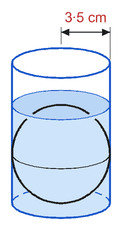
Given: Can radius 3·5 cm; the sphere just fits and the water just covers it.
Step 1 — Read the sizes.
The sphere just fits the can, so its radius is 3·5 cm. The water just covers it, so the water is as deep as the sphere's diameter, 7 cm.
(i)
Step 2 — Surface of the can touched by the water.
The water touches the base and the curved wall up to 7 cm.
S=πr2+2πr×7=722×3.52+2×722×3.5×7=38.5+154=192.5 cm2
(ii)
Step 3 — Volume of water.
The water is a cylinder 7 cm deep minus the sphere inside it.
W=38.5×7−34×722×3.53=269.5−3539=6539≈89.83 cm3
Step 4 — Depth before the sphere was put in.
Without the sphere this water stands on the base of area 38·5 cm².
Depth=6539÷38.5=37=231 cm
Watch out: The contact area is of the CAN only (its base and wall), not the sphere's surface.
Therefore, (i) the area of the can in contact with the water is 192·5 cm², and (ii) the depth of water before the sphere was put in was 2⅓ cm (about 2·33 cm).