Solution:
Concept: The volume of a cylinder of base radius r and height h is V = πr²h, that is, area of the base × height. For a sphere of radius r, the volume is V = ⁴⁄₃πr³ and the surface area is 4πr². For a hemisphere of radius r, the volume is ⅔πr³, the curved surface area is 2πr² and the total surface area is 3πr² (curved part 2πr² plus the flat circle πr²). The amount of water stays the same when the cylinder is turned over; only the shape of the space it fills changes.
Given: Common diameter 7 cm; cylinder height 20 cm; water 10 cm deep with the flat end down.
Step 1 — Volume of water.
With the flat plate at the bottom, the water is a cylinder of radius 3·5 cm (half of 7 cm) and height 10 cm. (The hemisphere is at the top, 20 cm up, and does not reach the water.)
W=πr2×10
Step 2 — After turning it over.
Now the solid hemisphere bulges into the bottom, taking up ⅔πr³ of the space. Let the new level be H cm above the base of the hemisphere; the water fills the cylinder of height H minus the hemisphere.
πr2H−32πr3=πr2×10
Step 3 — Solve for H.
Divide every term by πr², then put r = 3·5 cm.
H=10+32r=10+32×3.5=10+37=1231 cm
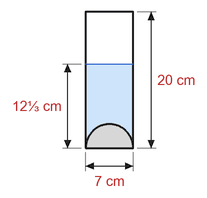
Watch out: The hemisphere is pushed INTO the cylinder, so it takes up space and raises the level; it does not add space.
Therefore, the level of the water after inverting is 12⅓ cm (about 12·33 cm).

