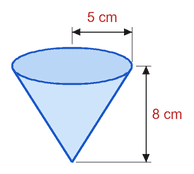
Solution:
Concept: When a solid is melted and recast (or water is displaced), no material is lost or gained: the volume before equals the volume after. In a vessel full to the brim, the water that flows out has the same volume as the shots dropped in. A right circular cone of base radius r, height h and slant height l has l² = r² + h² (Pythagoras' theorem in the right triangle formed by the axis, a radius and a slant edge), volume V = ⅓πr²h. For a sphere of radius r, the volume is V = ⁴⁄₃πr³ and the surface area is 4πr². For a hemisphere of radius r, the volume is ⅔πr³, the curved surface area is 2πr² and the total surface area is 3πr² (curved part 2πr² plus the flat circle πr²).
Given: Cone vessel: height 8 cm, top radius 5 cm, full; shots of radius 0·5 cm; ¼ of the water flows out.
Step 1 — Volume of water in the vessel.
The vessel is a cone of radius 5 cm and height 8 cm; keep π.
V=31π×52×8=3200π cm3
Step 2 — Water that flows out.
One-fourth of the water flows out.
41×3200π=350π cm3
Step 3 — Volume of one lead shot.
Each shot is a sphere of radius 0·5 cm.
Vshot=34π×0.53=34π×81=6π cm3
Step 4 — Number of shots.
The shots together have the volume of the water that flowed out.
n=350π÷6π=350×6=100
Watch out: Only ONE-FOURTH of the water flows out; the shots fill that part, not the whole cone.
Therefore, 100 lead shots were dropped into the vessel.