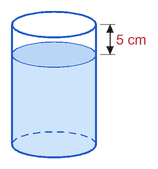
Solution:
Concept: A right circular cylinder of base radius r and height h has volume V = πr²h (area of the base × height), curved surface area 2πrh (circumference of the base × height) and total surface area 2πrh + 2πr² = 2πr(h + r) (curved surface plus the two circular ends). The difference between two amounts of water tells us the volume of the empty part between the two water levels.
Given: Full: 3080 cm³; filled to 5 cm below the top: 2310 cm³.
(i)
Step 1 — Find the volume of the top 5 cm.
Filling the last 5 cm takes the difference of the two amounts.
3080−2310=770 cm3
Step 2 — Find the radius.
The top 5 cm is a cylinder of radius r and height 5 cm, so its volume is πr² × 5.
722×r2×5=770
r2=22×5770×7=49
r=7 cm
(ii)
Step 3 — Find the height.
The full vessel holds 3080 cm³, so πr²h = 3080, with r = 7.
722×49×h=3080
h=22×493080×7=20 cm
(iii)
Step 4 — Find the wetted surface when half full.
Half full means water 10 cm deep. The water touches the base and the curved wall up to 10 cm.
Wet area=πr2+2πr×10=722×49+2×722×7×10=154+440=594 cm2
Watch out: The wetted surface includes the base; and 'half-filled' means half the HEIGHT (10 cm), not 5 cm below the top.
Therefore, (i) the radius is 7 cm, (ii) the height is 20 cm, and (iii) the wetted surface area when half-filled is 594 cm².