
Question 1193 marksEasy
An iron pole consisting of a cylindrical portion 110 cm high and of base diameter 12 cm is surmounted by a cone 9 cm high.
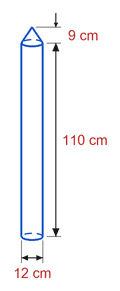
Find the mass of the pole, given that 1 cm³ of iron has 8 gm of mass (approx). (Take π = )
Confirming your payment
Sign up now and get 250 free tokens.
Cylinder, Cone and Sphere · Question 119 of 130
An iron pole consisting of a cylindrical portion 110 cm high and of base diameter 12 cm is surmounted by a cone 9 cm high.
Find the mass of the pole, given that 1 cm³ of iron has 8 gm of mass (approx). (Take π = )
Solution:
Concept: The volume of a solid made of simple parts is the sum of the volumes of the parts. Its surface area is the sum of only the surfaces you can see and touch: faces where two parts are joined are hidden and are left out. Mass = volume × mass of 1 cm³.
Given: Cylinder: height 110 cm, base diameter 12 cm; cone: height 9 cm; 1 cm³ of iron has mass 8 g; π = 355/113.
Step 1 — Volume of the cylindrical part.
The radius is 12 ÷ 2 = 6 cm and the height is 110 cm; keep π for now.
Step 2 — Volume of the cone.
The cone has the same radius, 6 cm, and height 9 cm.
Step 3 — Total volume.
Add the two parts and use π = 355/113, as given.
Step 4 — Mass of the pole.
Each cm³ has a mass of 8 g.
Watch out: Use the value of π the question gives (355/113); here 4068 = 36 × 113, so it divides exactly.
Therefore, the mass of the pole is 102240 g, that is 102·24 kg.