Solution:
Concept: A tunnel is a prism: its volume is area of cross-section × length, and its inner surface is perimeter of the cross-section (without the floor) × length.
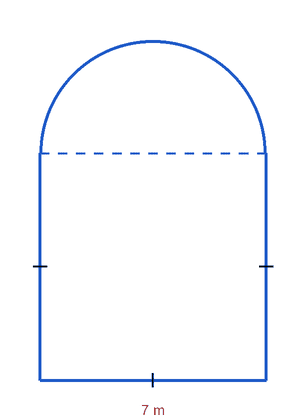
Given: Cross-section: square of side 7 m with a semicircle on top; length 80 m.
Step 1 — Area of the cross-section.
From the figure, the cross-section is a 7 m square with a semicircle of diameter 7 m (radius 3·5 m) on top.
A=7×7+21×722×3.52=49+19.25=68.25 m2
(i)
Step 2 — Volume.
Multiply the cross-section by the length 80 m.
V=68.25×80=5460 m3
(ii)
Step 3 — Perimeter without the floor.
The lining covers the two side walls and the semicircular arc, whose length is half of 2πr, that is πr.
p=7+7+722×3.5=14+11=25 m
Step 4 — Surface area.
Multiply this perimeter by the length.
S=25×80=2000 m2
(iii)
Step 5 — Floor area.
The floor is a rectangle 7 m wide and 80 m long.
F=7×80=560 m2
Watch out: The arc of a semicircle is πr (half the circumference), not 2πr; and the floor is not part of the surface in (ii).
Therefore, (i) the volume of the tunnel is 5460 m³, (ii) its surface area excluding the floor is 2000 m², and (iii) its floor area is 560 m².