Answer: (B) A is false, R is true.
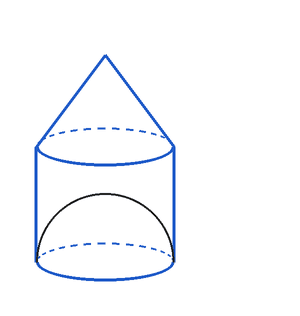
Concept: For an assertion–reason item, judge the Assertion (A) on its own, then the Reason (R) on its own, and only if both are true ask whether R explains why A is true. A toy made of thin sheet needs sheet for every surface it has. From the figure, its surface is the cone's curved surface, the cylinder's curved surface, and the hemisphere, which is pushed up into the bottom of the cylinder (so there is no flat base).
Step 1 — Judge the Assertion.
A SUBTRACTS the hemisphere's curved surface. But the hemisphere is part of the toy and is made of sheet too, so its area must be added. A is false.
Step 2 — Judge the Reason.
R adds the three curved surfaces: cone + cylinder + hemisphere. These are exactly the surfaces made of sheet. R is true.
Sheet=πrl+2πrh+2πr2
Step 3 — Choose the option.
A is false and R is true.
Watch out: The hemisphere is pushed inwards, but it is still a surface made of sheet, so its area is added.
Why the other options are wrong:
- (A) A is true, R is false: A is false (the hemisphere's area must be added) and R is true, the other way round.
- (C) Both A and R are true and R is the correct reason for A: A is false, so 'both true' cannot be right.
- (D) Both A and R are true and R is the incorrect reason for A: A is false, so 'both true' cannot be right.
Therefore, A is false and R is true, option (B).