
Question 933 marksMedium
From a solid cylinder whose height is 16 cm and radius is 12 cm, a conical cavity of height 8 cm and of base radius 6 cm is hollowed out.
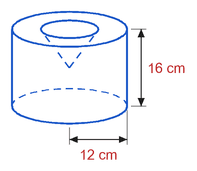
Find the volume and total surface area of the remaining solid.
Confirming your payment
Sign up now and get 250 free tokens.
Cylinder, Cone and Sphere · Question 93 of 130
From a solid cylinder whose height is 16 cm and radius is 12 cm, a conical cavity of height 8 cm and of base radius 6 cm is hollowed out.
Find the volume and total surface area of the remaining solid.
Solution:
Concept: The volume of a solid made of simple parts is the sum of the volumes of the parts. Its surface area is the sum of only the surfaces you can see and touch: faces where two parts are joined are hidden and are left out. Hollowing out a cavity removes a circle from the face it is cut into and adds the inside surface of the cavity. A right circular cone of base radius r, height h and slant height l has l² = r² + h² (Pythagoras' theorem in the right triangle formed by the axis, a radius and a slant edge), volume V = ⅓πr²h, curved surface area πrl and total surface area πrl + πr² = πr(l + r).
Given: Cylinder: height 16 cm, radius 12 cm; conical cavity: height 8 cm, base radius 6 cm.
Step 1 — Volume of the cylinder.
Radius 12 cm, height 16 cm; keep π until the end.
Step 2 — Volume of the cavity.
The cavity is a cone of radius 6 cm and height 8 cm.
Step 3 — Remaining volume.
Subtract the cavity.
Step 4 — Slant height of the cavity.
Use l² = r² + h².
Step 5 — List the surfaces of the remaining solid.
The cavity is cut into one end, so that end loses a circle of radius 6 cm, and the inside of the cavity is added.
Step 6 — Total surface area.
Add the surfaces and subtract the opening.
Watch out: The cavity is smaller than the end face, so only a circle of radius 6 cm is removed from it, not the whole end.
Therefore, the remaining solid has volume 2208π cm³ (about 6939·43 cm³) and total surface area 696π cm² (about 2187·43 cm²).