Solution:
Concept: The volume of a solid made of simple parts is the sum of the volumes of the parts. Its surface area is the sum of only the surfaces you can see and touch: faces where two parts are joined are hidden and are left out. A tent needs canvas for its walls and roof only (no floor): here the curved surface of the cylinder and the curved surface of the cone. Canvas of width w and length L has area w × L.
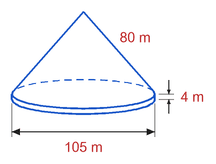
Given: Cylindrical part 4 m high; diameter 105 m; slant height of the cone 80 m; canvas 1·5 m wide at ₹ 15 per metre.
Step 1 — Find the radius.
The diameter is 105 m, so r = 52·5 m.
Step 2 — Canvas for the cylindrical part.
This is the curved surface of a cylinder of radius 52·5 m and height 4 m.
2πrh=2×722×52.5×4=1320 m2
Step 3 — Canvas for the conical part.
This is the curved surface of a cone of radius 52·5 m and slant height 80 m.
πrl=722×52.5×80=13200 m2
Step 4 — Total canvas.
Add the two parts.
Area=1320+13200=14520 m2
Step 5 — Length and cost.
The canvas is 1·5 m wide, and each metre of it costs ₹ 15.
Length=1.514520=9680 m
9680×15=145200
So the canvas costs ₹ 1,45,200.
Watch out: The rate is per METRE of canvas, so find the length (area ÷ width) before multiplying by ₹ 15.
Therefore, 14520 m² of canvas is required, and it costs ₹ 1,45,200.