
Question 973 marksEasy
Spherical marbles of diameter 1·4 cm are dropped into a beaker containing some water and are fully submerged. The diameter of the beaker is 7 cm.
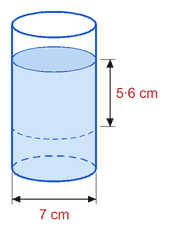
Find how many marbles have been dropped in it if the water rises by 5·6 cm ?
Confirming your payment
Sign up now and get 250 free tokens.
Cylinder, Cone and Sphere · Question 97 of 130
Spherical marbles of diameter 1·4 cm are dropped into a beaker containing some water and are fully submerged. The diameter of the beaker is 7 cm.
Find how many marbles have been dropped in it if the water rises by 5·6 cm ?
Solution:
Concept: A solid that sinks completely in water pushes the water up by its own volume. In a cylindrical vessel of radius r the raised water is a cylinder of radius r and height h (the rise), so πr²h = volume of the solid. For a sphere of radius r, the volume is V = ⁴⁄₃πr³ and the surface area is 4πr². For a hemisphere of radius r, the volume is ⅔πr³, the curved surface area is 2πr² and the total surface area is 3πr² (curved part 2πr² plus the flat circle πr²).
Given: Marble diameter 1·4 cm; beaker diameter 7 cm; rise 5·6 cm.
Step 1 — Volume of water raised.
The beaker has radius 7 ÷ 2 = 3·5 cm and the water rises 5·6 cm; keep π.
Step 2 — Volume of one marble.
Each marble has radius 1·4 ÷ 2 = 0·7 cm.
Step 3 — Number of marbles.
The marbles together have the volume of the raised water; π cancels.
Watch out: Both the beaker and the marbles are given by DIAMETER; halve each one.
Therefore, 150 marbles were dropped into the beaker.