If you are given a rectangular canvas of 1·5 m in width, what length of this canvas would you require to make a…
Question 403 marksMedium
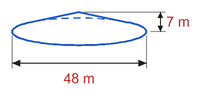
If you are given a rectangular canvas of 1·5 m in width, what length of this canvas would you require to make a conical tent that is 48 m in diameter and 7 m in height ? Note that 10% of the canvas is used (wasted) in folds and stitchings.
Also, find the cost of the canvas at the rate of ₹ 24 per metre.
Solution:
Concept: A right circular cone of base radius r, height h and slant height l has l² = r² + h² (Pythagoras' theorem in the right triangle formed by the axis, a radius and a slant edge), volume V = ⅓πr²h, curved surface area πrl and total surface area πrl + πr² = πr(l + r). Canvas of width w and length L has area w × L.
Given: Tent diameter 48 m, height 7 m; canvas 1·5 m wide at ₹ 24 per metre; 10% of the canvas is wasted.
Step 1 — Find the slant height.
The radius is 48 ÷ 2 = 24 m and the height is 7 m; use l² = r² + h².
l=242+72=625=25 m
Step 2 — Find the curved surface of the tent.
The canvas forms the curved surface πrl.
CSA=722×24×25=713200≈1885.71 m2
Step 3 — Allow for the waste.
10% of the canvas is used up in folds and stitching, so only 90% of the canvas forms the tent. Let the canvas be A m².
0.9A=713200A=7×0.913200≈2095.24 m2
Step 4 — Find the length of canvas.
The canvas is 1·5 m wide, so divide the area by 1·5.
Length=1.52095.24≈1396.83 m
Step 5 — Find the cost.
Each metre of canvas costs ₹ 24.
1396.825…×24≈33523.81
So the canvas costs about ₹ 33,523.81.
Watch out: The 10% is a part of the canvas bought, so divide by 0·9 (not multiply by 1·1).
Note: if the 10% is instead read as extra canvas added to the tent's area, the length is 1885·71 × 1·1 ÷ 1·5 ≈ 1382·86 m and the cost ≈ ₹ 33,188.57.
Therefore, about 1396·83 m of canvas is required, costing about ₹ 33,523.81.