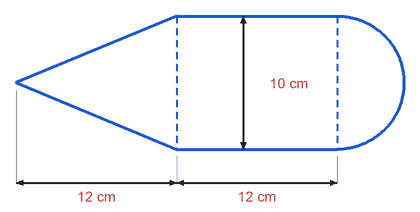
The given figure shows the cross-section of a cone, a cylinder and a hemisphere all with the same diameter 10 cm, and…
Question 1233 marksMedium
The given figure shows the cross-section of a cone, a cylinder and a hemisphere all with the same diameter 10 cm, and the other dimensions are as shown. Calculate :
(a) the total surface area,
(b) the total volume of the solid and
(c) the density of the material if its total weight is 1·7 kg.
Solution:
Concept: The volume of a solid made of simple parts is the sum of the volumes of the parts. Its surface area is the sum of only the surfaces you can see and touch: faces where two parts are joined are hidden and are left out. A right circular cone of base radius r, height h and slant height l has l² = r² + h² (Pythagoras' theorem in the right triangle formed by the axis, a radius and a slant edge), volume V = ⅓πr²h, curved surface area πrl and total surface area πrl + πr² = πr(l + r). For a sphere of radius r, the volume is V = ⁴⁄₃πr³ and the surface area is 4πr². For a hemisphere of radius r, the volume is ⅔πr³, the curved surface area is 2πr² and the total surface area is 3πr² (curved part 2πr² plus the flat circle πr²). Density = mass ÷ volume.
Given: Cone, cylinder and hemisphere of diameter 10 cm; cone height 12 cm, cylinder length 12 cm; mass 1·7 kg.
Step 1 — Read the figure.
All three parts have diameter 10 cm, so r = 5 cm. The cone is 12 cm long (its height) and the cylinder is 12 cm long. The cone's slant height follows from l² = r² + h².
l=52+122=13 cm
(a)
Step 2 — Total surface area.
The outside is the cone's curved surface, the cylinder's curved surface and the hemisphere's curved surface; the joins are hidden.
The mass is 1·7 kg = 1700 g; divide by the volume.
ρ=1519.051700≈1.12 g/cm3
Watch out: The 12 cm of the cone is its HEIGHT (along the axis); the curved surface needs the slant height 13 cm.
Therefore, (a) the total surface area is about 738·57 cm², (b) the total volume is about 1519·05 cm³, and (c) the density of the material is about 1·12 g/cm³.