
Opening your dashboard
Class 10 Maths Chapter 20 Cylinder, Cone and Sphere: Competency-Based Questions (CBQ)
40 questions on Chapter 20, each worked through on its own page with the AI tutor. Class 10 Maths, ICSE 2026-27.
40 questions
1–5 marks · Mixed difficulty
- 11 mark
Question 1
Competency: Application & Analysis
A rectangular sheet of paper is 44 cm long and 14 cm wide. Ria rolls it, without overlap, into an open cylinder in two ways.
Way 1 : the 44 cm side goes around the circle, so the height of the cylinder is 14 cm.
Way 2 : the 14 cm side goes around the circle, so the height of the cylinder is 44 cm.

Take . Which statement is correct?
- 21 mark
Question 2
Competency: Application
A clown's cap is a hollow cone with radius 7 cm and height 24 cm.

The area of paper needed to make the cap (ignoring the joint and any overlap) is :
- 31 mark
Question 3
Competency: Application
A solid hemispherical paperweight of radius 3·5 cm is to be gilded on its whole surface, including the flat face. Gilding costs ₹ 4 per cm². The cost is :
- 41 mark
Question 4
Competency: Understanding & Evaluation
Assertion (A) : A solid cone of base radius and height has the same volume as a solid hemisphere of radius .
Reason (R) : The volume of a solid hemisphere of radius is twice the volume of a solid cone of base radius and height .
- 51 mark
Question 5
Competency: Application & Analysis
A cylindrical glass jar of radius 6 cm holds water. Four identical marbles, each a solid sphere of radius 1·5 cm, are dropped into it and sink completely.
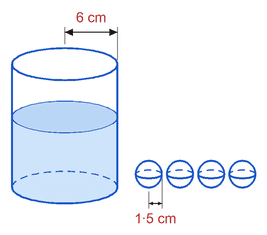
No water spills over. By how many cm does the water level rise?
- 61 mark
Question 6
Competency: Analysis & Evaluation
Anil is asked for the volume of metal in a hollow spherical shell of external radius 5 cm and internal radius 3 cm.
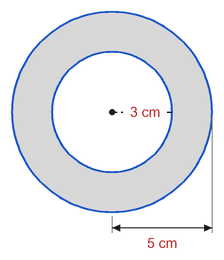
He writes :
Volume cm³.
The correct volume of metal in the shell is :
- 72 marks
Question 7
Competency: Application & Evaluation
A shopkeeper sells oil in two cylindrical tins. Tin A has radius 7 cm and height 10 cm. Tin B is narrower but taller, with radius 5 cm and height 20 cm.
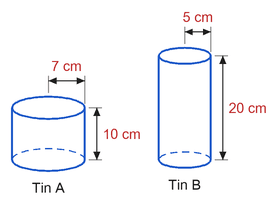
A customer says, "Tin A is wider, so it must hold more oil."
Is the customer right? Find the difference in the capacities of the two tins. (Take .)
- 82 marks
Question 8
Competency: Analysis
A canteen has two conical paper cups. Cup X has radius 3 cm and height 12 cm. Cup Y is wider and shorter, with radius 9 cm and height 4 cm.
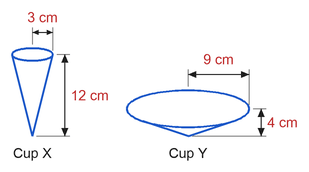
Which cup holds more, and how many times as much? Leave your answer in terms of for the volumes.
- 92 marks
Question 9
Competency: Understanding & Application
In a science exhibition, a model planet is a solid sphere whose diameter is 4 times the diameter of its model moon, which is also a solid sphere.
(a) How many model moons would have the same total volume as the model planet?
(b) How many times as large is the surface area of the planet as that of the moon?
- 102 marks
Question 10
Competency: Application
A circular well, 10 m deep, has an inner diameter of 2·8 m. Its wall is lined with a concrete ring 0·35 m thick for the full depth.
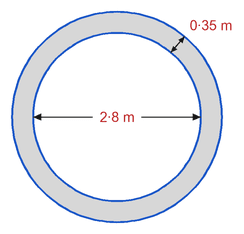
Find the volume of concrete used. (Take .)
- 113 marks
Question 11
Competency: Application & Analysis
At a mela, a juice seller keeps juice in a cylindrical can of radius 14 cm. The juice is 30 cm deep. He serves it in conical paper cups, each of radius 3·5 cm and height 12 cm, filled to the brim. (Take .)
(a) How many cups can he fill from the can?
(b) By the end of the day, 5% of the juice in the can has been spilt or wasted. How many cups can he fill now?
- 123 marks
Question 12
Competency: Analysis & Evaluation
A sculptor has a solid cylindrical block of wax with radius 3·5 cm and height 3·5 cm. She carves out a cone from it, with its base on the top face and its tip at the centre of the bottom face (the cone has the same radius and the same height as the block).
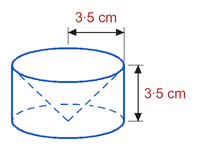
She says, "The wax left over has exactly the same volume as a solid hemisphere of radius 3·5 cm."
Find the volume of the block, of the cone and of the wax left over. Is the sculptor right? (Take .)
- 133 marks
Question 13
Competency: Creativity & Application
A company wants a closed cylindrical tin that holds exactly 1·54 litres of oil. To fit on a shelf, the tin must be at most 30 cm tall and at most 16 cm across. (1 litre cm³; take .)
(a) Design the tin: give a suitable radius and height.
(b) Find the area of metal sheet needed to make your tin, including its top and bottom.
- 145 marks
Question 14
Competency: Analysis & Evaluation
Case study: A kulfi factory uses three moulds, shown below. Each mould has a circular base of radius 3·5 cm. The cone mould is 12 cm high, and the cup mould is a cylinder 4 cm high. The dome mould is a hemisphere. (Take .)
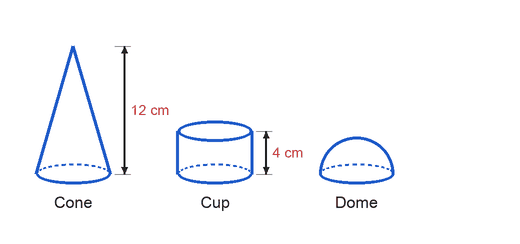
(a) Show that the cone mould and the cup mould hold the same volume of kulfi mixture, and find it.
(b) A "double kulfi" is made by placing the kulfi from the dome mould on top of the kulfi from the cone mould, with the flat face of the dome exactly on the base of the cone. Find its total volume and the area of its outer surface.
(c) Each kulfi from the cone mould and each kulfi from the cup mould is wrapped completely in foil. Which kulfi needs less foil, and by how much?
- 155 marks
Question 15
Competency: Analysis & Evaluation
Case study: A water tanker is a closed cylinder with a hemisphere fixed at each end, as shown in the side view. The total length of the tanker is 6·3 m and its diameter is 2·1 m. (Take .)
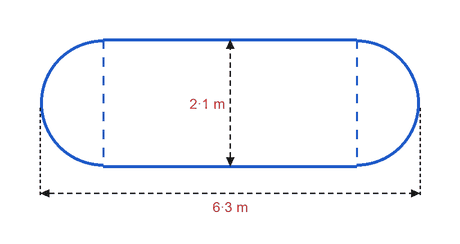
(a) Find the capacity of the tanker in litres. (1 m³ litres.)
(b) A tin of paint covers 10 m². How many tins must be bought to paint the whole outside of the tanker once?
(c) The owner is thinking of a plain closed cylinder of the same length 6·3 m and the same diameter 2·1 m. The capacity of the tanker is what percentage less than that of the plain cylinder? The outer surface of the tanker is what percentage less than that of the plain cylinder? Which of the two percentages is greater?
- 161 mark
Question 16
Competency: Application
A solid cylindrical pillar of a temple has radius 0·35 m and height 4 m. Only its curved side is to be painted (the top and bottom are not painted). Paint costs ₹ 25 per m². (Take .) The cost of painting the pillar is :
- 171 mark
Question 17
Competency: Analysis
Two hollow metal pipes P and Q have the same length. The outer and inner radii of pipe P are 5 cm and 4 cm. The outer and inner radii of pipe Q are 6 cm and 5 cm. Both pipes have walls 1 cm thick. Which statement about the metal used in the two pipes is correct?
- 181 mark
Question 18
Competency: Understanding & Analysis
Assertion (A) : If the radius of a cylinder is doubled and its height is halved, the volume of the cylinder becomes double.
Reason (R) : The volume of a cylinder is directly proportional to the square of its radius and directly proportional to its height.
- 191 mark
Question 19
Competency: Application
A football is a sphere of diameter 21 cm. Its cover is stitched from leather panels, and 10% extra leather is needed for the seams. (Hypothetical data.) (Take .) The area of leather needed for one football is :
- 201 mark
Question 20
Competency: Understanding & Application
A hollow steel ball is made by welding together two hemispherical shells. The finished ball has external diameter 15·4 cm, and its wall is 0·7 cm thick. Before the shells are welded, their inner surfaces are painted, so that the whole inside of the ball is painted. (Take .) The area to be painted is :
- 211 mark
Question 21
Competency: Analysis
A conical glass, with its point at the bottom, has a top radius of 4 cm and a depth of 12 cm. Juice is poured in up to half the depth, that is, to a level 6 cm above the point. At this level the surface of the juice is a circle of radius 2 cm. What fraction of the capacity of the glass is filled with juice?
- 221 mark
Question 22
Competency: Application & Analysis
A solid copper ingot in the shape of a hemisphere of radius 6 cm is melted and drawn into a wire 144 m long, of uniform circular cross-section. No copper is lost. The diameter of the wire is :
- 231 mark
Question 23
Competency: Understanding & Evaluation
A solid is made by joining a hemisphere of radius to one end of a solid cylinder of radius and height , so that their flat circular faces coincide.
Assertion (A) : The total surface area of this solid is equal to the sum of the total surface areas of the cylinder and the hemisphere taken separately.
Reason (R) : The two joined circular faces are inside the solid, so they are not part of its outer surface.
- 241 mark
Question 24
Competency: Analysis & Evaluation
A closed cylindrical can has its height equal to twice its radius. What fraction of its total surface area is its curved surface?
- 251 mark
Question 25
Competency: Application & Analysis
The figure shows a right-angled triangle ABC with the right angle at B. AB = 9 cm, BC = 12 cm and AC = 15 cm. The triangle is revolved completely about the side BC, and a solid cone is formed.
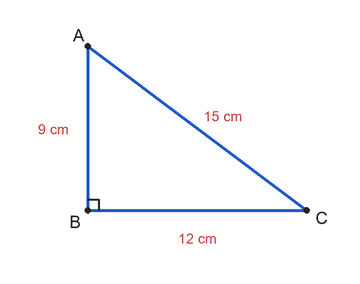
The volume of the cone is :
- 262 marks
Question 26
Competency: Application
A road roller is a solid cylinder of diameter 1·4 m and length 2·1 m. (Take .)
(a) Find the area of ground it presses in one complete revolution.
(b) How many complete revolutions must it make to level a playground of area 4620 m²?
- 272 marks
Question 27
Competency: Application & Analysis
A roll of adhesive tape is 2 cm wide. The tape is wound tightly, with no gaps, on a cardboard core. The outer diameter of the roll is 8·4 cm and the diameter of the core is 7 cm, so the tape forms a hollow cylinder of height 2 cm. The tape is 0·1 mm thick. (Take .)
(a) Find the volume of the tape on the roll.
(b) When the tape is unrolled it is a long thin strip (a very thin cuboid). Find the length of the tape in metres.
- 282 marks
Question 28
Competency: Application & Analysis
A sweet shop measures sugar syrup with a conical ladle, held with its point down. The ladle has radius 3·5 cm and slant height 12·5 cm, and it is filled to the brim each time. (1 litre = 1000 cm³.) (Take .)
(a) Find the vertical height (depth) of the ladle.
(b) How many full ladles of syrup are needed to fill a jar of 1·54 litres?
- 292 marks
Question 29
Competency: Application & Evaluation
An overhead water tank in a society is a sphere of diameter 4·2 m. When it is full, the families use 5400 litres of water every day, and the tank is refilled only after all the water is used. (1 m³ = 1000 litres.) (Take .)
For how many full days does a full tank supply water?
- 302 marks
Question 30
Competency: Application & Analysis
(Hypothetical data.) A halwai's large kadai is in the shape of a hemisphere. When it is full to the brim, it holds 19·404 litres. (1 litre = 1000 cm³.) (Take .)
(a) Find the inner radius of the kadai.
(b) The inside surface of the kadai is to be given a fresh coating at ₹ 0·25 per cm². Find the cost of the coating.
- 312 marks
Question 31
Competency: Analysis & Evaluation
Mohan melts 8 identical solid metal spheres, each of radius 3·5 cm, to make one bigger solid sphere. He says, "The big sphere has the same outer surface area as the 8 small spheres together." (Take .)
Find the radius of the big sphere. Is Mohan right? Give the surface areas to support your answer.
- 323 marks
Question 32
Competency: Application & Analysis
A builder empties a full cylindrical bucket of radius 21 cm and height 28 cm of dry sand on level ground. The sand forms a conical heap whose base radius is 42 cm. (Take .)
(a) Find the volume of sand in the bucket.
(b) Find the height of the conical heap.
(c) The same sand is now poured into an empty cylindrical drum of base radius 42 cm. To what height does the sand rise in the drum?
- 333 marks
Question 33
Competency: Analysis & Evaluation
A cylindrical tube holds exactly three identical balls, each of radius 3·5 cm, one above the other, as shown. Each ball touches the curved side of the tube, the next ball, and the top or bottom of the tube. (Take .)
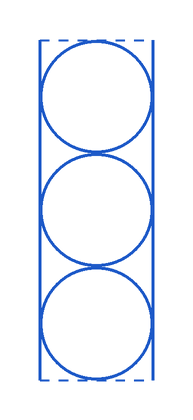
(a) Find the height and radius of the tube, and its volume.
(b) Find the volume of the space in the tube that is not filled by the balls.
(c) The same three balls can also be packed in a cuboidal box whose inside measures 7 cm × 7 cm × 21 cm. Which pack leaves less empty space? Find the percentage of each pack that is empty.
- 343 marks
Question 34
Competency: Analysis & Evaluation
A hollow brass ball has external diameter 12 cm and internal diameter 6 cm. Each cm³ of brass weighs 8·4 g. (Hypothetical data.) (Take .)
(a) Find the volume of brass in the ball.
(b) Find the weight of the ball in kilograms.
(c) A solid brass ball of the same external diameter would be how many times as heavy as this hollow ball?
- 353 marks
Question 35
Competency: Application & Analysis
A wooden spinning top is made of a cone of base radius 4·2 cm and height 5·6 cm, with a hemisphere of the same radius fixed on its base, as shown. It is turned on a lathe from the smallest solid cylindrical block of wood that the top fits inside. (Take .)
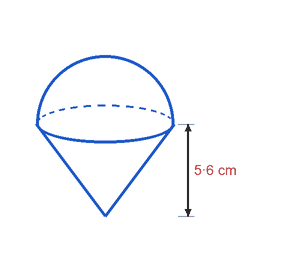
(a) Find the total height of the top and the volume of wood in it.
(b) Find the radius, the height and the volume of the cylindrical block.
(c) What percentage of the wood of the block is cut away in making the top? Give your answer correct to 1 decimal place.
- 363 marks
Question 36
Competency: Understanding & Analysis
A solid cone and a solid hemisphere have equal base radii and equal volumes.
(a) Show that the height of the cone is .
(b) Find the slant height of the cone in terms of .
(c) Find the ratio of the curved surface area of the cone to that of the hemisphere.
- 375 marks
Question 37
Competency: Analysis & Evaluation
Case study: (Hypothetical data.) A housing society needs a closed cylindrical water tank that holds at least 21000 litres. Three suppliers offer tanks made of metal sheet. The details are given below. (Take .)
Tank Radius Height Price of sheet per m² A 1·4 m 3·5 m ₹ 450 B 2·1 m 1·5 m ₹ 480 C 1·75 m 2·4 m ₹ 420 (1 m³ = 1000 litres. The price of a tank is the price of the sheet used for its total surface, and nothing else.)
(a) Find the capacity of each tank in litres.
(b) Which tanks meet the society's need?
(c) Of the tanks that meet the need, which one is cheaper to make, and by how much?
- 385 marks
Question 38
Competency: Application & Analysis
Case study: (Hypothetical data.) A workshop makes steel balls for bearings. It melts a solid steel rod in the shape of a cylinder of radius 3 cm and length 16 cm and recasts the metal into solid spherical balls, each of radius 1·5 cm. (Take .)
(a) How many balls can be made if no metal is wasted?
(b) In practice, 5% of the metal is lost during melting. How many complete balls can be made now?
(c) The 30 balls of part (b) are chrome-plated at ₹ 0·70 per cm² of surface. Find the total area to be plated and the cost of plating.
- 394 marks
Question 39
Competency: Analysis & Evaluation
Case study: A new pencil is a solid cylinder 17·5 cm long and 0·7 cm in diameter. When it is sharpened at one end, the end becomes a cone of height 1·2 cm, with the same base as the cylinder, as shown (only the sharpened end is drawn). The rest of the pencil stays a cylinder, and the pencil is still 17·5 cm long. (Take .)

(a) Find the volume of the sharpened pencil.
(b) Find the volume of wood and lead that is cut off in sharpening.
(c) Rani says, "Most of the wood and lead of the old 1·2 cm end is still there in the cone; only one-third of it is cut off as shavings." Is she right? Explain with the help of your answers.
- 405 marks
Question 40
Competency: Creativity & Application
Case study: (Hypothetical data.) A school wants a closed water tank for its garden. The tank is to be a cylinder of radius 2·1 m with a hemisphere of the same radius on top. It must hold at least 30000 litres (1 m³ = 1000 litres). The total height of the tank, including the hemisphere, must not be more than 3·5 m. (Take .)
(a) Design the tank: choose a height (in m) for the cylindrical part, and show that your tank holds at least 30000 litres and is not too tall.
(b) For your tank, find the area of metal sheet needed to make the outer surface, including the flat base.
(c) Find the least height of the cylindrical part, correct to 2 decimal places and rounded up, that gives at least 30000 litres. Also find the greatest capacity allowed by the height limit.