
Opening your dashboard
Class 10 Maths Chapter 20 Cylinder, Cone and Sphere: Previous Year Questions
30 questions on Chapter 20, each solved step by step. Class 10 Maths, ICSE 2026-27.
30 questions with solutions
1–4 marks · Mixed difficulty
The first 25 solutions are on this page. This chapter is a long one, so the rest open on their own page to keep this one quick to load.
- 13 marks
Question 1
A certain number of metallic cones, each of radius 2 cm and height 3 cm are melted and recast into a solid sphere of radius 6cm. Find the number of cones.
Solve with AIWritten solution
Solution:
Concept: These facts are used here.
- Cone: volume , slant height , curved surface .
- Sphere: volume , surface .
- Melting and recasting: the volume of metal stays the same, so total volume before = total volume after.
Step 1 — Volume of one cone.
Each cone has radius 2 cm and height 3 cm. Keep as it is; it cancels later.
Step 2 — Volume of the sphere.
The sphere has radius 6 cm.
Step 3 — Number of cones.
All the metal of the n cones goes into the sphere, so n times one cone's volume equals the sphere's volume.
Watch out: Use the cube of the sphere's radius () but the square of the cone's radius ().
Therefore, 72 cones were melted.
- 23 marks
Question 2
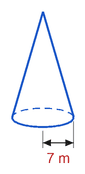
A conical tent is to accommodate 77 persons. Each person must have of air to breathe. Given the radius of the tent as find the height of the tent and also its curved surface area.
 Solve with AI
Written solution
Solution:
Concept: Cone: volume , slant height , curved surface .
Step 1 — Volume of air needed.
77 persons each need , so the tent must hold:
Step 2 — Find the height.
Set the cone's volume equal to 1232, with m.
Step 3 — Find the slant height.
The radius, the height and the slant height form a right-angled triangle.
Step 4 — Curved surface area.
Use .
Watch out: The curved surface needs the SLANT height (25 m), not the vertical height (24 m).
Therefore, the height of the tent is m and its curved surface area is .
- 33 marks
Question 3
The circumference of the base of a cylindrical vessel is 132 cm and its height is 25 cm. Find the
(i) radius of the cylinder
(ii) volume of cylinder. (use )
Solve with AIWritten solution
Solution:
Concept: These facts are used here.
- Cylinder: volume , curved surface , total surface .
- Circle: circumference .
Step 1 — Find the radius (part i).
The circumference of the base is .
Step 2 — Find the volume (part ii).
Use with cm.
Watch out: 132 cm is the circumference, , not ; dividing by alone gives the diameter.
Therefore, the radius is cm and the volume is .
- 44 marks
Question 4
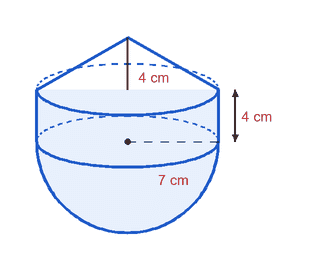
The following figure represents a solid consisting of a right circular cylinder with a hemisphere at one end and a cone at the other. Their common radius is 7 cm. The height of the cylinder and cone are each of 4 cm. Find the volume of the solid.
 Solve with AI
Written solution
Solution:
Concept: These facts are used here.
- Hemisphere: volume , curved surface , total surface .
- Cylinder: volume , curved surface , total surface .
- Cone: volume , slant height , curved surface .
Step 1 — Add the three volumes.
The solid is a hemisphere, a cylinder and a cone, all of radius cm; the cylinder and the cone are each 4 cm high. Each volume has the factor , so take it out.
Step 2 — Simplify the bracket.
Put and .
Step 3 — Find the volume.
Multiply by .
Watch out: The hemisphere's volume is , half of a sphere's; do not use .
Therefore, the volume of the solid is .
- 54 marks
Question 5
A solid metallic sphere of radius 6 cm is melted and made into a solid cylinder of height 32 cm. Find the:
(i) radius of the cylinder.
(ii) curved surface area of the cylinder.
Take
Solve with AIWritten solution
Solution:
Concept: These facts are used here.
- Sphere: volume , surface .
- Cylinder: volume , curved surface , total surface .
- Melting and recasting: the volume of metal stays the same, so total volume before = total volume after.
Step 1 — Equate the volumes.
The sphere (radius 6 cm) is recast into a cylinder of height 32 cm, so the volumes are equal; cancels.
Step 2 — Find the radius (part i).
Divide and take the square root.
Step 3 — Curved surface area (part ii).
Use with .
Watch out: Use , as the question says, not .
Therefore, the radius of the cylinder is cm and its curved surface area is .
- 64 marks
Question 6
A hemispherical and a conical hole is scooped out of a solid wooden cylinder. Find the volume of the remaining solid where the measurements are as follows:
The height of the solid cylinder is 7 cm, radius of each of hemisphere, cone and cylinder is 3 cm. Height of cone is 3 cm.
Give your answer correct to the nearest whole number. Take .
 Solve with AI
Written solution
Solution:
Concept: These facts are used here.
- Cylinder: volume , curved surface , total surface .
- Hemisphere: volume , curved surface , total surface .
- Cone: volume , slant height , curved surface .
Step 1 — Volume of the cylinder.
Radius 3 cm, height 7 cm.
Step 2 — Volume of the hemispherical hole.
Radius 3 cm.
Step 3 — Volume of the conical hole.
Radius 3 cm, height 3 cm.
Step 4 — Remaining volume.
Take both holes away from the cylinder.
Watch out: Both holes are SUBTRACTED from the cylinder; nothing is added.
Therefore, the volume of the remaining solid is (to the nearest whole number).
- 73 marks
Question 7
A solid spherical ball of radius 6 cm is melted and recast into 64 identical spherical marbles. Find the radius of each marble.
Solve with AIWritten solution
Solution:
Concept: These facts are used here.
- Sphere: volume , surface .
- Melting and recasting: the volume of metal stays the same, so total volume before = total volume after.
Step 1 — Equate the volumes.
The ball (radius 6 cm) makes 64 equal marbles of radius r; cancels.
Step 2 — Find r.
Divide by 64 and take the cube root.
Watch out: Take the CUBE root: 64 marbles means the radius is divided by , not by 64.
Therefore, the radius of each marble is cm.
- 83 marks
Question 8
From a solid wooden cylinder of height 28 cm and diameter 6 cm, two conical cavities are hollowed out. The diameters of the cones are also of 6 cm and height 10.5 cm.
Taking find the volume of the remaining solid.
 Solve with AI
Written solution
Solution:
Concept: These facts are used here.
- Cylinder: volume , curved surface , total surface .
- Cone: volume , slant height , curved surface .
Step 1 — Volume of the cylinder.
Diameter 6 cm, so the radius is 3 cm; height 28 cm.
Step 2 — Volume of the two cones.
Each cone has radius 3 cm and height 10.5 cm.
Step 3 — Remaining volume.
Take the cavities away.
Watch out: The 6 cm is a DIAMETER; the radius is 3 cm.
Therefore, the volume of the remaining solid is .
- 91 mark
Question 9
The volume of a conical tent is 462 and the area of the base is 154 . The height of the cone is:
Solve with AIAnswer
(A) 15 m
(B) 12 m
- Correct
(C) 9 m
(D) 24 m
Answer: (C) 9 m
Concept: Cone: volume , slant height , curved surface . Here the base area is given directly.
Step 1 — Write the volume with the base area.
The volume of a cone is one third of base area times height.
Step 2 — Solve for h.
Multiply by 3 and divide by 154.
Watch out: Do not forget the ; without it, gives 3 m, which is not even an option.
Why the other options are wrong:
- (A) 15 m: 15 m gives a volume of , not 462.
- (B) 12 m: 12 m gives , not 462.
- (D) 24 m: 24 m gives , not 462.
Therefore, the height of the cone is 9 m, option (C).
- 101 mark
Question 10
The radius of a roller 100 cm long is 14 cm. The curved surface area of the roller is: (Take )
Solve with AIAnswer
(A) 13200
(B) 15400
(C) 4400
- Correct
(D) 8800
Answer: (D) 8800
Concept: Cylinder: volume , curved surface , total surface . A roller is a cylinder whose length is its height.
Step 1 — Use the curved surface formula.
Radius 14 cm and length (height) 100 cm.
Watch out: The curved surface is ; leaving out the 2 gives half the answer.
Why the other options are wrong:
- (A) 13200 : does not come from with these values.
- (B) 15400 : does not come from with these values.
- (C) 4400 : is only , half of the curved surface.
Therefore, the curved surface area is , option (D).
- 112 marks
Question 11
A solid cone of radius 5 cm and height 9 cm is melted and made into small cylinders of radius of 0.5 cm and height 1.5 cm. Find the number of cylinders so formed.
Solve with AIWritten solution
Solution:
Concept: These facts are used here.
- Cone: volume , slant height , curved surface .
- Cylinder: volume , curved surface , total surface .
- Melting and recasting: the volume of metal stays the same, so total volume before = total volume after.
Step 1 — Volume of the cone.
Radius 5 cm, height 9 cm.
Step 2 — Volume of one small cylinder.
Radius 0.5 cm, height 1.5 cm.
Step 3 — Number of cylinders.
The metal of the cone is shared equally among the cylinders.
Watch out: Square the radius 0.5 (), do not halve it.
Therefore, 200 cylinders are formed.
- 123 marks
Question 12
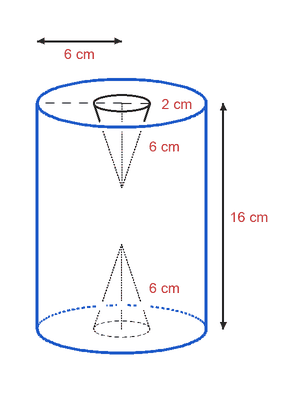
A solid wooden cylinder is of radius 6 cm and height 16 cm. Two cones each of radius 2 cm and height 6 cm are drilled out of the cylinder. Find the volume of the remaining solid.
(Take )
 Solve with AI
Written solution
Solution:
Concept: These facts are used here.
- Cylinder: volume , curved surface , total surface .
- Cone: volume , slant height , curved surface .
Step 1 — Volume of the cylinder.
Radius 6 cm, height 16 cm.
Step 2 — Volume of the two cones.
Each cone has radius 2 cm and height 6 cm.
Step 3 — Remaining volume.
Take the drilled cones away.
Watch out: There are TWO cones; subtract both.
Therefore, the volume of the remaining solid is .
- 131 mark
Question 13
Volume of a cylinder of height 3 cm is . Radius of the cylinder is :
Solve with AIAnswer
(A) 48 cm
(B) 16 cm
- Correct
(C) 4 cm
(D) 24 cm
Answer: (C) 4 cm
Concept: Cylinder: volume , curved surface , total surface .
Step 1 — Write the volume.
Height 3 cm and volume ; cancels.
Step 2 — Take the square root.
The radius is positive.
Watch out: After dividing by 3 you have ; take its square root.
Why the other options are wrong:
- (A) 48 cm: 48 cm ignores the formula altogether.
- (B) 16 cm: 16 is ; its square root has not been taken.
- (D) 24 cm: 24 cm is , which has no link to .
Therefore, the radius of the cylinder is 4 cm, option (C).
- 144 marks
Question 14
A solid is in the shape of a hemisphere of radius 7 cm, surmounted by a cone of height 4 cm. The solid is immersed completely in a cylindrical container filled with water to a certain height so that the solid is completely submerged in water. If the radius of the cylinder is 14 cm, find the rise in the water level.
 Solve with AI
Written solution
Solution:
Concept: These facts are used here.
- Hemisphere: volume , curved surface , total surface .
- Cone: volume , slant height , curved surface .
- Rise in water level: the water displaced equals the volume of the solid, and it forms a cylinder of the container's radius whose height is the rise.
Step 1 — Volume of the solid.
A hemisphere of radius 7 cm with a cone of radius 7 cm and height 4 cm on it.
Step 2 — Find the rise.
The displaced water is a cylinder of radius 14 cm and height h (the rise).
Watch out: Use the CONTAINER's radius (14 cm) for the rise, not the solid's radius (7 cm).
Therefore, the water level rises by cm.
- 151 mark
Question 15
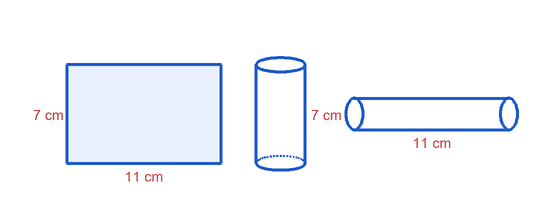
A rectangular sheet of paper of size 11 cm 7 cm is first rotated about the side 11 cm and then about the side 7 cm to form a cylinder, as shown in the diagram. The ratio of their curved surface areas is:
 Solve with AI
Answer
- Correct
(A)
(B)
(C)
(D)
Answer: (A)
Concept: Cylinder: volume , curved surface , total surface . When a sheet is rolled into a cylinder, the sheet itself becomes the curved surface.
Step 1 — First cylinder.
Rolled about the 11 cm side: the height is 11 cm and the base circumference is 7 cm.
Step 2 — Second cylinder.
Rolled about the 7 cm side: the height is 7 cm and the circumference is 11 cm.
Step 3 — Compare.
Both curved surfaces are the same sheet of paper, so the ratio is .
Watch out: The curved surface is the whole sheet in both cases, whichever side is the height.
Why the other options are wrong:
- (B) : 7 : 11 compares the two side lengths, not the areas.
- (C) : 11 : 7 is the same mistake the other way round.
- (D) : these expressions are not the curved surfaces; each curved surface equals the sheet's area, .
Therefore, the ratio of the curved surface areas is , option (A).
- 164 marks
Question 16
A solid metallic cylinder is cut into two identical halves along its height (as shown in the diagram). The diameter of the cylinder is 7 cm and the height is 10 cm. Find :
(a) The total surface area (both the halves).
(b) The total cost of painting the two halves at the rate of ₹ 30 per cm.
 Solve with AI
Written solution
Solution:
Concept: Half cylinder: cutting a cylinder along its height gives each half three kinds of faces: half the curved surface (), two semicircular ends (together ), and a new rectangular face (diameter height).
Step 1 — Half the curved surface.
Radius 3.5 cm, height 10 cm.
Step 2 — The two semicircular ends.
Two semicircles make one full circle.
Step 3 — The rectangular cut face.
Its sides are the diameter (7 cm) and the height (10 cm).
Step 4 — Total surface of both halves (part a).
Add the three parts for one half, then double.
Step 5 — Cost of painting (part b).
The rate is ₹ 30 per square centimetre.
So the cost is ₹ 13,110.
Watch out: The cut creates two NEW rectangular faces (one on each half); do not forget them.
Therefore, the total surface area of the two halves is , and the cost of painting is ₹ 13,110.
- 174 marks
Question 17
Oil is stored in a spherical vessel occupying of its full capacity. Radius of this spherical vessel is 28 cm. This oil is then poured into a cylindrical vessel with a radius of 21 cm. Find the height of the oil in the cylindrical vessel (correct to the nearest cm).
Take
 Solve with AI
Written solution
Solution:
Concept: These facts are used here.
- Sphere: volume , surface .
- Cylinder: volume , curved surface , total surface .
Step 1 — Volume of the oil.
The oil fills of the sphere of radius 28 cm.
Step 2 — Height in the cylinder.
Poured into a cylinder of radius 21 cm, the oil forms a cylinder of height h; cancels.
Watch out: Take only of the sphere's volume; the vessel is not full.
Therefore, the height of the oil in the cylindrical vessel is cm (to the nearest cm).
- 181 mark
Question 18
If the volume of two spheres is in the ratio , then the ratio of their radii is:
Solve with AIAnswer
- Correct
(A)
(B)
(C)
(D)
Answer: (A)
Concept: Sphere: volume , surface . So volumes of spheres are in the ratio of the cubes of their radii.
Step 1 — Write the ratio of cubes.
cancels.
Step 2 — Take cube roots.
and .
Watch out: Volume goes with the CUBE of the radius, so take cube roots, not square roots.
Why the other options are wrong:
- (B) : 4 : 3 is the correct ratio turned upside down.
- (C) : 9 : 16 is the ratio of the squares of the radii (the surface areas).
- (D) : 16 : 9 is the ratio of the surface areas, upside down.
Therefore, the radii are in the ratio , option (A).
- 194 marks
Question 19
A solid wooden capsule is shown in Figure 1. The capsule is formed of a cylindrical block and two hemispheres.
Find the sum of total surface area of the three parts as shown in Figure 2. Given, the radius of the capsule is 3.5 cm and the length of the cylindrical block is 14 cm. (Use )
 Solve with AI
Written solution
Solution:
Concept: These facts are used here.
- Cylinder: volume , curved surface , total surface .
- Hemisphere: volume , curved surface , total surface .
Step 1 — Total surface of the cylinder.
Figure 2 shows the cylinder on its own, so both circular ends count. Radius 3.5 cm, length 14 cm.
Step 2 — Total surface of one hemisphere.
Each separate hemisphere has its curved surface and its flat circular face.
Step 3 — Sum of the three parts.
Add the cylinder and two hemispheres.
Watch out: The parts are separate (Figure 2), so use TOTAL surfaces: the circular faces are now outside.
Therefore, the sum of the total surface areas of the three parts is .
- 203 marks
Question 20
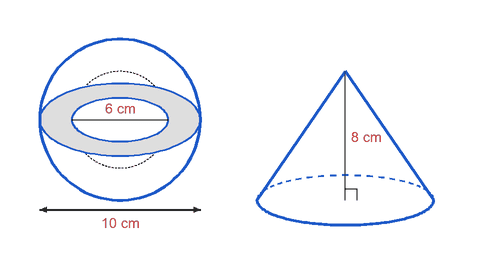
A hollow sphere of external diameter 10 cm and internal diameter 6 cm is melted and made into a solid right circular cone of height 8 cm. Find the radius of the cone so formed. (Use )
 Solve with AI
Written solution
Solution:
Concept: These facts are used here.
- Sphere: volume , surface .
- Cone: volume , slant height , curved surface .
- Melting and recasting: the volume of metal stays the same, so total volume before = total volume after.
Step 1 — Volume of the metal.
External radius 5 cm, internal radius 3 cm; the metal is the space between the two spheres.
Step 2 — Equate with the cone.
The cone has height 8 cm and radius r.
Watch out: Subtract the CUBES of the radii (), not the radii first (, then ).
Therefore, the radius of the cone is cm.
- 211 mark
Question 21
The ratio of diameters of two right circular cones is and that of their heights is , then their volumes are in ratio:
Solve with AIAnswer
(A)
- Correct
(B)
(C)
(D)
Answer: (B)
Concept: Cone: volume , slant height , curved surface . The ratio of diameters equals the ratio of radii.
Step 1 — Write the ratio of volumes.
cancels, leaving .
Watch out: The radii are SQUARED; the heights are not.
Why the other options are wrong:
- (A) : 3 : 7 is just the ratio of the diameters.
- (C) : 3 : 2 does not come from for these values.
- (D) : 9 : 49 is the ratio of only; it leaves out the heights.
Therefore, the volumes are in the ratio , option (B).
- 223 marks
Question 22
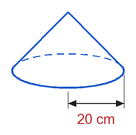
A right circular cone of radius 20 cm has its volume 8800 cm.
Find its:
(a) height
(b) curved surface area.
Give your answer to the nearest whole number.
Solve with AIWritten solution
Solution:
Concept: Cone: volume , slant height , curved surface .
Step 1 — Find the height (part a).
Use the volume formula with cm.
Step 2 — Find the slant height.
Radius, height and slant height form a right-angled triangle.
Step 3 — Curved surface area (part b).
Use .
Watch out: The curved surface uses the slant height (29 cm), not the height (21 cm).
Therefore, the height is cm and the curved surface area is (to the nearest whole number).
- 234 marks
Question 23
An ice cream cone has a diameter of 7 cm and its height is 9 cm. It is filled with a scoop of spherical shaped ice cream of radius 3.5 cm.
Find: (Give all answers correct to the nearest whole number)

(a) on melting, is the ice cream sufficient to fill the cone completely without any wastage?
(b) the volume of ice cream, if any, is in excess or less.
Solve with AIWritten solution
Solution:
Concept: These facts are used here.
- Cone: volume , slant height , curved surface .
- Sphere: volume , surface .
Step 1 — Volume of the cone.
Diameter 7 cm, so the radius is 3.5 cm; height 9 cm.
Step 2 — Volume of the ice cream.
A sphere of radius 3.5 cm.
Step 3 — Compare (part a).
The melted ice cream (about 180 cm³) is more than the cone holds (about 116 cm³). So it fills the cone completely, but some is left over: it cannot fill the cone WITHOUT wastage.
Step 4 — Find the excess (part b).
Subtract the cone's volume from the ice cream's volume.
Watch out: The cone's radius is HALF its 7 cm diameter.
Therefore, the ice cream fills the cone completely with some to spare, so it is not without wastage, and it is in excess by (to the nearest whole number).
- 241 mark
Question 24
The total surface area of a solid sphere and a solid hemisphere , as shown in the diagram, are equal. The ratio of radii R and r is :
 Solve with AI
Answer
(A)
(B)
- Correct
(C)
(D)
Answer: (C)
Concept: Surface areas: a solid sphere has surface ; a solid hemisphere has curved surface and a flat circular face , so its total surface is .
Step 1 — Equate the two total surfaces.
cancels.
Step 2 — Take square roots.
Both radii are positive.
Watch out: The hemisphere's TOTAL surface includes its flat face: use , not .
Why the other options are wrong:
- (A) : 1 : 1 would need , but the hemisphere's surface is .
- (B) : 2 : 1 does not satisfy ; it ignores the squares and the flat face.
- (D) : is the correct ratio turned upside down (that is r : R).
Therefore, , option (C).
- 254 marks
Question 25
An eye drop bottle is prepared consisting of a hemisphere, a cylinder and a conical cap, as shown in the given diagram. Height of the cylindrical and conical parts are each, equal to the diameter (7 cm). Find the :
(a) minimum height of the cylindrical box required to pack this bottle.
(b) volume of the liquid medicine (shaded part) in the bottle. Give your answer to the nearest whole number. (Use )
 Solve with AI
Written solution
Solution:
Concept: These facts are used here.
- Cylinder: volume , curved surface , total surface .
- Hemisphere: volume , curved surface , total surface .
Step 1 — Height of the box (part a).
The hemisphere is pushed INTO the bottom of the cylinder (see the figure), so it adds no height. The bottle is the cylinder (7 cm) plus the conical cap (7 cm).
Step 2 — Volume of the cylinder.
Diameter 7 cm, so the radius is 3.5 cm; height 7 cm.
Step 3 — Volume of the hemispherical dome.
Radius 3.5 cm.
Step 4 — Volume of the liquid (part b).
The liquid fills the cylinder outside the dome.
Watch out: The dome is pushed in, so subtract its volume and do not add its height.
Therefore, the box must be at least cm high, and the bottle holds of medicine (to the nearest whole number).
- 264 marks
Question 26
A solid wooden toy is prepared by joining a cone, a cylinder and a sphere, as shown in the given diagram. The radius of each of the three solids is 7 cm and heights of each of the cone and the cylinder is 24 cm. Find :
(a) the total surface area of the given solid.
(b) the cost of painting the total surface at the rate of ₹ 0.50 per cm.

- 271 mark
Question 27
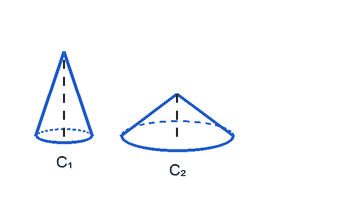
Two right circular cones, and , have their heights in the ratio and radii in the ratio . The ratio of their volumes is:
- 281 mark
Question 28
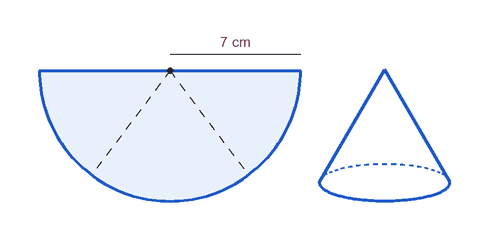
A semi-circular sheet of paper having radius 7 cm is folded to form a right circular cone, as shown in the diagram. The slant height of the cone so formed is:
- 294 marks
Question 29
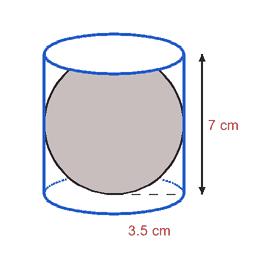
A solid sphere completely fits into a cylindrical container of radius 3.5 cm and height 7 cm as shown in the figure below. Find the volume of water required to fill the remaining (unshaded) space of the container to the nearest of a whole number.
- 304 marks
Question 30
The surface area of a solid metallic sphere is 616 cm. It is melted and recast into solid right circular cones of diameter 3.5 cm and height 3.5 cm. Find the:
(a) radius of the sphere.
(b) number of cones formed.