
Question 31 markMCQEasy
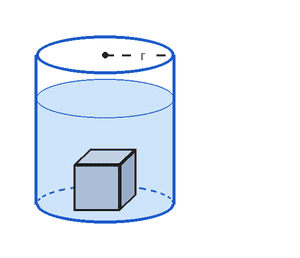
A cylindrical container has sufficient water to submerge a solid cubical object of its each edge a cm. If the radius of the container is r cm, the rise in level (h cm) of water in the container is :
Confirming your payment
Sign up now and get 250 free tokens.
Cylinder, Cone and Sphere · Question 3 of 130
A cylindrical container has sufficient water to submerge a solid cubical object of its each edge a cm. If the radius of the container is r cm, the rise in level (h cm) of water in the container is :
(A)
(B)
(C)
(D)
Answer: (C)
Concept: A solid that sinks completely in water pushes the water up by its own volume. In a cylindrical vessel of radius r the raised water is a cylinder of radius r and height h (the rise), so πr²h = volume of the solid.
Step 1 — Find the volume of the cube.
The cube has edge a cm, so its volume is a × a × a.
Step 2 — Write the volume of the raised water.
The water rises by h cm in a container of radius r cm, so the raised water is a cylinder of radius r and height h.
Step 3 — Equate and solve for h.
The raised water has the same volume as the cube, so we equate the two volumes and divide by πr².
Watch out: Divide by the area of the base πr², not by πr.
Why the other options are wrong:
Therefore, the rise in level is h = a³ ÷ πr² cm, option (C).