Answer: (A) Both the statements are true.
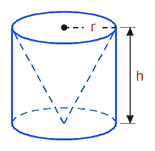
Concept: For a two-statement item, test each statement on its own against the facts, then pick the matching option. The volume of a cylinder of base radius r and height h is V = πr²h, that is, area of the base × height. A cone with the same base and height has volume ⅓πr²h.
Step 1 — Test statement 1.
Drilling out the cone removes its volume from the cylinder, so the wood left is the cylinder's volume minus the cone's. Statement 1 is true.
Step 2 — Test statement 2.
Put the formulas into statement 1.
V=πr2h−31πr2h=32πr2h
This is statement 2, so it is true.
Watch out: The cone removes one-third, so two-thirds of the cylinder remains.
Why the other options are wrong:
- (B) Both the statements are false: both statements are true, as shown in Steps 1 and 2.
- (C) Statement 1 is true, and statement 2 is false: statement 2 is also true: πr²h − ⅓πr²h is ⅔πr²h.
- (D) Statement 1 is false, and statement 2 is true: statement 1 is also true: the wood left is the cylinder minus the cone.
Therefore, both statements are true, option (A).