
Opening your dashboard
Class 12 Physics Chapter 6: Direct Current Circuits Solutions
126 textbook questions with step-by-step answers, free to read, for ISC 2026-27.
Get talked through Ch 6, not just shown the answer
Reading a finished solution is not the same as being able to do it. The AI tutor takes one question at a time and works it with you, in your own words, until you can.
- Ask it out loud, in your own words
- It gives you the next step, not the answer
- Stuck on part (ii)? Start there
126 questions with solutions
1–5 marks · Mixed difficulty
The first 16 solutions are on this page. This chapter is a long one, so the rest open on their own page to keep this one quick to load.
- 11 mark
Question 1
The potentiometer is best for measuring voltage as
Solve with AIAnswer
- Correct
(A) it has sensitive galvanometer and gives null deflection
(B) it has wire of high resistance
(C) it measures p.d. in closed circuit
(D) it measures p.d. in open circuit
Answer: (A) it has sensitive galvanometer and gives null deflection
Key idea: A potentiometer is a null (balance) instrument. At the balance point its galvanometer shows no deflection, so no current is drawn from the cell or circuit being measured.
Step 1 — Recall how a voltmeter measures.
A voltmeter is connected across the source and must draw a small current to deflect. The source then loses a p.d. inside itself, so the voltmeter reads less than the true value.
Step 2 — Recall how a potentiometer measures.
The unknown p.d. is balanced against the fall of potential along the potentiometer wire. At balance the sensitive galvanometer shows zero deflection, so no current flows from the source and nothing is lost inside it.
Step 3 — Pick the reason.
The accuracy therefore comes from the null deflection read on a sensitive galvanometer, which is what option (A) states.
Why the other options are wrong:
- (B) is wrong: The wire is made of a high-resistivity alloy, but its total resistance is only a few ohms; the accuracy comes from the null method, not from a high wire resistance.
- (C) is wrong: Measuring while drawing current from the circuit is exactly what a voltmeter does, and that is the cause of its error; a potentiometer draws no current at balance.
- (D) is wrong: It is partly true, since at balance the source gives no current and so behaves as on open circuit; but this follows from the null deflection in (A), which is the reason the question asks for.
Note: The open-circuit option describes a result of the same zero-current balance. The null-deflection option is kept as the key because it names the cause.
Therefore, a potentiometer is best for measuring voltage because it uses a sensitive galvanometer and a null deflection: option (A).
- 21 mark
Question 2
The resistance of each arm of the Wheatstone bridge is 10 ohm. A resistance of 10 ohm is connected in series with a galvanometer then the equivalent resistance across the battery will be
Solve with AIAnswer
- Correct
(A) 10 ohm
(B) 15 ohm
(C) 20 ohm
(D) 40 ohm
Answer: (A) 10 ohm
Key idea: A Wheatstone bridge is balanced when the ratio of the two arms on one side equals the ratio on the other side. The two ends of the galvanometer branch are then at the same potential, so that branch carries no current, whatever resistance is in series with the galvanometer.
Step 1 — Check that the bridge is balanced.
All four arms are , so the ratio of the arms on each side is and the bridge is balanced.
Step 2 — Remove the galvanometer branch.
The galvanometer and its series carry no current, so we can leave them out. Each side of the bridge then has two arms in series.
Step 3 — Combine the two sides.
The two sides are in parallel across the battery.
Why the other options are wrong:
- (B) is wrong: A value of would mean the galvanometer branch changes the resistance, but at balance it carries no current and so cannot; is one arm in series with two arms in parallel, which is not how the bridge is joined.
- (C) is wrong: A value of is the resistance of one side of the bridge only; the second side in parallel halves it.
- (D) is wrong: A value of treats all four arms as one series chain, but the battery sees two sides in parallel.
Therefore, the equivalent resistance across the battery is 10 Ω: option (A).
- 31 mark
Question 3
The net resistance of the circuit between A and B is
 Solve with AI
Answer
(A)
- Correct
(B)
(C)
(D)
Answer: (B)
Key idea: A bridge network is balanced when the ratios of the arms on its two sides are equal. The two ends of the middle resistor are then at the same potential, so it carries no current and can be removed.
Step 1 — Check the balance.
The upper arms are and ; the lower arms are and . We compare the two ratios.
The ratios are equal, so the bridge is balanced and the resistor carries no current.
Step 2 — Find the resistance of each path.
Removing the resistor leaves two separate paths from A to B, each with two resistors in series.
Step 3 — Combine the two paths.
The two paths are in parallel between A and B.
Step 4 — Check another way.
Because the carries no current, replacing it by a plain wire must give the same value. The and in parallel give , and the and in parallel give ; these two are then in series.
Why the other options are wrong:
- (A) is wrong: A value of is only the and pair in parallel; it leaves out the of the and pair in series with it.
- (C) is wrong: A value of cannot occur: removing the branch and replacing it by a plain wire both give , and any resistance in that branch gives a value between these two.
- (D) is wrong: A value of is more than , but two paths in parallel always give less than the smaller path ().
Therefore, the net resistance between A and B is 14/3 Ω: option (B).
- 41 mark
Question 4
If the specific resistance of a potentiometer wire is and current flow through it is 0.1 amp, cross-sectional area of wire is , then potential gradient will be
Solve with AIAnswer
- Correct
(A) volt/m
(B) volt/m
(C) volt/m
(D) volt/m
Answer: (A) volt/m
Key idea: The potential gradient of a potentiometer wire is the fall of potential per unit length of the wire. It follows from Ohm's law and for the wire.
Step 1 — Write in terms of the data.
The p.d. across a length of the wire is times the resistance of that length, , so the length cancels.
Step 2 — Write the data.
The current is A.
The resistivity is .
The area of cross-section is .
Step 3 — Substitute the values.
We multiply the current by the resistivity and divide by the area.
Why the other options are wrong:
- (B) is wrong: A gradient of V/m would need a current of only A, a hundred times smaller than A, since is proportional to .
- (C) is wrong: A gradient of V/m simply repeats the number of the area; it would need a current of A.
- (D) is wrong: The number is the product alone (in V m); it forgets to divide by the area .
Therefore, the potential gradient is 10⁻² V/m: option (A).
- 51 mark
Question 5
A car battery of emf 12 V and internal resistance , received a current of 60 amp, from external source, then terminal potential difference of battery is
Solve with AIAnswer
- Correct
(A) 12 V
(B) 9 V
(C) 15 V
(D) 20 V
Answer: (A) 12 V
Key idea: When a battery is being charged, the charging current enters at its positive terminal and flows against its emf. The external source must then supply the emf plus the p.d. across the internal resistance.
Step 1 — Decide whether the battery is charging or discharging.
The battery receives a current of A from an external source, so it is being charged and its terminal p.d. is a little more than its emf.
Step 2 — Find the p.d. across the internal resistance.
We multiply the charging current by the printed internal resistance.
Step 3 — Find the terminal p.d.
We add this small p.d. to the emf.
Why the other options are wrong:
- (B) is wrong: A value of V is for a discharging battery with an internal resistance of ; here the battery is charging and its internal resistance is far smaller.
- (C) is wrong: A value of V would need lost volts of V, an internal resistance of , not the printed .
- (D) is wrong: A value of V would need lost volts of V, an internal resistance of about .
Note: The book's printed answer is V. That value fits an internal resistance of ; with the printed the extra p.d. is only V, so the terminal p.d. stays V.
Therefore, the terminal p.d. of the battery is about 12 V: option (A).
- 61 mark
Question 6
For a cell terminal potential difference is 2.2 V when circuit is open and reduces to 1.8 V when cell is connected to a resistance of . Determine internal resistance of cell ()
Solve with AIAnswer
- Correct
(A)
(B)
(C)
(D)
Answer: (A)
Key idea: On open circuit the terminal p.d. of a cell equals its emf. When a current flows, the terminal p.d. falls by the lost volts , so the internal resistance is the lost volts divided by the current.
Step 1 — Read the emf.
With the circuit open, no current flows, so the terminal p.d. of V is the emf.
Step 2 — Find the current.
With connected, the terminal p.d. of V is across , so Ohm's law gives the current.
Step 3 — Find the lost volts.
The lost volts is the fall from the emf to the terminal p.d.
Step 4 — Find the internal resistance.
We divide the lost volts by the current.
Step 5 — Check the answer.
We put back into and see whether we get the same current.
This matches Step 2.
Why the other options are wrong:
- (B) is wrong: The value is the reciprocal of the correct one; with it the terminal p.d. would be about V, not V.
- (C) is wrong: The number is the ratio (), a pure number, taken as a resistance; with the terminal p.d. would be about V.
- (D) is wrong: The value is half the correct one; with it the terminal p.d. would be V.
Therefore, the internal resistance of the cell is 10/9 Ω (about 1.11 Ω): option (A).
- 71 mark
Question 7
In a Wheatstone bridge, all the four arms have equal resistance . If the resistance of the galvanometer arm is also , the equivalent resistance of the combination as seen by the battery is
Solve with AIAnswer
(A)
(B)
- Correct
(C)
(D)
Answer: (C)
Key idea: A Wheatstone bridge whose arms are in the same ratio on both sides is balanced. Its galvanometer arm then carries no current, so the resistance of that arm does not affect the equivalent resistance.
Step 1 — Check that the bridge is balanced.
All four arms are equal, so the ratio of the arms on each side is and the bridge is balanced. The galvanometer arm (resistance ) carries no current and can be removed.
Step 2 — Find the resistance of each side.
Each side of the bridge has two arms in series.
Step 3 — Combine the two sides.
The two sides are in parallel across the battery.
Watch out: The galvanometer arm's own resistance does not enter the answer, because at balance no current flows through it.
Why the other options are wrong:
- (A) is wrong: The value treats all four arms as if they were in parallel across the battery.
- (B) is wrong: The value is two single arms in parallel; it forgets that each side has two arms in series ().
- (D) is wrong: The value is one side of the bridge alone; the second side in parallel halves it.
Therefore, the battery sees an equivalent resistance R: option (C).
- 81 mark
Question 8
Resistance , each of ohm, when connected in parallel give an equivalent resistance of ohm, if these resistances were connected in series, the combination would have a resistance in ohms, equal to
Solve with AIAnswer
- Correct
(A)
(B)
(C)
(D)
Answer: (A)
Key idea: For equal resistors of each, the parallel combination is and the series combination is .
Step 1 — Use the parallel value to find .
We are told the parallel combination is , so we write in terms of .
Step 2 — Find the series value.
In series the resistances simply add.
Step 3 — Check with numbers.
Two resistors give in parallel and in series, and is , as the formula says.
Why the other options are wrong:
- (B) is wrong: The value is smaller than , but joining resistors in series always gives more than joining them in parallel.
- (C) is wrong: The value is also smaller than ; it equals , not a series value.
- (D) is wrong: The value equals , the resistance of one resistor, not of all in series.
Therefore, the series combination has a resistance of n²R ohm: option (A).
- 91 mark
Question 9
Five equal resistances each of resistance R are connected as shown in the figure. A battery of V volts is connected between A and B. The current flowing in AFCEB will be
 Solve with AI
Answer
(A)
(B)
- Correct
(C)
(D)
Answer: (C)
Key idea: When a network is symmetric about the line joining its two terminals, points placed symmetrically are at the same potential. A resistor joining two such points carries no current.
Step 1 — Find where the battery acts.
A is joined to F and B is joined to E by plain wires, so the battery acts between F and E. We take its internal resistance as negligible.
Step 2 — List the paths from F to E.
There are two paths, F–C–E and F–D–E, each made of two resistors in series (). The fifth resistor CD joins the middle points of these two paths.
Step 3 — Use the symmetry.
The two paths are identical, so C and D are at the same potential (each halfway between F and E). The resistor CD carries no current: the network is a balanced Wheatstone bridge.
Step 4 — Find the equivalent resistance.
With CD removed, the two paths are in parallel.
Step 5 — Find the total current.
The battery of volts drives the total current through this equivalent resistance.
Step 6 — Find the current in AFCEB.
The two equal paths share the total current equally, and AFCEB is one of them.
Why the other options are wrong:
- (A) is wrong: The value is three times the total current , but the current in one path can never exceed the total current.
- (B) is wrong: The value is the total current drawn from the battery; it divides between the two paths.
- (D) is wrong: The value is twice the total current, which is impossible for one of two paths.
Therefore, the current in AFCEB is V/(2R): option (C).
- 101 mark
Question 10
A 6 volt battery is connected to the terminals of a three metre long wire of uniform thickness and resistance of 100 ohm. The difference of potential between two points on the wire separated by a distance of 50 cm will be
Solve with AIAnswer
(A) 2 volt
(B) 3 volt
- Correct
(C) 1 volt
(D) 1.5 volt
Answer: (C) 1 volt
Key idea: In a wire of uniform thickness the potential falls uniformly along its length. The p.d. between two points is therefore proportional to the length between them.
Step 1 — Find the potential gradient.
Taking the battery's internal resistance as negligible, the whole V falls along the m ( cm) of wire.
Step 2 — Find the p.d. across cm.
We multiply the gradient by the separation of the two points.
Step 3 — Check using the current.
The current in the wire is A, and cm is one-sixth of the wire, so its resistance is one-sixth of .
Why the other options are wrong:
- (A) is wrong: A p.d. of V is across cm ( m) of the wire, twice the given separation.
- (B) is wrong: A p.d. of V is across half the wire ( cm).
- (D) is wrong: A p.d. of V is across cm; it would also follow if the wire were taken as m long instead of m.
Therefore, the p.d. between the two points is 1 V: option (C).
- 111 mark
Question 11
When a wire of uniform cross-section , length and resistance is bent into a complete circle, resistance between any two of diametrically opposite point will be
Solve with AIAnswer
- Correct
(A)
(B)
(C)
(D)
Answer: (A)
Key idea: For a uniform wire, resistance is proportional to length. Two diametrically opposite points divide the circle into two equal semicircles, which are in parallel between those points.
Step 1 — Find the resistance of each semicircle.
Each semicircle is half the wire, so each has half the resistance.
Step 2 — Combine the two semicircles.
The two semicircles join the same two points, so they are in parallel.
Why the other options are wrong:
- (B) is wrong: The value is more than the whole wire , but two arcs in parallel give less than either arc.
- (C) is wrong: The value comes from taking each half as (halving twice) before combining.
- (D) is wrong: The value is one semicircle alone; the other semicircle in parallel halves it again.
Therefore, the resistance between diametrically opposite points is R/4: option (A).
- 121 mark
Question 12
Kirchhoff’s first and second laws of electrical circuits are consequences of
Solve with AIAnswer
(A) Conservation of energy and electric charge respectively
(B) Conservation of energy
- Correct
(C) Conservation of electric charge and energy respectively
(D) Conservation of electric charge
Answer: (C) Conservation of electric charge and energy respectively
Key idea: Kirchhoff's first (junction) law says the total current entering a junction equals the total current leaving it. His second (loop) law says the sum of the emfs round any closed loop equals the sum of the drops in it.
Step 1 — Explain the first law.
Charge cannot pile up at a junction, nor be created or destroyed there. So the charge flowing in per second equals the charge flowing out per second: the first law expresses conservation of charge.
Step 2 — Explain the second law.
The potential returns to its starting value after going once round a closed loop. So the net work done on a charge taken round the loop is zero: the energy given by the sources equals the energy used in the resistors, and the second law expresses conservation of energy.
Step 3 — Match the order.
The first law goes with charge and the second with energy, in that order, which is option (C).
Why the other options are wrong:
- (A) is wrong: It names the same two conservation laws but in the reverse order.
- (B) is wrong: It names only energy, which explains the second law but not the first.
- (D) is wrong: It names only charge, which explains the first law but not the second.
Therefore, Kirchhoff's first and second laws follow from conservation of charge and of energy respectively: option (C).
- 131 mark
Question 13
The internal resistance of a cell of emf 2 volt is . It is connected to resistance . The voltage across the cell will be (in volts)
Solve with AIAnswer
- Correct
(A) 1.95 V
(B) 0.5 V
(C) 2 V
(D) 1.9 V
Answer: (A) 1.95 V
Key idea: The voltage across a cell that is giving a current is its terminal voltage, which is the emf minus the lost volts in its internal resistance.
Step 1 — Find the current.
The internal resistance is in series with the external resistor.
Step 2 — Find the lost volts.
We multiply the current by the internal resistance.
Step 3 — Find the terminal voltage.
We subtract the lost volts from the emf.
Step 4 — Check the answer.
The terminal voltage is also the p.d. across the external resistor.
Why the other options are wrong:
- (B) is wrong: The number is the current in amperes, not a voltage.
- (C) is wrong: A voltage of V is the emf, which equals the terminal voltage only when no current flows.
- (D) is wrong: A voltage of V takes the lost volts as V, as if the current were A instead of A.
Therefore, the voltage across the cell is 1.95 V: option (A).
- 141 mark
Question 14
A battery of emf 10 V and internal resistance is connected to a resistor. If the current in the circuit is 0.5 A, what is the resistance of the resistor?
 Solve with AI
Answer
(A)
(B)
- Correct
(C)
(D)
Answer: (C)
Key idea: The internal resistance of the battery is in series with the external resistor , so the current is the emf divided by their sum.
Step 1 — Write the data.
The emf is V, the internal resistance is and the current is A.
Step 2 — Find the total resistance.
We rearrange the key relation to get the total resistance of the circuit.
Step 3 — Find the external resistance.
We subtract the internal resistance from the total.
Why the other options are wrong:
- (A) is wrong: A resistor would give a current of about A; it simply repeats the number of the emf as a resistance.
- (B) is wrong: A resistor would give about A, more than the stated A.
- (D) is wrong: A resistor would give about A, less than the stated A.
Therefore, the resistance of the resistor is 17 Ω: option (C).
- 151 mark
Question 15
What is the value of current (I) in the given circuit?
 Solve with AI
Answer
(A) 1.2 A
(B) 0.5 A
(C) 1 A
- Correct
(D) 2 A
Answer: (D) 2 A
Key idea: Reduce the network step by step using series and parallel rules, then find the current from the cell with Ohm's law. The cell's internal resistance is taken as negligible.
Step 1 — Combine the resistors in series.
The resistors , and form one branch with no junction between them, so they are in series.
Step 2 — Combine this branch with .
The resistor joins the same two junctions as the branch, so the two are in parallel.
Step 3 — Find the current from the cell.
The current marked in the figure is the total current from the V cell.
Step 4 — Check the answer.
The resistor takes A and the other branch takes A, which add up to the A from the cell.
Why the other options are wrong:
- (A) is wrong: A current of A would need an equivalent resistance of , more than alone (); a branch added in parallel with can only lower the resistance below .
- (B) is wrong: A current of A is the current in the branch only.
- (C) is wrong: A current of A would need an equivalent resistance of , again more than alone, which is impossible for the same reason.
Therefore, the current I is 2 A: option (D).
- 161 mark
Question 16
The equivalent resistance between the points X and Y in the following circuit diagram will be
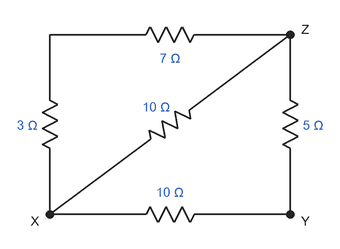 Solve with AI
Answer
(A)
- Correct
(B)
(C)
(D)
Answer: (B)
Key idea: Reduce the network step by step from the side away from the terminals, combining resistors in series (one after another with no junction between) or in parallel (joining the same two points).
Step 1 — Combine the and .
The and meet at the top-left corner, where nothing else is connected, so they are in series between X and Z.
Step 2 — Add the diagonal in parallel.
This and the diagonal both join X to Z, so they are in parallel.
Step 3 — Add the arm ZY in series.
The path from X to Y through Z has followed by the arm.
Step 4 — Add the arm XY in parallel.
The path X–Z–Y and the arm both join X to Y, so they are in parallel.
Why the other options are wrong:
- (A) is wrong: A value of is the path X–Z–Y alone; it leaves out the arm joined directly between X and Y.
- (C) is wrong: A value of cannot occur: even without the diagonal, the path X–Z–Y is at most (), and in parallel with gives only .
- (D) is wrong: A value of is too small: the path X–Z–Y contains the arm in series, so it is at least , and in parallel with already gives about .
Note: In the book's figure both top corners are marked Z. The top-left corner is a separate junction, as the book's own working treats it, and it is drawn unlabelled here.
Therefore, the equivalent resistance between X and Y is 5 Ω: option (B).
- 171 mark
Question 17
Define electromotive force (emf) of a cell.
- 181 mark
Question 18
On what factors does the internal resistance of a cell depend?
- 191 mark
Question 19
What is the principle of a metre bridge?
- 201 mark
Question 20
Of which material is a potentiometer wire normally made?
- 211 mark
Question 21
Name the device used for measuring internal resistance of secondary cell.
- 221 mark
Question 22
The variation of potential difference V with length in case of two potentiometer x and y is as shown in the given figure. Which one of these two will you prefer for comparing emfs of two cells and why?

- 231 mark
Question 23
Why do we prefer a potentiometer with a longer bridge wire?
- 241 mark
Question 24
How can you make a potentiometer of given wire length more sensitive using a resistance box?
- 251 mark
Question 25
A wire of resistance is bent in the form of a circle. What is the effective resistance between the ends of the diameter?
- 261 mark
Question 26
Why a low voltage supply from which one requires high currents must have very low internal resistance?
- 271 mark
Question 27
What is the principle of metre bridge?
- 281 mark
Question 28
Of which material is a potentiometer wire normally made and why?
- 291 mark
Question 29
Distinguish between emf and p.d.
- 301 mark
Question 30
Name the factors on which the emf of a cell depends.
- 311 mark
Question 31
Cells are connected (i) in series, (ii) in parallel and (iii) in mixed grouping. What main purpose is served in each connection?
- 321 mark
Question 32
A cell of emf and internal resistance is connected across a variable resistor . Plot a graph showing the variation of terminal voltage with resistance . Predict from the graph the condition under which becomes equal to .
- 331 mark
Question 33
A variable resistance and a cell of emf and internal resistance are connected in series. Determine the value of such that
(a) The current in the circuit is maximum.
(b) The potential difference across the terminals is maximum.
- 341 mark
Question 34
Why is the emf of a cell measured by the voltmeter not accurate?
- 351 mark
Question 35
Name the factors on which the potential gradient of a potentiometer depends.
- 361 mark
Question 36
What happens to the balance point in the Wheatstone bridge if the position of the cell and the galvanometer are interchanged?
- 371 mark
Question 37
What is lost volt?
- 381 mark
Question 38
Why lost volt is called back emf?
- 391 mark
Question 39
The terminal voltage of a cell is less than its emf. Why?
- 401 mark
Question 40
In series connection of resistors, what is the relation connecting p.d. and resistance?
- 411 mark
Question 41
In parallel connection of resistors what is the relation connecting current and resistance?
- 421 mark
Question 42
What is a shunt?
- 431 mark
Question 43
What is the resistance of an ideal ammeter?
- 441 mark
Question 44
What is the resistance of an ideal voltmeter?
- 451 mark
Question 45
Of which material is a potentiometer wire normally made and why?
- 461 mark
Question 46
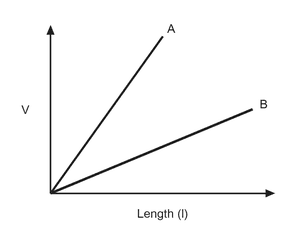
The variation of potential difference with length in case of two potentiometers A and B. Which of the two is preferred to find emf of a cell? Give reason for your answer.
- 472 marks
Question 47
What is meant by emf of a cell? Does it depend on the current passing through the cell?
- 482 marks
Question 48
Show that the potential difference across a cell in an open circuit is equal to the emf of the cell.
- 492 marks
Question 49
How is emf and power related?
- 502 marks
Question 50
What is internal resistance? Name the factors on which the internal resistance depend.
- 512 marks
Question 51
What is an ideal battery? Is it practicable?
- 522 marks
Question 52
Write down the expression for the current passing through a circuit containing a cell of emf , internal resistance and an external resistance .
- 532 marks
Question 53
What is terminal potential difference of a cell?
- 542 marks
Question 54
What is meant by series connection of resistors? Write down the expression for the effective resistance of a number of resistances in series.
- 552 marks
Question 55
Derive an expression for the effective resistance of a number of resistors in parallel.
- 562 marks
Question 56
Explain Kirchhoff’s laws.
- 572 marks
Question 57
State the law in electric networks which expresses the law of conservation of (a) charge and (b) energy.
- 582 marks
Question 58
“No current flows through the galvanometer when the bridge is balanced”. Why?
- 592 marks
Question 59
“The one metre wire used in the metre bridge must be of uniform cross section”. Why?
- 602 marks
Question 60
With a known resistance in one gap and an unknown resistance in the other gap, the metre bridge is balanced. If and are interchanged, will there be any change in the balancing length?
- 612 marks
Question 61
“Wheatstone bridge method is not preferred for the accurate measurement of very low and very high resistances.” Why?
- 622 marks
Question 62
What is meant by sensitivity of Wheatstone bridge?
- 632 marks
Question 63
Draw a labelled diagram of a metre bridge.
- 642 marks
Question 64
Explain the principle of working of a potentiometer.
- 652 marks
Question 65
What is meant by the sensitivity of a potentiometer?
- 662 marks
Question 66
Show that when cells are grouped in series, for getting large current through the external resistance , the internal resistance of the cell must be small compared to .
- 672 marks
Question 67
When the internal resistance of the cell is large, show that for getting large current in the external resistance , the cells must be connected in parallel.
- 682 marks
Question 68
Draw a diagram to show the mixed grouping of cells, consisting of rows, each row containing cells.
- 692 marks
Question 69
Write down the condition for getting maximum current in the mixed grouping of cells.
- 702 marks
Question 70
identical cells are to be connected (i) in series and (ii) in parallel, with an external resistance. Obtain the condition for which the current through the external resistance is the same in the two cases.
- 712 marks
Question 71
identical resistors each are connected (i) in series and (ii) in parallel. The effective resistance in series is and in parallel is . Find the ratio .
- 722 marks
Question 72
Draw the Wheatstone bridge. What is the condition for balancing the bridge?
- 732 marks
Question 73
Draw the circuit diagram of a potentiometer used to determine the internal resistance of a cell. Write down the formula used.
- 742 marks
Question 74
Two cells of emfs and and internal resistance and are connected in series. Write down the equation for the effective emf and equivalent internal resistance .
- 752 marks
Question 75
Write down the equation for the effective emf and equivalent internal resistance when two cells of emfs and and internal resistance and are connected in parallel.
- 763 marks
Question 76
Define the emf of a source. Obtain an equation for the current passing through a circuit. Hence explain (i) back emf and (ii) terminal potential difference.
- 773 marks
Question 77
Derive an expression for equivalent resistance when three resistors are connected in parallel.
- 783 marks
Question 78
Derive an equation for the equivalent emf of two cells of different emf and different internal resistances when they are connected in series.
- 793 marks
Question 79
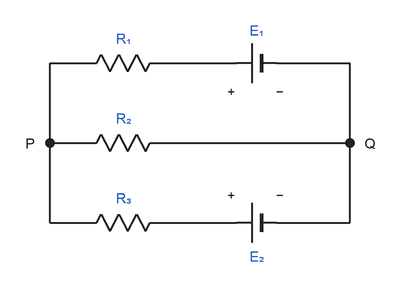
State and explain Kirchhoff’s laws for electric circuits. What are the conservation laws implied in each law? State the sign convention for current and emf. Use the given circuit for your explanation.
- 803 marks
Question 80
Define the emf of a cell in terms of the work done in moving a charge through the cell. Using Joule’s law, obtain the equation, emf .
- 813 marks
Question 81
Obtain the relation for Wheatstone bridge, the symbols have their standard meaning.
- 823 marks
Question 82
Describe an experiment to compare the emf of the given two cells using potentiometer.
- 833 marks
Question 83
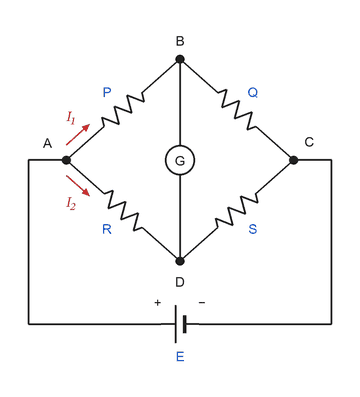
Obtain the balance condition for the Wheatstone bridge arrangement as shown in the given figure.
- 843 marks
Question 84
Draw a labelled diagram of a potentiometer to measure the internal resistance of a cell. Write the working formula (derivation not required).
- 855 marks
Question 85
(a) What is (i) internal resistance of a cell, (ii) back emf and (iii) terminal potential difference?
(b) Obtain an equation for current passing through a cell of emf E and internal resistance r when connected to an external resistance R.
(c) Obtain an equation for the terminal potential difference.
- 865 marks
Question 86
(a) Derive an equation for the equivalent resistance of three resistors when they are connected (i) in series and (ii) in parallel.
(b) Show that when n identical resistors each of value R ohm are connected in series, their equivalent resistance is and when in parallel .
- 875 marks
Question 87
(a) State Kirchhoff’s laws.
(b) Explain the working of Wheatstone bridge with a suitable diagram and hence obtain the condition for the balancing of the bridge.
(c) How will you find the value of unknown resistance using metre bridge?
- 885 marks
Question 88
(a) Explain the principle of a potentiometer.
(b) What is potential gradient of a potentiometer?
(c) How will you compare the emfs of two cells using potentiometer?
- 895 marks
Question 89
(a) What is sensitivity of a potentiometer?
(b) How will you determine the internal resistance of a cell using potentiometer?
- 905 marks
Question 90
cells each of emf and internal resistance are connected in series to form a row, such rows are connected in parallel to form a battery of cells. This battery is connected to an external resistance . (i) What is the emf of this battery and how much is its internal resistance? (ii) Show that the current flowing through the external resistance is given by .
- 913 marks
Question 91
A V battery with a total energy storage of J is used to run a car. The electric motor draws kW of power.
(i) Find the current delivered to the motors.
(ii) If the electric motor draws kW as the car moves at a steady speed of m/s find the distance covered by the car before coming to rest.
- 923 marks
Question 92
A battery of emf V and internal resistance is connected across a load resistance .
(i) If the current in the circuit is A what is the value of ?
(ii) What power is dissipated in the internal resistance of the battery?
- 933 marks
Question 93
The terminal voltage of a battery of emf V and internal resistance is V, when it is delivering a power of W to an external load resistance . Find the value of and .
- 943 marks
Question 94
When a current of A is passed through two resistances in series the potential difference between the ends of the series arrangement is V. On connecting them in parallel and passing a current of A, the p.d. between their ends is V. Calculate the two resistances.
- 953 marks
Question 95
Given three resistances, how can they give a total resistance of , , and ohm.
- 963 marks
Question 96
The resistance of two conductors is and their resistance becomes when connected in parallel. Find the resistance of individual conductors.
- 973 marks
Question 97
When a resistor of resistance is connected in parallel with the resistance of a circuit the current is tripled. What is the resistance of the circuit in the absence of the resistor?
- 983 marks
Question 98
Three resistances , , and are connected in parallel. A current of A passes through the first resistance. Find the total current through the resistances.
- 994 marks
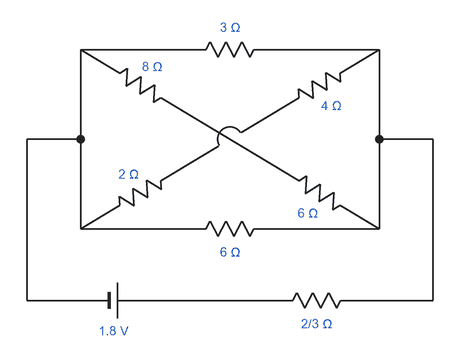
Question 99
For the network shown in the given figure, the emf of the cell is V and its internal resistance is ohm. Calculate the current in the resistor and power losses in the whole circuit.
- 1003 marks
Question 100
Three resistances of , and are connected in parallel. The arrangement is connected in series with another resistance of ohm, an ammeter and a battery of V having an internal resistance of ohm. Find the reading of the ammeter and the strength of current in each of the three resistances connected in parallel.
- 1013 marks
Question 101
When two resistances are connected in series, their effective resistance is and when they are in parallel, the effective resistance is . Calculate the individual resistance.
- 1023 marks
Question 102
A coil has a resistance of . What resistance must be connected in parallel to it, so as to make the resistance of the combination exactly ?
- 1034 marks
Question 103
Eleven equal wires, each of resistance form the edges of an incomplete cube. What is the total resistance between the corners of the vacant edge?

- 1043 marks
Question 104
For the network shown in the given figure, find the effective resistance between the points and , if all the four resistances are the same and equal to ohm each.

- 1053 marks
Question 105
What is the equivalent resistance of the network between the points and ?

- 1063 marks
Question 106
The potential difference across ohm resistance is V as shown in the given figure. Find the potential difference across the points and .

- 1073 marks
Question 107
In the given figure, what is the final voltage across the capacitor?

- 1083 marks
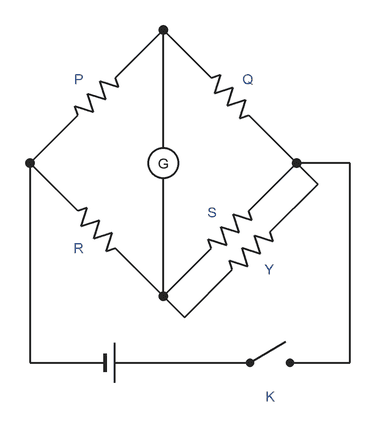
Question 108
A Wheatstone bridge is , . Find the value of the resistance with which the must be shunted such that the bridge is balanced.
- 1093 marks
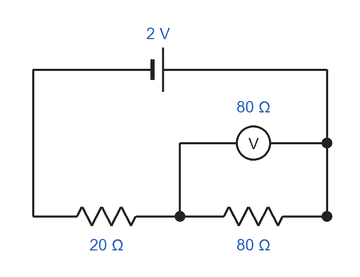
Question 109
In the given figure, the emf of the cell is V and its internal resistance is negligible. The resistance of the voltmeter is . Find the reading of the voltmeter.
- 1104 marks
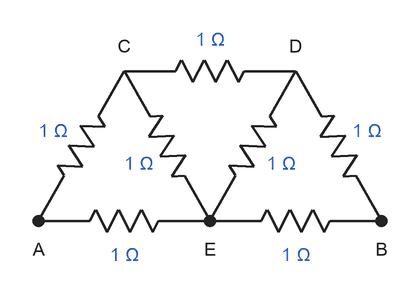
Question 110
For the network shown in the given figure, each resistance is . Find the effective resistance between and .
- 1113 marks
Question 111
A parallel combination of three resistors take a current of A from a V supply. If the two resistors are and , find the third one.
- 1123 marks
Question 112
Find the resistance between (i) and , and (ii) and of the given network.
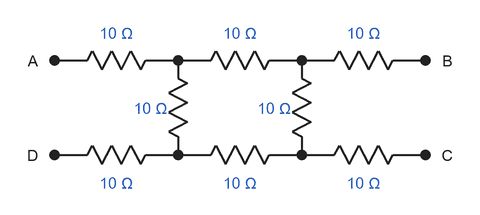
- 1133 marks
Question 113
Find the equivalent resistance of the network between the points and , if each resistance is one ohm.
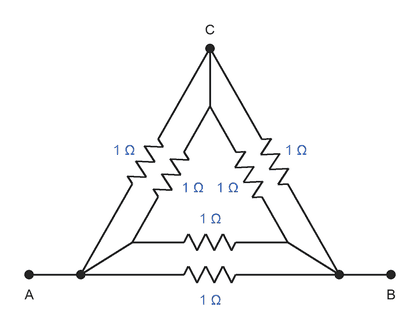
- 1143 marks
Question 114
Resistors of and are connected in series with a V battery. It is desired to measure the current in the circuit. An ammeter of resistance is used for the purpose. What will be the reading in the ammeter? Similarly, if a voltmeter of resistance is used to measure the potential difference across the resistor, what will be the reading of the voltmeter?
- 1154 marks
Question 115
In the given circuit, V, , , . Find the current in and the energy stored in the capacitor.
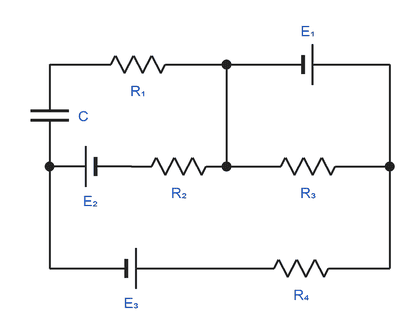
- 1164 marks
Question 116
Consider the two circuits shown in Fig. (a) and (b). Calculate the resistances and such that the current drawn from the batteries is the same in the two cases, but the current through in circuit (b) is reduced to one-tenth of that through in circuit (a).
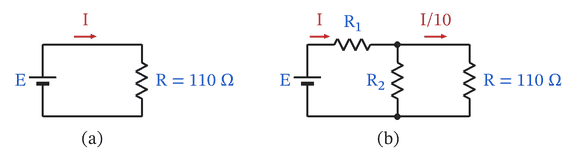
- 1173 marks
Question 117
In the given circuit diagram, the resistance is increased. What will be the effect on the galvanometer () reading, if the internal resistance of the battery is (a) zero and (b) finite?

- 1183 marks
Question 118
A cell of emf V and negligible internal resistance is in series with a m long potentiometer wire and a resistor. The resistance per unit length of the wire is . The p.d. across a length cm of the potentiometer wire balances the emf of V of a standard cell. Find the resistance of the resistor.
- 1193 marks
Question 119
In a method for comparing emfs by a potentiometer the balance point is found to be cm with a Daniell cell of emf V. Where will you get the balance point with a Leclanche cell of emf V?
- 1203 marks
Question 120
With a certain cell the balance point is obtained at cm from the zero end of the potentiometer wire. With another cell whose emf differs from that of the first by V the balance point is obtained at cm mark. Calculate the emf of each cell.
- 1213 marks
Question 121
When cells in series are connected to the ends of a resistance of ohm, the current is found to be A, but when the same cells after being connected in parallel are joined to the ends of a the current is A. Calculate the internal resistance and the emf of each cell.
- 1223 marks
Question 122
Three resistors , and are combined in series.
(a) What is the total resistance of the combination?
(b) If the combination is connected to a battery of emf V and negligible internal resistance, obtain the potential drop across each resistor.
- 1233 marks
Question 123
How would you arrange similar cells each having an emf of V and internal resistance ohm so as to send maximum current through an external resistance of ohm?
- 1243 marks
Question 124
How would you arrange cells each of emf V and internal resistance ohm to send maximum current through an external resistance of ohm? Calculate the value of the current.
- 1253 marks
Question 125
Find the minimum number of cells required to produce an electric current of A through a resistor of , given that the emf of each cell is V and internal resistance of each cell is ohm.
- 1264 marks
Question 126
Three cells of emfs , and are joined in parallel. Their ends are connected to an external resistance as shown in the given figure. If the internal resistance of the cells are , and respectively, find the current through .

What Class 12 Physics Ch 6 covers
The sections of the chapter, in the order the book takes them. Every question above comes from one of these.
- 01EMF and Internal Resistance of a Cell
- 02Terminal Voltage and Lost Volts
- 03Combination of Resistors
- 04Kirchhoff's Laws
- 05Wheatstone Bridge
- 06Metre Bridge
More ways to study this chapter
The same chapter asked three other ways. Practise it, revise it, and see what the board has set on Ch 6 before.
- Competency-Based Questions (CBQ)Case study questions: a situation, and the part of the chapter that answers it.40questionsOpen
- Previous Year QuestionsQuestions that have actually appeared in board papers, each tagged with its year.36questionsOpen
- Practice QuestionsExtra questions per chapter, for when one attempt at a method is not enough.137questionsOpen
Ch 6 in past ISC papers
The same chapter as the board has actually asked it. These are worded differently from the textbook exercise, which is the point of reading them.
- 11 mark
Board paper question 1
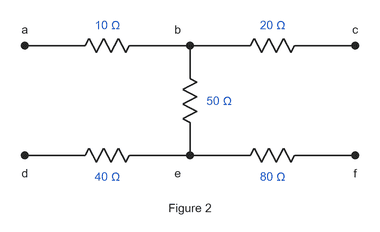
The equivalent resistance between points a and f of the network shown in Figure 2 is:
 Solve with AI
Answer
(A)
(B)
- Correct
(C)
(D)
Answer: (C)
Key idea: A current flows only round a closed path. A resistor joined to an open end (a terminal with nothing connected) carries no current, so it adds nothing to the resistance between the two terminals used.
Step 1 — Find the path from a to f.
Current entering at a passes the resistor to b. Point c is an open end, so the resistor carries no current. From b the current goes down the resistor to e. Point d is also an open end, so the resistor carries no current. From e the current passes the resistor to f.
Step 2 — Add the resistors on this path.
The three resistors on the path are in series, so their resistances add.
Why the others are wrong:
- (A) A value of is less than the resistor alone, yet all the current must pass through that resistor.
- (B) The value is : it uses the resistor in place of the one, but the resistor leads to the open end c and carries no current.
- (D) The value is the sum of all five resistors, but the and resistors carry no current.
Therefore, the equivalent resistance between a and f is , option (C).
- 21 mark
Board paper question 2
A resistor R is connected to a cell of emf e and internal resistance r. Potential difference across the resistor R is found to be V. State the relation between e, V, R and r.
Solve with AIWritten solution
Solution:
Key idea: The emf of a cell equals the potential difference across the external resistor plus the "lost volts" inside the cell, , where is the current.
Step 1 — Write the current through the circuit.
The resistor has a potential difference across it, so by Ohm's law the current is
Step 2 — Add the lost volts inside the cell.
The same current flows through the internal resistance , so the emf is the terminal p.d. plus the drop across .
Step 3 — Write the relation in a neat form.
Taking out as a common factor gives a compact relation, which can also be rearranged for .
Therefore, the relation is , or equivalently .
- 31 mark
Board paper question 3
Three identical cells each of emf and internal resistance are connected in series to form a battery. The battery is then connected to a parallel combination of two identical resistors, each of resistance . Find the current delivered by the battery.
Solve with AIWritten solution
Solution:
Key idea: For identical cells in series, the emfs add and the internal resistances add. The current is the total emf divided by the total resistance (external plus internal).
Step 1 — Find the emf and internal resistance of the battery.
Three cells of and each are joined in series.
Step 2 — Find the external resistance.
Two equal resistors of in parallel give half of one resistor.
Step 3 — Find the current delivered by the battery.
The total resistance in the circuit is the external resistance plus the internal resistance.
Therefore, the battery delivers a current of .
- 43 marks
Board paper question 4
With the help of a labelled diagram, show that the balancing condition of a Wheatstone bridge is:
where the terms have their usual meaning.
Solve with AIWritten solution
Solution:
Key idea: A Wheatstone bridge is four resistors joined in a loop ABCD, with a cell across one diagonal (A to C) and a galvanometer across the other (B to D). The bridge is balanced when the galvanometer shows no current, which happens when B and D are at the same potential.
Step 1 — Draw and label the circuit.
The labelled diagram below shows from A to B, from B to C, from A to D and from D to C. The galvanometer G joins B and D, and the cell E with key K joins A and C.
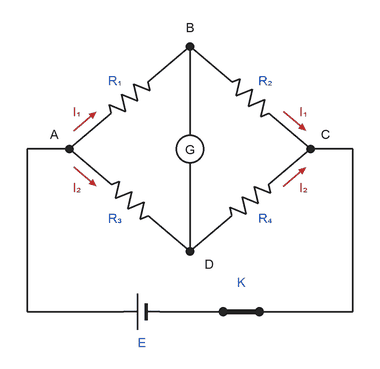
Step 2 — Use the balanced condition.
With the key K closed, the cell drives current through the bridge, and the resistances are adjusted until the galvanometer shows no deflection. Then no current flows through G, so the current entering at A also flows on through . In the same way, the current through also flows on through .
Step 3 — Equate the potential drops from A.
With no current in G, points B and D are at the same potential. So the drop from A to B equals the drop from A to D.
Step 4 — Equate the potential drops to C.
Since , the drop from B to C also equals the drop from D to C.
Step 5 — Divide the two equations.
Dividing equation (1) by equation (2) cancels both currents.
Watch out: The balance condition does not depend on the emf of the cell or on the resistance of the galvanometer, because no current flows through G at balance.
Therefore, at balance , which is the balancing condition of a Wheatstone bridge.
- 53 marks
Board paper question 5
A long uniform metallic wire having a resistance of is used as a potentiometer wire. This wire is connected in series with another resistance of and a battery of emf having negligible internal resistance. If an unknown emf is balanced across of the potentiometer wire, calculate:
(i) the potential gradient across the potentiometer wire.
(ii) the value of the unknown emf .
Solve with AIWritten solution
Solution:
Key idea: The potential gradient of a potentiometer wire is the potential difference across the wire divided by its length. An emf balanced over a length equals .
Step 1 — Find the current in the potentiometer circuit.
The wire () and the series resistance () are joined in series with the battery, whose internal resistance is negligible.
Step 2 — Find the potential difference across the wire.
The current flows through the wire, so by Ohm's law
Step 3 — Find the potential gradient (part (i)).
This potential difference is spread evenly over the wire.
Step 4 — Find the unknown emf (part (ii)).
The emf is balanced across of the wire, so it equals the potential difference across that length.
Therefore, (i) the potential gradient is and (ii) the unknown emf is .
- 61 mark
Board paper question 6
In Figure 3 given below, find the value of resistance x for which points A and B are at the same potential:
 Solve with AI
Written solution
Solution:
Key idea: The network is a Wheatstone bridge. Points A and B are at the same potential when the ratio of the resistances in the upper arm equals the ratio in the lower arm, taken in the same order: .
Step 1 — Write the balance condition for this network.
On the upper path from the left node, comes before A and after it. On the lower path, comes before B and after it. So A and B are at the same potential when
Step 2 — Solve for x.
Cross-multiplying gives a simple equation.
Therefore, A and B are at the same potential when .
All 36 board paper questions for this chapter, solved the same way.
Class 12 Physics Ch 6 questions students ask
How many questions are there in Class 12 Physics Ch 6?
126 questions. Every one is solved step by step on this page.
Are these Class 12 Physics solutions free?
Yes. Every question and its full working is free to read, with no account needed.
Can I download the Class 12 Physics Ch 6 solutions as a PDF?
There is no PDF to download. Every solution is on this page instead, which means it is searchable, always the current syllabus, and readable on a phone. Use your browser's print option if you want it on paper.