Solution:
Key idea: Kirchhoff's laws come from conservation of charge and energy; a Wheatstone bridge is balanced when the galvanometer carries no current, and a metre bridge is a Wheatstone bridge whose two arms are parts of a uniform wire.
Step 1 — State Kirchhoff's laws, part (a).
First law (junction law): the algebraic sum of the currents meeting at a junction is zero (conservation of charge).
∑I=0
Second law (loop law): in any closed loop, the algebraic sum of the IR products equals the algebraic sum of the emfs (conservation of energy).
∑IR=∑E
Step 2 — Describe the working of the Wheatstone bridge, part (b).
Four resistances R1 (AB), R2 (BC), R3 (AD) and R4 (DC) are joined in a quadrilateral, as shown. A cell and key are joined between A and C, and a galvanometer between B and D. One resistance is adjusted until the galvanometer shows no deflection; the bridge is then balanced.

Step 3 — Use the balance condition.
At balance Ig=0, so the current I1 flows through R1 and R2, the current I2 flows through R3 and R4, and B and D are at the same potential. So the fall of potential from A to B equals that from A to D, and the fall from B to C equals that from D to C.
I1R1=I2R3(1)
I1R2=I2R4(2)
Step 4 — Obtain the balance condition.
Dividing (1) by (2) cancels the currents.
R2R1=R4R3
Step 5 — Set up the metre bridge, part (c).
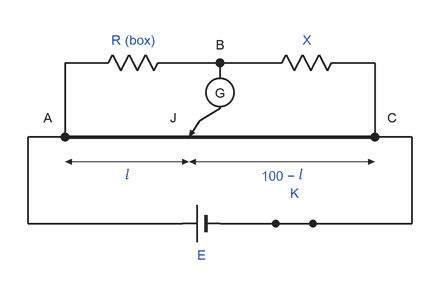
Put a known resistance R (resistance box) in the left gap and the unknown X in the right gap. Join the cell and key across the wire AC, and the galvanometer from the middle terminal B to the jockey J, as shown.
Step 6 — Find the balance point.
Take out a suitable resistance R and slide the jockey along the wire until the galvanometer shows no deflection. Note the balancing length l (in cm) from A.
Step 7 — Calculate the unknown resistance.
The two parts of the uniform wire form the other two arms, with resistances in the ratio l:(100−l), so
XR=100−ll
X=Rl100−l
Repeat with different values of R (keeping the null point near the middle of the wire) and take the mean value of X.
Therefore, (a) ∑I=0 at a junction and ∑IR=∑E round a loop; (b) the Wheatstone bridge is balanced when R2R1=R4R3; (c) the metre bridge gives X=Rl100−l.
