Solution:
Key idea: In series the same current flows through every resistor and the p.d.s add; in parallel the same p.d. acts across every resistor and the currents add.
Step 1 — Find the p.d.s for three resistors in series, part (a)(i).
The resistors R1, R2 and R3 are joined end to end between A and B, as shown, so the same current I flows through each.
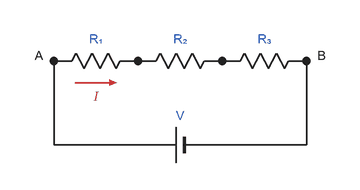
By Ohm's law the p.d.s are IR1, IR2 and IR3, and the total p.d. V is their sum.
V=IR1+IR2+IR3
V=I(R1+R2+R3)
Step 2 — Compare with one equivalent resistor in series.
A single resistor Rs with the same current and p.d. has V=IRs. Comparing:
Rs=R1+R2+R3
Step 3 — Find the currents for three resistors in parallel, part (a)(ii).
Now R1, R2 and R3 are joined between the same two points A and B, as shown, so the same p.d. V acts across each.
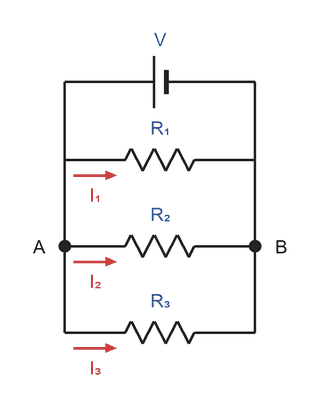
The branch currents are R1V, R2V and R3V. Charge is conserved at A, so the main current is their sum.
I=R1V+R2V+R3V
I=V(R11+R21+R31)
Step 4 — Compare with one equivalent resistor in parallel.
A single resistor Rp with the same current and p.d. has I=RpV. Comparing and cancelling V:
Rp1=R11+R21+R31
Step 5 — Apply the results to n identical resistors, part (b).
For n resistors each of value R in series, the series rule adds n equal terms.
Rs=R+R+⋯+R
Rs=nR
In parallel, the parallel rule adds n equal reciprocals.
Rp1=R1+R1+⋯+R1
Rp1=Rn
Rp=nR
Therefore, (a) Rs=R1+R2+R3 and Rp1=R11+R21+R31; (b) for n identical resistors Rs=nR and Rp=nR.
