Solution:
Key idea: The emf of a cell is shared between the external resistance and the cell's own internal resistance; energy conservation gives the current and the terminal p.d.
Step 1 — Define internal resistance, part (a)(i).
The internal resistance r of a cell is the resistance offered by its electrolyte and electrodes to the current flowing inside the cell.
Step 2 — Define back emf, part (a)(ii).
The back emf is the p.d. Ir needed to drive the current I through the internal resistance r. It acts against the emf of the cell and reduces the voltage available outside, so it is also called the lost volts.
Step 3 — Define terminal potential difference, part (a)(iii).
The terminal potential difference is the p.d. between the terminals of a cell while it sends a current through the external circuit.
Step 4 — Obtain the current, part (b).
The cell (emf E, internal resistance r) is joined to an external resistance R, as shown.
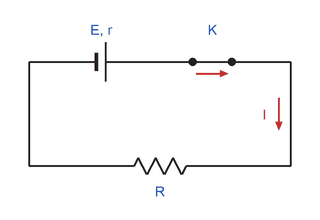
The cell gives energy E to each unit of charge, and this is used up as IR in the external resistance and Ir in the internal resistance. By conservation of energy:
E=IR+Ir
E=I(R+r)
I=R+rE
Step 5 — Obtain the terminal p.d., part (c).
The terminal p.d. is the p.d. across R.
V=IR
V=E−Ir
Putting in the current from Step 4:
V=R+rER
So V is less than E while current flows, and V equals E on open circuit (R very large, I=0).
Note: The name "lost volts" is more exact for Ir, since it is a potential drop and not an emf; the term back emf is more often used for the opposing emf of a running motor or of a cell being charged.
Therefore, the current is I=R+rE and the terminal potential difference is V=E−Ir, or V=R+rER.
