
Question 843 marksEasy
Draw a labelled diagram of a potentiometer to measure the internal resistance of a cell. Write the working formula (derivation not required).
Confirming your payment
Sign up now and get 250 free tokens.
Direct Current Circuits · Question 84 of 126
Draw a labelled diagram of a potentiometer to measure the internal resistance of a cell. Write the working formula (derivation not required).
Solution:
Key idea: A potentiometer measures the emf of a cell when it gives no current, and its terminal p.d. when it sends a current through a known resistance ; the internal resistance follows from the two balancing lengths.
Step 1 — Draw the circuit.
The labelled diagram is shown below.
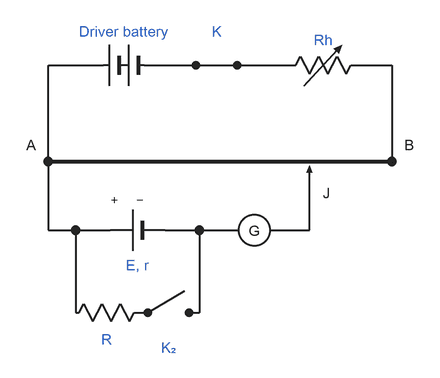
Step 2 — Describe the connections.
AB is the potentiometer wire, joined to a driver battery, key K and rheostat Rh, with the driver's positive terminal at A. The cell of emf and internal resistance has its positive terminal at A and its negative terminal joined through the galvanometer G to the jockey J. A resistance box with key is joined across the cell.
Step 3 — Take the two readings.
With open the balancing length is (this balances the emf). With closed the cell sends a current through , and the balancing length is (this balances the terminal p.d.).
Step 4 — Write the working formula.
The internal resistance is found from
Therefore, the working formula is , with and the balancing lengths with open and closed.