
Question 885 marksMedium
(a) Explain the principle of a potentiometer.
(b) What is potential gradient of a potentiometer?
(c) How will you compare the emfs of two cells using potentiometer?
Confirming your payment
Sign up now and get 250 free tokens.
Direct Current Circuits · Question 88 of 126
(a) Explain the principle of a potentiometer.
(b) What is potential gradient of a potentiometer?
(c) How will you compare the emfs of two cells using potentiometer?
Solution:
Key idea: When a steady current flows along a uniform wire, the potential falls evenly along it; an unknown emf is balanced against the p.d. across a measured length of the wire.
Step 1 — State the principle, part (a).
When a steady current flows through a wire of uniform cross-section and resistivity , the p.d. across any length of the wire is proportional to . By Ohm's law:
Since , and are constant, is proportional to . An unknown emf is balanced against the fall of potential along a length of the wire, and at balance no current is drawn from it.
Step 2 — Define the potential gradient, part (b).
The potential gradient is the fall of potential per unit length of the potentiometer wire.
From Step 1 it also equals , and its unit is .
Step 3 — Set up the circuit to compare emfs, part (c).
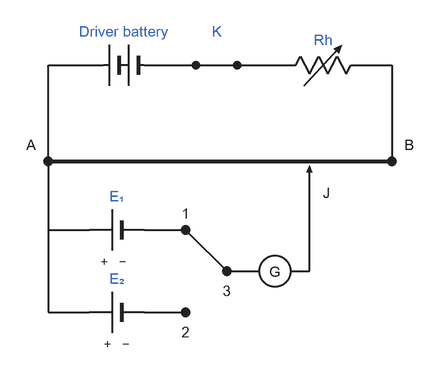
Join the driver battery (emf greater than both cells), key K and rheostat across the wire AB, with its positive terminal at A. Join the positive terminals of both cells to A, and their negative terminals through a two-way key and a galvanometer to the jockey, as shown.
Step 4 — Balance each cell in turn.
With in the circuit, find the null point and its balancing length . Then, without changing the rheostat, put in the circuit and find its balancing length .
Step 5 — Divide to compare the emfs.
The potential gradient is the same for both, so it cancels.
Therefore, (a) the p.d. across a length of a uniform current-carrying wire is proportional to that length; (b) the potential gradient is the fall of potential per unit length, ; (c) the emfs compare as .