
Question 895 marksMedium
(a) What is sensitivity of a potentiometer?
(b) How will you determine the internal resistance of a cell using potentiometer?
Confirming your payment
Sign up now and get 250 free tokens.
Direct Current Circuits · Question 89 of 126
(a) What is sensitivity of a potentiometer?
(b) How will you determine the internal resistance of a cell using potentiometer?
Solution:
Key idea: On a potentiometer a p.d. balances a length ; measuring both the emf and the terminal p.d. of a cell gives its internal resistance.
Step 1 — Define the sensitivity, part (a).
A potentiometer is sensitive if it can measure very small potential differences, that is, if a small p.d. gives a large balancing length. Since , the sensitivity is greater when the potential gradient is smaller, for example with a longer wire or a smaller current in the wire.
Step 2 — Set up the circuit, part (b).
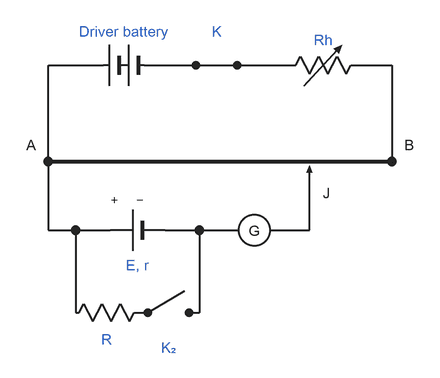
Join the driver circuit (battery, key K, rheostat) across the potentiometer wire AB, with its positive terminal at A. Join the cell (emf , internal resistance ) with its positive terminal to A and its negative terminal through the galvanometer to the jockey. Join a resistance box and key across the cell, as shown.
Step 3 — Balance the emf.
With open the cell gives no current. Find the balancing length :
Step 4 — Balance the terminal p.d.
Close so that the cell sends a current through . Find the balancing length for the terminal p.d. :
Step 5 — Relate the two readings to .
Dividing the two balance equations:
Since and , the same ratio is
Step 6 — Solve for the internal resistance.
Equating the two expressions for :
Therefore, (a) a potentiometer is more sensitive the smaller its potential gradient, and (b) the internal resistance is from the balancing lengths with open and closed.