
Question 763 marksMedium
Define the emf of a source. Obtain an equation for the current passing through a circuit. Hence explain (i) back emf and (ii) terminal potential difference.
Confirming your payment
Sign up now and get 250 free tokens.
Direct Current Circuits · Question 76 of 126
Define the emf of a source. Obtain an equation for the current passing through a circuit. Hence explain (i) back emf and (ii) terminal potential difference.
Solution:
Key idea: By conservation of energy, the work a cell does on each unit of charge equals the energy that charge gives up in the external resistance and in the cell's own internal resistance.
Step 1 — Define the emf of a source.
The emf of a source is the work done by the source in taking a unit positive charge through it from its negative terminal to its positive terminal. This is the energy given to each unit of charge that goes once round the circuit. If work is done on charge :
It equals the terminal p.d. of the source on open circuit.
Step 2 — Obtain the equation for the current.
A cell of emf and internal resistance drives a current through an external resistance , as shown.
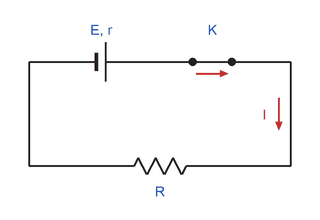
Each unit of charge gives up energy in the external resistance and in the internal resistance. These must add up to the energy the cell gave it.
Step 3 — Explain the back emf, part (i).
The term is the p.d. used up inside the cell in driving the current through its internal resistance. It acts against the emf, reducing the voltage available outside the cell, so it is called the back emf (or lost volts).
Step 4 — Explain the terminal potential difference, part (ii).
The terminal potential difference is the p.d. across the terminals of the cell while it gives current, which is the p.d. across .
It is less than the emf by the back emf , and equals on open circuit ().
Note: The name "lost volts" is more exact for , since it is a potential drop and not an emf; the term back emf is more often used for the opposing emf of a running motor or of a cell being charged.
Therefore, the current is ; the back emf (lost volts) is , and the terminal potential difference is .