
Question 773 marksEasy
Derive an expression for equivalent resistance when three resistors are connected in parallel.
Confirming your payment
Sign up now and get 250 free tokens.
Direct Current Circuits · Question 77 of 126
Derive an expression for equivalent resistance when three resistors are connected in parallel.
Solution:
Key idea: Resistors in parallel all have the same p.d. across them, and the main current is the sum of the branch currents because charge is conserved at a junction.
Step 1 — Note what is the same for the three resistors.
The resistors , and are joined between the same two points A and B, as in the figure, so the p.d. across each is the same.
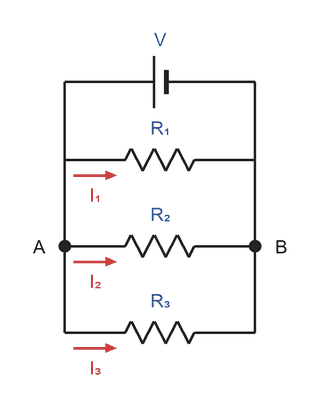
Step 2 — Find the branch currents by Ohm's law.
Each resistor has the p.d. across it, so
Step 3 — Add the branch currents.
The main current divides at A and joins again at B. No charge collects at A, so the main current is the sum of the three.
Step 4 — Compare with one equivalent resistor.
A single resistor carrying the same current with the same p.d. satisfies
Equating the two expressions for and cancelling :
Step 5 — Compare with the separate resistances.
The right-hand side is larger than any one of its terms, such as , so is smaller than each of , and .
Therefore, for three resistors in parallel , and the equivalent resistance is less than the smallest of the three.