
Question 461 markEasy
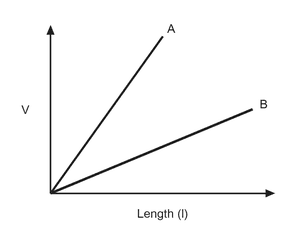
The variation of potential difference with length in case of two potentiometers A and B. Which of the two is preferred to find emf of a cell? Give reason for your answer.
Confirming your payment
Sign up now and get 250 free tokens.
Direct Current Circuits · Question 46 of 126
The variation of potential difference with length in case of two potentiometers A and B. Which of the two is preferred to find emf of a cell? Give reason for your answer.
Solution:
Key idea: For a potentiometer the graph of against is a straight line through the origin, and its slope is the potential gradient . The smaller the gradient, the longer the balancing length for a given emf, and the more sensitive the potentiometer.
Step 1 — Compare the slopes.
Line A is steeper than line B, so potentiometer A has the larger potential gradient and potentiometer B the smaller one.
Step 2 — See how the gradient affects a measurement.
A cell of emf balances at a length that is inversely proportional to the gradient.
With the smaller gradient of B, the balancing length is longer. The same small error in reading the length is then a smaller fraction of it, and a small change in emf moves the balance point further, so B is more sensitive and more accurate.
Step 3 — Choose the potentiometer.
For comparing emfs we want the more sensitive instrument, which is B.
Therefore, potentiometer B is preferred, because its smaller potential gradient (smaller slope) makes it more sensitive and gives longer, more accurate balancing lengths.