
Opening your dashboard
Class 12 Physics Chapter 6 Direct Current Circuits: Competency-Based Questions (CBQ)
40 questions on Chapter 6, each worked through on its own page with the AI tutor. Class 12 Physics, ICSE 2026-27.
40 questions
1–4 marks · Mixed difficulty
- 11 mark
Question 1
Competency: Analysis & Evaluation
In a class discussion, one student describes the written on a torch cell as "the push of the cell", while another describes it in terms of energy.
Assertion (A): The emf of a cell is the work done by the cell per unit positive charge in taking the charge once round the complete circuit, including the cell itself.
Reason (R): The emf of a cell is the force with which the cell pushes the charges round the circuit.
- 23 marks
Question 2
Competency: Application
A smartphone battery is marked ", ". Treat it as a single cell of emf and internal resistance . The rating means that it can deliver a current of for hour.
(a) Find the total charge, in coulombs, that the battery can send round a circuit when fully charged.
(b) Using the meaning of emf, find the chemical energy converted into electrical energy when all this charge flows.
(c) The phone switches itself off if the terminal p.d. of the battery falls below . Find the largest current the phone can draw. As the battery ages, its internal resistance doubles. What is the largest current then?
(Hypothetical data.)
- 31 mark
Question 3
Competency: Analysis & Evaluation
On a very cold winter morning in Shimla, a car's starter motor turns the engine more slowly than on a warm afternoon, even though the battery is fully charged. A mechanic checks the battery on both days by connecting the same fixed test resistor across its terminals.
Assertion (A): On the cold morning, the fully charged battery sends a smaller current through the fixed test resistor than it does on the warm afternoon.
Reason (R): The internal resistance of a cell increases when its temperature falls.
- 43 marks
Question 4
Competency: Application
A school's emergency lantern has a battery of emf and internal resistance . It has two identical bulbs, each of resistance (assume constant). A switch lets you light one bulb, or both bulbs connected in parallel.
(a) With one bulb on, find the current from the battery and the terminal p.d.
(b) With both bulbs on, find the current from the battery, the terminal p.d. and the current in each bulb.
(c) Find the power of one bulb in each case, and explain why each bulb glows less brightly when both are on.
(Hypothetical data.)
- 51 mark
Question 5
Competency: Analysis & Evaluation
A shopkeeper tests two cells, one new and one that has been lying in a drawer for years, with a high-resistance voltmeter. Both read . He concludes that both will work equally well in a torch.
Assertion (A): Two cells that give the same reading on a high-resistance voltmeter will always light the same torch bulb equally brightly.
Reason (R): The lost volts of a cell are equal to the product of the current drawn from it and its internal resistance.
- 61 mark
Question 6
Competency: Application
The battery pack of an electric car has an emf of and an internal resistance of . During hard acceleration, the motor controller draws from it. What percentage of the power produced by the pack is turned into heat inside the pack itself? (Hypothetical data.)
- 73 marks
Question 7
Competency: Application
The rear-window demister of a car has identical heating strips printed on the glass. They are connected in parallel across the car battery (treat it as having negligible internal resistance). Each strip has a resistance of .
(a) Find the equivalent resistance of the demister, the current it draws and its total power.
(b) One strip cracks, so no current flows in it. Find the new total current and power. What happens to the power of each of the other strips?
(c) Find the total power if the same strips had instead been joined in series across the battery, and say why the designer used the parallel arrangement.
(Hypothetical data.)
- 81 mark
Question 8
Competency: Application
A frost alarm for a tea garden uses a thermistor in series with a fixed resistor of across a battery of negligible internal resistance. The alarm unit reads the p.d. across the fixed resistor and draws negligible current. The thermistor's resistance is at and at . At , the p.d. across the fixed resistor is (Hypothetical data.)
- 91 mark
Question 9
Competency: Analysis & Evaluation
All the appliances in a house are connected in parallel across the mains. An electrician notices that switching on even a small night-lamp, whose resistance is very large, slightly increases the total current drawn from the mains.
Assertion (A): Connecting an extra resistor in parallel with a circuit always lowers the equivalent resistance, however large that resistor is.
Reason (R): For resistors in parallel, , so every extra branch adds a positive term to .
- 103 marks
Question 10
Competency: Application
A metro line runs on d.c. A train on a section of track is fed from both ends: substation keeps its end at and substation keeps its end at (treat both as ideal sources). The resistance of the supply rail and return path from to the train is , and from the train to it is . The train draws a current of .

(a) Taking and as the currents flowing from and from to the train, write the equation given by Kirchhoff's first law at the train.
(b) Using Kirchhoff's second law, find and .
(c) Find the voltage at the train.
(Hypothetical data.)
- 111 mark
Question 11
Competency: Application
A battery of negligible internal resistance is connected in series with a resistor and a resistor. The resistor is joined to the positive terminal and the resistor to the negative terminal. The junction of the two resistors is earthed, so its potential is zero.

The potential of the negative terminal of the battery is
- 121 mark
Question 12
Competency: Analysis & Evaluation
A student joins resistors of , and in series with a cell, and places ammeters before, between and after the resistors. All the ammeters show the same reading.
Assertion (A): In a single closed loop carrying a steady current, the current is the same in every resistor, whatever its resistance.
Reason (R): In a series loop, the p.d. across each resistor is proportional to its resistance.
- 134 marks
Question 13
Competency: Analysis & Evaluation
On a fishing boat, a battery of emf and internal resistance runs a cabin lamp of resistance and a bilge pump, connected in parallel between and as shown. While it is running, the pump's motor behaves like an opposing emf of in series with a resistance of . The power taken by this opposing emf is the mechanical power of the pump.

(a) Using Kirchhoff's laws, find the p.d. between and and the current in the battery, the lamp and the pump.
(b) Find the mechanical power of the pump and the heat produced per second in its coil.
(c) The pump jams, so its opposing emf becomes zero. Find the new power of the lamp and compare it with its earlier power.
(Hypothetical data.)
- 143 marks
Question 14
Competency: Application
An underground two-core cable is long; each core has a resistance of per km. Core 1 has developed a fault at an unknown point , where it touches the earthed sheath. To locate it, an engineer joins the two cores together at the far end and sets up the bridge shown (the Murray loop test): ratio arms and go from to the near ends and of the cores, a galvanometer joins and , and a battery is connected between and earth. and are adjusted until the galvanometer shows no deflection.

(a) Name the four arms of this Wheatstone bridge, and write the balance condition in terms of the distance (in km) from to the fault.
(b) Balance is obtained with and . Find .
(c) The resistance of the earth path between the fault and the battery is not known. Explain why it does not affect the result.
(Hypothetical data.)
- 153 marks
Question 15
Competency: Analysis & Evaluation
A methane detector in a coal mine uses two identical platinum filaments in the same chamber. Methane burns on the surface of the "active" filament and heats it; the "compensating" filament is coated so that methane cannot burn on it. and form two adjacent arms of a Wheatstone bridge, with fixed arms , as shown. The bridge is fed by a supply of negligible internal resistance, and a high-resistance voltmeter (drawing negligible current) is connected between and .

(a) In clean air, . Show that the voltmeter reads zero.
(b) In air containing methane, rises to while stays at . Find the voltmeter reading.
(c) On a warm day both filaments rise to in clean air. What does the voltmeter read? Use this to explain why the compensating filament is used.
(Hypothetical data.)
- 161 mark
Question 16
Competency: Analysis & Evaluation
A student measures the resistance of a coil with a Wheatstone bridge whose balance condition is . She sets the ratio arms to and ; is a resistance box that changes in steps of . The galvanometer deflects to the left when and to the right when . What can she conclude about ? (Hypothetical data.)
- 173 marks
Question 17
Competency: Application
To find the temperature coefficient of resistance of copper, a student puts a coil of insulated copper wire, dipped in a water bath, in the left gap of a metre bridge. A standard manganin resistor, kept at room temperature, is in the right gap. With the water at , the balance point is from the left end; at it is . Take .
(a) Find the resistance of the coil at .
(b) Find the resistance of the coil at .
(c) Find for copper. Why is the standard resistor made of manganin and kept out of the bath?
(Hypothetical data.)
- 181 mark
Question 18
Competency: Analysis & Evaluation
In a metre bridge experiment with a cell, a student finds the balance point at from the left end. Her partner replaces the cell by a battery, without changing the resistors in the two gaps. The new balance point is at (Hypothetical data.)
- 191 mark
Question 19
Competency: Analysis & Evaluation
During a metre bridge experiment, the galvanometer's leads are accidentally interchanged after the balance point has been found.
Assertion (A): Interchanging the two terminals of the galvanometer shifts the balance point of a metre bridge.
Reason (R): At the balance point, the jockey and the junction of the two gaps are at the same potential.
- 203 marks
Question 20
Competency: Application
A potentiometer is used to check the accuracy of an ammeter. The potentiometer wire is long. A standard cell of emf balances at . The ammeter is then connected in series with a standard resistor of , a rheostat and a battery. When the ammeter reads , the p.d. across the standard resistor balances at . The current in the potentiometer wire is kept the same throughout.
(a) Find the potential gradient of the wire.
(b) Find the true current, and the error in the ammeter reading.
(c) Why is the p.d. across the standard resistor measured with the potentiometer and not with a voltmeter connected across it?
(Hypothetical data.)
- 211 mark
Question 21
Competency: Application
A standard resistor of and an unknown resistor are joined in series and carry a steady current. On a potentiometer, the p.d. across the resistor alone balances at , and the p.d. across the resistor and together balances at . The value of is (Hypothetical data.)
- 221 mark
Question 22
Competency: Analysis & Evaluation
Two cells of the same emf, one with an internal resistance of and the other with , are tested one after the other on the same potentiometer, without changing the driver circuit.
Assertion (A): The two cells give the same balancing length, although their internal resistances are different.
Reason (R): The potential gradient along a potentiometer wire depends on the emf of the cell being tested.
- 233 marks
Question 23
Competency: Analysis & Evaluation
For a science fair, students make "potato cells" with a zinc and a copper strip in each potato. Each potato cell has an emf of and an internal resistance of . They want to run a small digital clock, which behaves as a resistor and needs a p.d. of at least .
(a) Find the p.d. across the clock when it is run by a single potato cell.
(b) Find the least number of potato cells that must be joined in series to run the clock.
(c) A student suggests joining many potato cells in parallel instead. Show that this can never run the clock.
(Hypothetical data.)
- 241 mark
Question 24
Competency: Application
A power-bank designer wants the pack to stay cool while fast-charging a phone at . She builds it from four identical lithium-ion cells, each with an internal resistance of , joined in parallel, so that they share the current equally. How much heat is produced per second inside the whole pack? (Hypothetical data.)
- 251 mark
Question 25
Competency: Analysis & Evaluation
A solar-lantern maker joins four identical rechargeable cells in parallel, positive terminal to positive terminal.
Assertion (A): The emf of the parallel combination is the same as the emf of one cell.
Reason (R): The internal resistance of identical cells in parallel is .
- 264 marks
Question 26
In the circuit shown, the cells have emfs and , and the resistors in their branches include the internal resistances.

(i) Using Kirchhoff's laws, find the current in each of the three branches, with its direction.
(ii) Show that the cell is being charged.
(iii) Show that the power supplied by equals the power taken in by plus the total heat produced per second in the resistors.
- 274 marks
Question 27
In the circuit shown, the cell has an emf of and negligible internal resistance. The galvanometer arm has a resistance of .

(a) Show that the bridge is not balanced.
(b) Using Kirchhoff's laws, find the current in the galvanometer arm and state its direction.
(c) Find the current drawn from the cell.
- 284 marks
Question 28
The copper strips and joints of a metre bridge add resistances equal to those of extra lengths at end and at end of the bridge wire (end corrections). With in the left gap and in the right gap, the balance point is from . When the two resistors are interchanged, it is from . (Hypothetical data.)
(a) Find and .
(b) A coil in the left gap and in the right gap give a balance point from . Find with the end corrections, and without them.
- 293 marks
Question 29
The emf of a cell is V. On connecting a resistance across the cell, the terminal potential difference falls to V. Calculate the internal resistance of the cell.
- 303 marks
Question 30
Two identical cells, whether joined in series or in parallel give the same current when connected to external resistance of . Find the internal resistance of each cell.
- 313 marks
Question 31
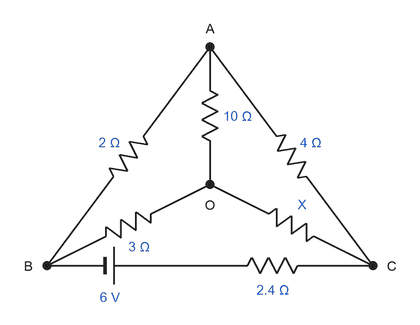
Find the value of the unknown resistance in the circuit if no current flows through the section . Also calculate the current drawn from the battery of emf V and negligible internal resistance.
- 323 marks
Question 32
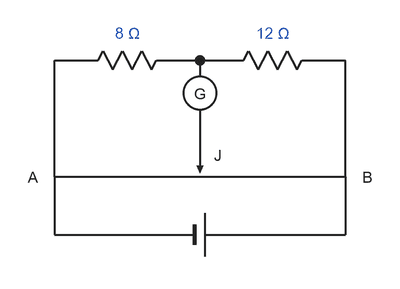
The wire of a slide wire bridge, shown in the given figure, is cm long. Where should the free end of the galvanometer be connected on , so that the galvanometer shows zero deflection?
- 333 marks
Question 33
With a certain cell, the balance point is obtained at cm from the end of a potentiometer wire. With another cell, whose emf differs from that of first by V, the balance point is obtained at cm. Find the emf of each cell.
- 344 marks
Question 34
If the galvanometer in the given circuit reads zero,
(a) calculate the value of resistor , assuming that the V source has negligible internal resistance.
(b) If cool air is blown across the wire-wound resistor, what effect will be noticed and why?

- 354 marks
Question 35
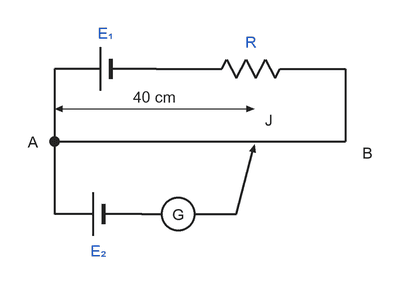
In the given circuit diagram, is a uniform wire of resistance and length m. It is connected to a series arrangement of cell of emf V and negligible internal resistance and a resistor . Terminal is also connected to an electrochemical cell of emf mV and a galvanometer . In this set up, a balancing point is obtained at cm mark from . Calculate the resistance of . If were to have a emf of mV, where will you expect the balance point to be?
- 364 marks
Question 36
The length of a potentiometer wire is cm and it carries a current of mA. For a cell of emf V and internal resistance the null point is formed to be at cm. If a voltmeter is connected across the cell, the balancing length decreases by cm. Find
(a) the resistance of the potentiometer wire,
(b) the reading of the voltmeter and
(c) the resistance of the voltmeter.
- 373 marks
Question 37
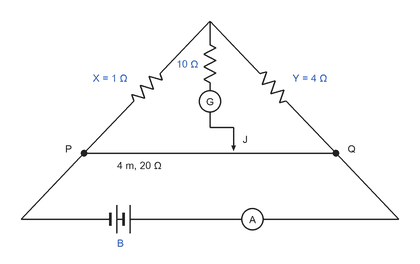
In the given circuit, is a uniform metallic wire of length m and resistance . Battery has an emf of V and internal resistance of . is a jockey or slide contact. Resistance of the ammeter and the connecting wire is negligible.
(i) When the jockey does not touch the wire what is the reading of the ammeter ?
(ii) Where should the jockey be pressed on the wire so that the galvanometer shows no deflection?
- 383 marks
Question 38
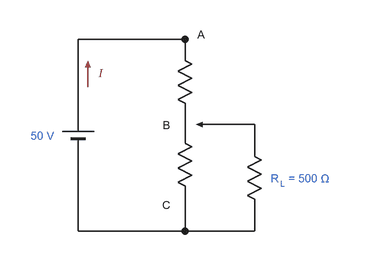
A variable rheostat of k is used to control the p.d. across a load . If the resistance is what is the p.d. across ? If is removed, what should be the resistance to get V between and ?
- 391 mark
Question 39
Competency: Application
A town's automatic street-light controller uses a light-dependent resistor (LDR), whose resistance rises as the light falls. The LDR forms the arm of a Wheatstone bridge whose other arms are , and ; the bridge is balanced when . As the evening light fades, the controller switches the lights on at the moment the bridge passes through balance. The LDR's resistance at four light levels is given below.
Light level (lux) Resistance of LDR () (Hypothetical data.)
The street lights switch on when the light level falls to about
- 403 marks
Question 40
Competency: Analysis & Evaluation
A village solar d.c. microgrid stores energy in two battery banks, and , each of emf (treat both as ideal). The negative terminal of is joined to the positive terminal of , and a neutral wire runs from this joint to the village. The houses of Street 1, taken together, behave as a resistor connected between the line from the positive terminal of and the neutral wire. The houses of Street 2 behave as a resistor connected between the neutral wire and the line from the negative terminal of . All appliances are rated for , and the connecting wires have negligible resistance. Treat both loads as fixed resistors.
(a) Find the current in each street's load. Use Kirchhoff's junction rule to find the current in the neutral wire, and state its direction.
(b) One evening the neutral wire snaps near the battery banks, while both lines stay connected. Find the p.d. across each street's load now.
(c) Which street's appliances are at risk of damage after the break, and why? A technician suggests putting a fuse in the neutral wire for extra safety. Evaluate this suggestion.
(Hypothetical data.)