
Question 321 markEasy
A cell of emf and internal resistance is connected across a variable resistor . Plot a graph showing the variation of terminal voltage with resistance . Predict from the graph the condition under which becomes equal to .
Confirming your payment
Sign up now and get 250 free tokens.
Direct Current Circuits · Question 32 of 126
A cell of emf and internal resistance is connected across a variable resistor . Plot a graph showing the variation of terminal voltage with resistance . Predict from the graph the condition under which becomes equal to .
Solution:
Key idea: The terminal voltage of the cell is the p.d. across , which is the current multiplied by .
Step 1 — Write as a function of .
We multiply the current by the external resistance.
Step 2 — Find how changes with .
For the terminal voltage is zero (short circuit).
For the terminal voltage is .
Dividing the top and bottom by shows what happens for large :
As increases, gets smaller and gets closer to , but it never exceeds .
Step 3 — Plot the graph.
The graph rises steeply from the origin and then bends over towards the dashed line at without crossing it.
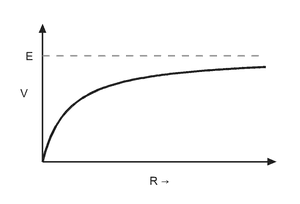
Step 4 — Read the condition from the graph.
The curve reaches only when becomes zero, that is when is infinitely large (open circuit, no current drawn).
Therefore, V rises from 0 towards E as R increases, and V becomes equal to E only when R is infinite (open circuit, no current drawn).