
Question 43 marksAsked 2015Medium
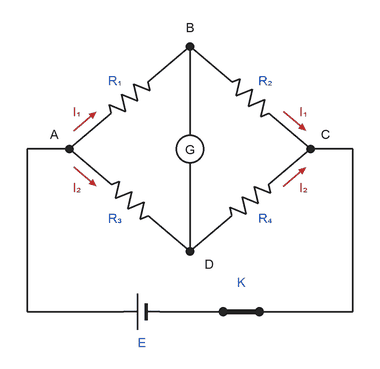
With the help of a labelled diagram, show that the balancing condition of a Wheatstone bridge is:
where the terms have their usual meaning.
Confirming your payment
Sign up now and get 250 free tokens.
Previous Year Questions · Question 4 of 36
With the help of a labelled diagram, show that the balancing condition of a Wheatstone bridge is:
where the terms have their usual meaning.
Solution:
Key idea: A Wheatstone bridge is four resistors joined in a loop ABCD, with a cell across one diagonal (A to C) and a galvanometer across the other (B to D). The bridge is balanced when the galvanometer shows no current, which happens when B and D are at the same potential.
Step 1 — Draw and label the circuit.
The labelled diagram below shows from A to B, from B to C, from A to D and from D to C. The galvanometer G joins B and D, and the cell E with key K joins A and C.
Step 2 — Use the balanced condition.
With the key K closed, the cell drives current through the bridge, and the resistances are adjusted until the galvanometer shows no deflection. Then no current flows through G, so the current entering at A also flows on through . In the same way, the current through also flows on through .
Step 3 — Equate the potential drops from A.
With no current in G, points B and D are at the same potential. So the drop from A to B equals the drop from A to D.
Step 4 — Equate the potential drops to C.
Since , the drop from B to C also equals the drop from D to C.
Step 5 — Divide the two equations.
Dividing equation (1) by equation (2) cancels both currents.
Watch out: The balance condition does not depend on the emf of the cell or on the resistance of the galvanometer, because no current flows through G at balance.
Therefore, at balance , which is the balancing condition of a Wheatstone bridge.