
Question 823 marksEasy
Describe an experiment to compare the emf of the given two cells using potentiometer.
Confirming your payment
Sign up now and get 250 free tokens.
Direct Current Circuits · Question 82 of 126
Describe an experiment to compare the emf of the given two cells using potentiometer.
Solution:
Key idea: On a potentiometer an emf is balanced by the p.d. across a length of the wire, , so with the same potential gradient the ratio of two emfs equals the ratio of their balancing lengths.
Step 1 — Set up the circuit.
The circuit is shown below.
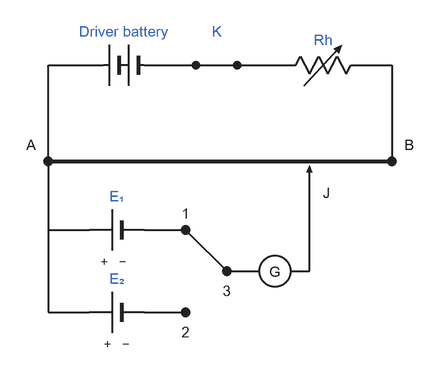
A driver battery, key K and rheostat Rh are joined across the potentiometer wire AB, with the driver's positive terminal at A. The positive terminals of the two cells and are joined to A. Their negative terminals go to terminals 1 and 2 of a two-way key, whose common terminal 3 is joined through a galvanometer G to the jockey J. The emf of the driver battery must be greater than both and .
Step 2 — Balance the first cell.
Close K and put the plug between 1 and 3, so that is in the circuit. Slide the jockey along the wire until the galvanometer shows no deflection, and note the balancing length .
Step 3 — Balance the second cell.
Without changing the rheostat, move the plug to between 2 and 3, so that is in the circuit, and find its balancing length .
Step 4 — Divide to compare the emfs.
The potential gradient is the same in both, so it cancels.
Step 5 — Improve the result.
Repeat for a few different rheostat settings and take the mean of the ratios. Since no current is drawn from either cell at balance, the true emfs are compared.
Therefore, the emfs are compared from their balancing lengths on the same potentiometer wire: .