
Opening your dashboard
Class 12 Physics Chapter 6 Direct Current Circuits: Practice Questions
137 questions on Chapter 6, each worked through on its own page with the AI tutor. Class 12 Physics, ICSE 2026-27.
137 questions
1–3 marks · Mixed difficulty
- 11 mark
Question 1
Which one of the following changes will decrease the internal resistance of a simple voltaic cell?
- 23 marks
Question 2
A student connects a cell to a rheostat, an ammeter and a high-resistance voltmeter (across the cell), and records the terminal p.d. for different currents . (Hypothetical data.)
(A) (V) (i) Show that falls by equal amounts for equal increases in , and find the internal resistance of the cell.
(ii) Find the emf of the cell.
(iii) Estimate the current if the terminals of the cell were joined by a thick copper wire of negligible resistance.
- 31 mark
Question 3
A cell of emf and internal resistance drives a steady current of through a torch bulb for minutes. The chemical energy converted into electrical energy by the cell in this time is
- 43 marks
Question 4
A battery of internal resistance is connected to a resistor of . (Hypothetical data.)
(i) Find the current in the circuit.
(ii) The efficiency of the battery is the fraction of the power supplied by the battery that reaches the external resistor. Show that the efficiency is and find its value here.
(iii) How much heat is produced inside the battery in one minute?
- 51 mark
Question 5
A rechargeable cell of emf and internal resistance is being charged by a current from a charger. Which statement about the cell is correct?
- 63 marks
Question 6
A torch bulb of resistance (assume it stays constant) is lit by a dry cell. When the cell is new, its emf is and its internal resistance is . After months of use, its emf is and its internal resistance is . (Hypothetical data.)
(i) Find the current and the power in the bulb with the new cell.
(ii) Find the current and the power in the bulb with the old cell.
(iii) The bulb is much dimmer with the old cell. Which change in the cell is mainly responsible, the fall in emf or the rise in internal resistance? Support your answer with a calculation.
- 71 mark
Question 7
A high-resistance voltmeter connected across a car battery reads when nothing is switched on. When the starter motor is operated, it draws and the voltmeter reading drops to . The internal resistance of the battery is (Hypothetical data.)
- 83 marks
Question 8
The graphs of terminal p.d. (on the -axis) against current (on the -axis) for two cells and are straight lines. The line for meets the -axis at and, when extended, meets the -axis at . The line for meets the -axis at and, when extended, meets the -axis at . (Hypothetical data.)
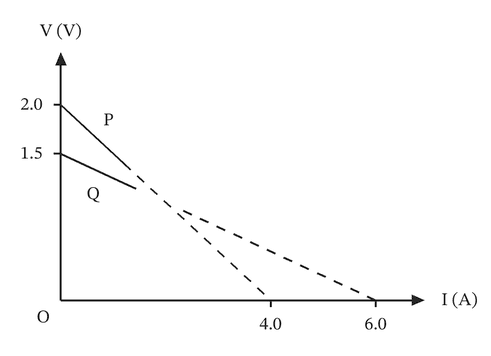
(i) Find the emf and the internal resistance of each cell.
(ii) At what current do the two cells have the same terminal p.d.? What is this p.d.?
(iii) Which cell gives the larger terminal p.d. when each supplies a current of ?
- 91 mark
Question 9
A resistor is connected across a cell of emf and internal resistance . The lost volts are found to be one-fifth of the emf. Then
- 103 marks
Question 10
A student connects a voltmeter of resistance directly across an old cell of emf and internal resistance . (Hypothetical data.)
(i) What does the voltmeter read? By what percentage is this less than the emf?
(ii) What is the least resistance the voltmeter should have so that its reading is less than the emf by no more than ?
- 111 mark
Question 11
A cell of emf and internal resistance (not zero) is connected to an external resistor . If is doubled, the terminal p.d. of the cell
- 123 marks
Question 12
A battery of emf and internal resistance is to deliver a power of to an external resistor . (Hypothetical data.)
(i) Show that there are two possible values of , and find them.
(ii) For each value, find the current and the terminal p.d.
(iii) Which value of would you choose? Give a reason.
- 132 marks
Question 13
In the circuit shown, the cell has an emf of and negligible internal resistance. The current in the resistor is .
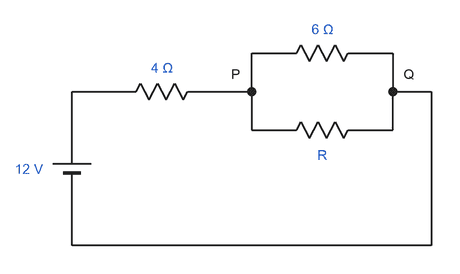
Find (i) the current drawn from the cell and (ii) the resistance .
- 143 marks
Question 14
A student has a large supply of identical resistors, each of which can safely dissipate at most . The student needs a combination of total resistance that can safely dissipate . (Hypothetical data.)
(i) Explain why at least four resistors are needed.
(ii) Show how four of them can be connected to give .
(iii) Show that, when this combination dissipates , each resistor dissipates exactly , and find the total current.
- 151 mark
Question 15
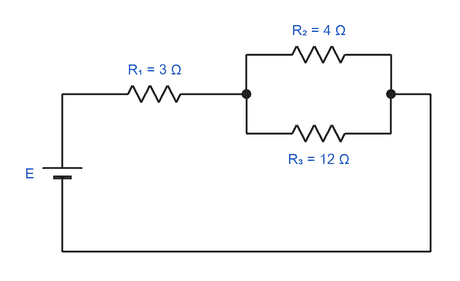
In the circuit shown, which resistor dissipates the greatest power?
- 163 marks
Question 16
A string of identical decorative bulbs is connected in series to a supply. Each bulb has a resistance of (assume it stays constant). (Hypothetical data.)
(i) Find the current in the string and the power of each bulb.
(ii) One bulb fuses. Someone joins the two wires of its holder together so that the remaining bulbs light again. Find the new current and the new power of each bulb.
(iii) By what percentage has the power of each bulb increased? What effect will this have on the bulbs?
- 172 marks
Question 17
In the network shown, a wire of negligible resistance is joined from to the far end of the resistor.

(i) Find the equivalent resistance between and .
(ii) A battery of negligible internal resistance is connected across and . Find the current in each resistor.
- 181 mark
Question 18
Two resistors connected in parallel across a battery carry currents in the ratio . If the same two resistors are connected in series across the battery, the p.d.s across them are in the ratio
- 193 marks
Question 19
Six identical resistors of each form the sides of a regular hexagon , as shown.
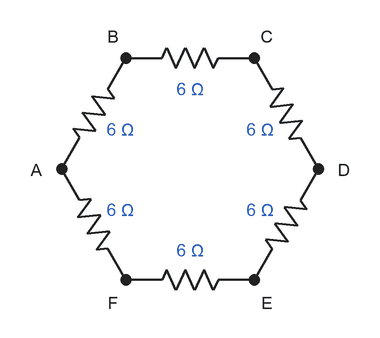
Find the equivalent resistance between (i) and , (ii) and , (iii) and .
- 201 mark
Question 20
Four wires meet at a junction . Currents of and flow towards in two of the wires, and a current of flows away from in the third. The current in the fourth wire is
- 211 mark
Question 21
Going round a closed loop, you first cross a resistor in the same direction as the current in it, and then cross a cell of emf (negligible internal resistance) from its negative to its positive terminal. The total change in potential over these two steps is
- 223 marks
Question 22
In the circuit shown, the cells have emfs and ; the and resistors include their internal resistances. The resistance is adjusted until no current flows through the cell .
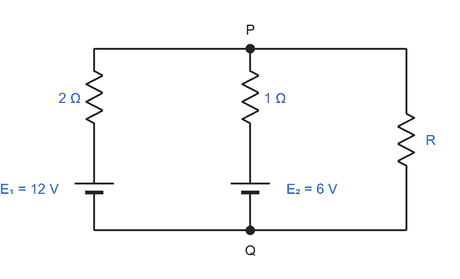
Using Kirchhoff's laws, find (i) the p.d. between and , (ii) the current through , (iii) the value of and the power dissipated in it.
- 231 mark
Question 23
While solving a circuit with Kirchhoff's laws, a student assumes that a current flows clockwise in one branch, and finds . This means that
- 243 marks
Question 24
Two separate loops are joined by a single wire that contains a cell, as shown. All cells have negligible internal resistance.

(i) Use Kirchhoff's first law to explain why no current flows in the wire .
(ii) Find the current in each loop.
(iii) Find the potential difference .
- 251 mark
Question 25
The Wheatstone bridge shown is balanced. The resistance of the arm is then increased slightly, with nothing else changed. The current in the galvanometer now flows

- 263 marks
Question 26
A platinum resistance thermometer forms the arm of a Wheatstone bridge whose ratio arms are . The thermometer's resistance is at and varies as , with . With the thermometer dipped in a hot liquid, the bridge balances when the variable arm is set to . (Hypothetical data.)
(a) Find the resistance of the thermometer at balance.
(b) Find the temperature of the liquid.
- 271 mark
Question 27
A Wheatstone bridge with arms , , and is balanced, so that . Which one of the following changes will upset the balance?
- 281 mark
Question 28
A strain gauge of resistance forms the arm of a Wheatstone bridge. The ratio arms are , and the bridge is balanced with the variable arm . When a load is applied, the resistance of the gauge increases by . To restore the balance, must now be set to (Hypothetical data.)
- 292 marks
Question 29
A resistor marked is tested with a Wheatstone bridge. It forms the arm ; the ratio arms are and , and the bridge balances when the variable arm is . Find the resistance of the resistor and state whether it is within its tolerance. (Hypothetical data.)
- 303 marks
Question 30
In a metre bridge experiment, a length of nichrome wire of diameter is placed in the left gap, and a standard resistance of in the right gap. The balance point is found from the left end of the bridge wire. (Hypothetical data.)
(a) Find the resistance of the nichrome wire.
(b) Find the resistivity of nichrome.
- 311 mark
Question 31
In a metre bridge experiment, the galvanometer deflects to the same side whether the jockey touches the wire near end or near end . The most likely cause is that
- 323 marks
Question 32
In a metre bridge, the unknown resistance is found from , where is known exactly and the balancing length (in cm) can be read only to . (Hypothetical data.)
(a) Show that the maximum percentage error in is .
(b) Find this error when and when .
(c) Hence state where the balance point should preferably lie.
- 331 mark
Question 33
A copper coil is in the left gap of a metre bridge and a standard resistor is in the right gap. The balance point is at , measured from end on the left. If the coil warms up during the experiment, the balance point
- 342 marks
Question 34
In a metre bridge, a uniform wire in the left gap balances a resistor in the right gap at from the left end. The wire is cut into two equal halves, which are joined in parallel and put back in the left gap. Find the new balance point. (Hypothetical data.)
- 351 mark
Question 35
A potentiometer wire of length and resistance is joined in series with a rheostat set at and a driver cell of emf and negligible internal resistance. The largest emf that can be measured with this potentiometer is
- 363 marks
Question 36
A potentiometer wire is long and has a resistance of . It is driven by an accumulator of emf and negligible internal resistance, through a resistance box in series. (Hypothetical data.)
(a) What resistance must be taken in the box so that the potential gradient along the wire is ?
(b) With this setting, the emf of a thermocouple is balanced by of the wire. Find the emf.
(c) Why is such a small potential gradient chosen for measuring a thermocouple emf?
- 371 mark
Question 37
In a potentiometer experiment, the positive terminals of the driver cell and of the cell under test are both joined to end . Yet no balance point is found, because the emf of the test cell is more than the p.d. across the whole wire. Which change can not help to obtain a balance point?
- 383 marks
Question 38
A cell of internal resistance gives a balancing length of on a potentiometer when no current is drawn from it. (Hypothetical data.)
(a) What resistance must be connected across the cell so that the balancing length becomes ?
(b) If the emf of the cell is , find the current drawn from it and its terminal p.d. in that case.
- 391 mark
Question 39
A potentiometer wire is joined directly across a driver cell of negligible internal resistance (no rheostat), and a cell under test balances at a length . The wire is now replaced by one of the same material and thickness but twice as long, joined across the same driver cell. The new balancing length for the same test cell is
- 403 marks
Question 40
In the potentiometer circuit shown, the wire is long with a resistance of . The driver cell has an emf of and an unknown internal resistance ; there is no rheostat. A cell of emf is balanced at . (Hypothetical data.)
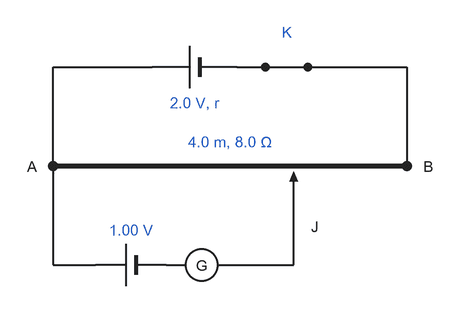
(a) Find the potential gradient along .
(b) Find the current in , and hence .
(c) Where would the balance point be if were negligible?
- 413 marks
Question 41
With a standard cell of emf in the secondary circuit, a potentiometer balances at . The standard cell is then replaced by a test cell, which balances at . (Hypothetical data.)
(a) Find the potential gradient and the emf of the test cell, assuming the current in the potentiometer wire stayed constant.
(b) In fact the driver cell was running down, and the current in the wire fell by between the two readings. Find the true emf of the test cell.
(c) State one precaution that avoids this error.
- 423 marks
Question 42
Six identical cells, each of emf and internal resistance , are arranged in parallel rows, each row having cells in series. The battery supplies a heater coil. (Hypothetical data.)
(a) Find the emf and the internal resistance of this battery.
(b) For what resistance of the coil is the power in it greatest? Find this power.
(c) What fraction of the total power produced by the cells is then wasted inside the battery?
- 431 mark
Question 43
Four identical cells, each of emf and internal resistance , are joined in series across a resistor. (Hypothetical data.) If one of the cells is put in the wrong way round, the current in the resistor becomes
- 443 marks
Question 44
A new cell (emf , internal resistance ) drives a current through a resistor. A run-down cell (emf , internal resistance ) is then added in series with it, correctly connected. (Hypothetical data.)
(a) Find the current in the resistor before and after the run-down cell is added.
(b) Find the terminal p.d. of the run-down cell when it is in the circuit, and explain what the result shows.
- 453 marks
Question 45
A car battery of emf and internal resistance is joined in parallel (positive to positive, negative to negative) with a flat battery of emf and internal resistance , using leads of negligible resistance. Nothing else is connected. (Hypothetical data.)
(a) Find the current that flows, and state which battery it charges.
(b) Find the common terminal p.d. of the two batteries.
(c) Find the equivalent emf and internal resistance of the pair, and check your answer to (b).
- 461 mark
Question 46
A battery is made of identical cells in series, each of emf and internal resistance . If its terminals are joined by a thick wire of negligible resistance, the current is
- 473 marks
Question 47
Two cells, each of emf , with internal resistances and , are joined in parallel and connected to an external resistor of . (Hypothetical data.)
(a) Find the equivalent emf and internal resistance of the combination.
(b) Find the current in the external resistor and the current supplied by each cell.
- 481 mark
Question 48
The emf of a cell is the work done per unit charge. Is this work done by an electrostatic force or non-electrostatic force?
- 491 mark
Question 49
“The internal resistance of a low voltage supply must be low”. Why?
- 501 mark
Question 50
The internal resistance of a high voltage supply must be high. Why?
- 511 mark
Question 51
What is an ideal battery?
- 521 mark
Question 52
“Kirchhoff’s law is preferred over Ohm’s law”. Why?
- 531 mark
Question 53
Can we apply Kirchhoff’s law to both a.c. and d.c.?
- 541 mark
Question 54
“Kirchhoff’s laws are related to certain conservation laws”. Name them.
- 551 mark
Question 55
“Wheatstone bridge method of determination of resistance is considered to be more accurate than the voltmeter-ammeter method”. Why?
- 561 mark
Question 56
For making the Wheatstone bridge most sensitive, how it should be arranged?
- 571 mark
Question 57
Wheatstone bridge is not suitable for measuring very low resistance. Why?
- 581 mark
Question 58
“Wheatstone bridge is not suitable for measuring high resistance”. Why?
- 591 mark
Question 59
“A metre bridge is also called a slide wire bridge”. Why?
- 601 mark
Question 60
“It is better to get the null point in the middle of the wire in a metre bridge”. Why?
- 611 mark
Question 61
What is meant by end-correction for a metre bridge?
- 621 mark
Question 62
Why a potentiometer is called so?
- 631 mark
Question 63
“Which is preferred for measuring emf of a cell, a voltmeter or a potentiometer”. Why?
- 641 mark
Question 64
“The potentiometer wire must be long and of uniform thickness”. Why?
- 651 mark
Question 65
What do you mean by potential gradient of a potentiometer?
- 661 mark
Question 66
For accurate measurements, using a potentiometer, length of the wires must be longer. Why?
- 671 mark
Question 67
“While performing experiments with potentiometer (or metre bridge) the jockey should not be rubbed against the wire”. Why?
- 683 marks
Question 68
Two resistors are in the ratio . If these are connected in parallel, this total resistance becomes . Find the value of each resistance.
- 693 marks
Question 69
A parallel combination of three resistors takes a current of A from a V supply. If the two resistors are of ohm and ohm, find the value of the third one.
- 701 mark
Question 70
Name the two conservation laws implied in Kirchhoff's laws for electric current.
- 712 marks
Question 71
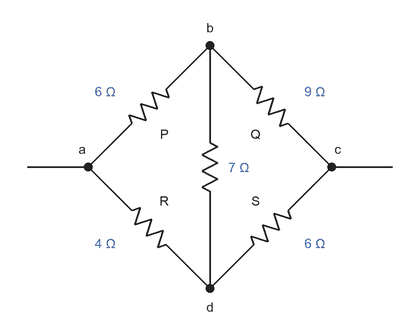
Find the equivalent resistance between the points and of the given network of resistors.
- 722 marks
Question 72
The resistance of a galvanometer is . It is converted into (a) a voltmeter using a k resistor and (b) an ammeter using a m resistor. Calculate the resistance of the voltmeter and the ammeter to an accuracy of two significant figures only.
- 732 marks
Question 73
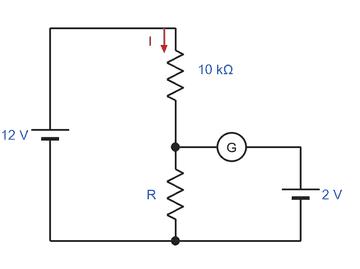
If the galvanometer in the circuit reads zero, find the value of the resistor . The V source is resistance free.
- 742 marks
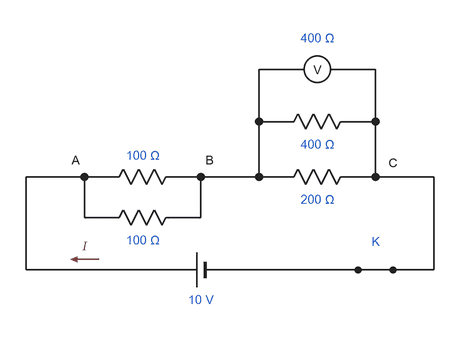
Question 74
Given that the resistance of voltmeter is . Find the reading of the voltmeter.
- 751 mark
Question 75
An ammeter and a voltmeter are joined in series to a cell. Their readings are A and V respectively. A resistance is now joined parallel with the voltmeter. Then,
- 761 mark
Question 76
A resistance wire connected in the left gap of metre bridge balances a resistance in the right gap at a point which divides the bridge wire in the ratio . If the length of the resistance wire is , then the length of of the resistance wire is
- 771 mark
Question 77
The rows each containing cells in series are joined in parallel. Maximum current is taken from this combination across an external resistance of . If the total number of cells used is 24 and internal resistance of each cell is , then
- 781 mark
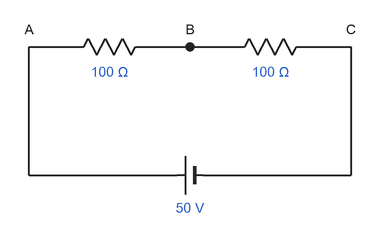
Question 78
Consider the given diagram. A voltmeter of resistance is connected across A and B. The potential drop across B and C measured by voltmeter is
- 791 mark
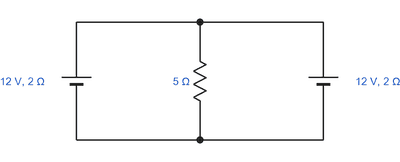
Question 79
In the given arrangement, the current through resistor is
- 801 mark
Question 80
For the current provided by a battery (a combination of cells) to be maximum, how should the cells be grouped?
- 811 mark
Question 81
The potentiometer is best for measuring voltage as
- 821 mark
Question 82
Kirchhoff's I and II laws are based on conservation of
- 831 mark
Question 83
In a Wheatstone bridge, all the four arms have an equal resistance . If the resistance of the galvanometer arm is also , the equivalent resistance of the combination as seen by the battery is
- 841 mark
Question 84
Three bulbs of , and are connected in series with a supply. Which bulb has the minimum resistance?
- 851 mark
Question 85
The potentiometer consists of a wire of length and resistance of . It is connected to a cell of emf . The potential difference per unit length of the wire will be
- 861 mark
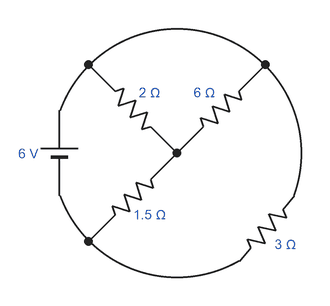
Question 86
The total current supplied to the circuit by the battery is
- 871 mark
Question 87
In a Wheatstone bridge, three resistances P, Q and R are connected in the three arms and the fourth arm is formed by two resistances and connected in parallel. The condition for the bridge to be balanced will be
- 881 mark
Question 88
An electric current is passed through a circuit containing two wires of the same material, connected in parallel. If the lengths and radii of the wires are in the ratio of and , then the ratio of the currents passing through the wire will be
- 891 mark
Question 89
A cell whose emf is and internal resistance is , is connected with a resistance of . The voltage across the cell terminal will be
- 901 mark
Question 90
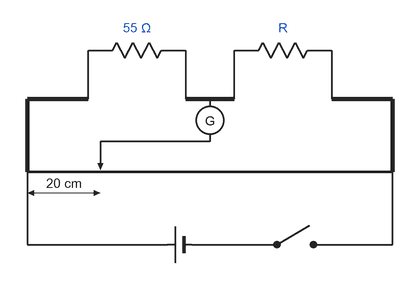
The given figure shows a meter-bridge set up with null deflection in the galvanometer. The value of the unknown resistor R is
- 911 mark
Question 91
The length of a wire of a potentiometer is , and the emf of its standard cell is volt. It is employed to measure the emf of a battery whose internal resistance is . If the balance point is obtained at from the positive end, the emf of the battery is
- 921 mark
Question 92
In a metre bridge experiment, null point is obtained at from one end of the wire when resistance X is balanced against another resistance Y. If , then where will be the new position of the null point from the same end, if one decides to balance a resistance of against Y?
- 931 mark
Question 93
In an electrical cable, there is a single wire of radius of copper. Its resistance is . The cable is replaced by 6 different insulated copper wires, the radius of each wire is . Now the total resistance of the cable will be
- 941 mark
Question 94
Three identical bulbs connected in series across an accumulator consumes power. If the bulbs are connected in parallel to the same source, the power consumed is
- 951 mark
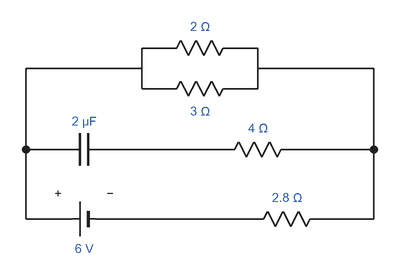
Question 95
In the given figure, the capacity of the condenser, C is . The current in resistor is
- 961 mark
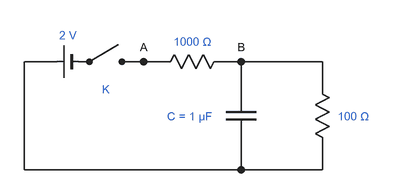
Question 96
When the key K is pressed at time , which of the following statements about the current I in the resistor AB of the given circuit is true? (Resistance of AB .)
- 971 mark
Question 97
Two cells of equal emf and of internal resistances and are connected in series. On connecting this combination to an external resistance R, it is observed that the potential difference across the first cell becomes zero. The value of R will be
- 981 mark
Question 98
A potentiometer is an accurate and versatile device to make electrical measurements of emf because the method involves
- 991 mark
Question 99
The resistance of the series combination of two resistances is S. When they are joined in parallel, the total resistance is P. If , then the minimum possible value of is
- 1001 mark
Question 100
In the given circuit, the readings of the ammeter and voltmeter are

- 1011 mark
Question 101
A uniform metallic wire has a resistance of and is bent into an equilateral triangle. Then, the resistance between any two vertices of the triangle is
- 1021 mark
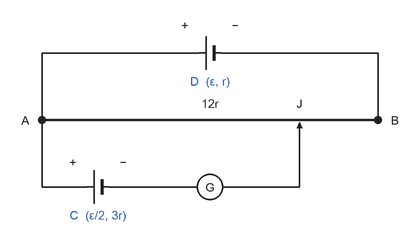
Question 102
A potentiometer wire AB having length and resistance is joined to a cell D of emf and internal resistance . A cell C having emf and internal resistance is connected. The length AJ at which the galvanometer, as shown in the figure, shows no deflection is
- 1031 mark
Question 103
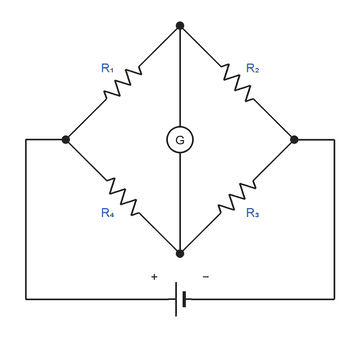
The Wheatstone bridge shown in the given figure gets balanced when the carbon resistor used as has the colour code (Orange, Red, Brown). The resistor and are and , respectively. Assuming that the colour code for the carbon resistors gives their accurate values, the colour code for the carbon resistor, used as , would be
- 1041 mark
Question 104
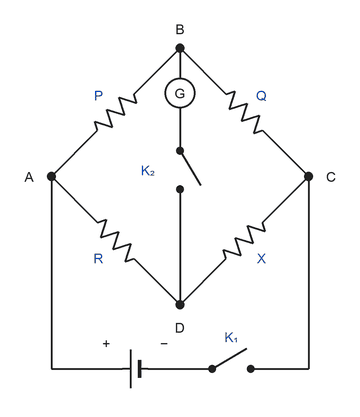
In a Wheatstone bridge as shown in the given figure, resistances P and Q are approximately equal. When , the bridge is balanced. On interchanging P and Q, the value of R, for balance, is . The value of X is close to
- 1051 mark
Question 105
Two equal resistance when connected in series to a battery, consume electric power of . If these resistances are now connected in parallel combination to the same battery, the electric power consumed will be
- 1061 mark
Question 106
A circuit consisting of five resistors each of resistance R, forming a Wheatstone bridge. What is the equivalent resistance of the circuit?
- 1071 mark
Question 107
Find the voltage drop across a capacitor connected with a resistance and a battery of in series after a long time.
- 1081 mark
Question 108
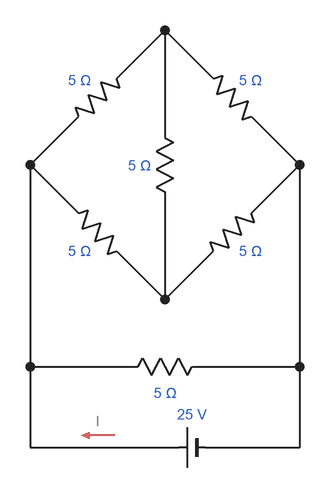
Calculate I for the given circuit diagram
- 1091 mark
Question 109
The equivalent resistance between the points X and Y in the given circuit diagram will be

- 1101 mark
Question 110
Two batteries of emf and with internal resistance and respectively are connected to an external resistance . The current in circuit and the potential difference between P and Q respectively will be

- 1111 mark
Question 111
A potentiometer has uniform potential gradient across it. Two cells connected in series (i) to support each other and (ii) to oppose each other are balanced over and respectively on the potentiometer wire. The emfs of the cells are in the ratio of
- 1121 mark
Question 112
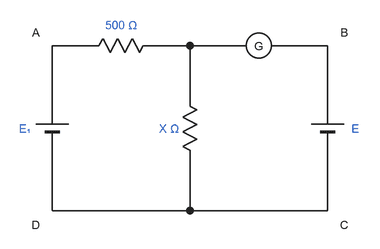
In the given circuit, the battery has an emf of volt and zero internal resistance while the battery E has an emf of Volt. If the galvanometer G reads zero, then the value of the resistance X in ohm is
- 1131 mark
Question 113
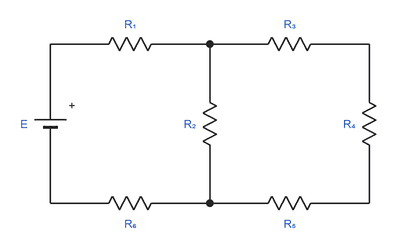
In the given figure, what is the current (in ampere) drawn from the battery? You are given: , , , , , ,
- 1141 mark
Question 114
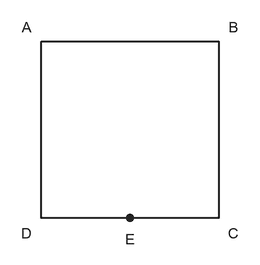
A wire of resistance R is bent to form a square ABCD as shown in the figure. The effective resistance between E and C is (E is mid-point of arm CD)
- 1151 mark
Question 115
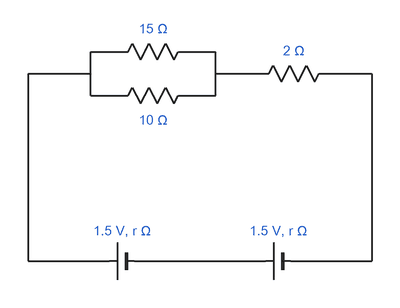
In the given circuit, an ideal voltmeter connected across the resistance reads . The internal resistance r, of each cell is
- 1161 mark
Question 116
A metal wire of resistance is elongated to make a uniform wire of double its previous length. This new wire is now bent and the ends joined to make a circle. If two points on this circle make an angle at the centre, the equivalent resistance between these two points will be
- 1171 mark
Question 117
A current flows through a resistor when connected across a battery. The same battery supplies a current when connected across a resistor. The internal resistance of the battery is
- 1181 mark
Question 118
To draw maximum current from a combination of cells, how should the cells be grouped
- 1191 mark
Question 119
A cell of internal resistance r drives current through an external resistance R, the power delivered by the cell to the external resistance will be maximum when
- 1201 mark
Question 120
The resistive network shown in the given figure is connected to a DC source of . The power consumed by the network is watt. The value of R is

- 1211 mark
Question 121
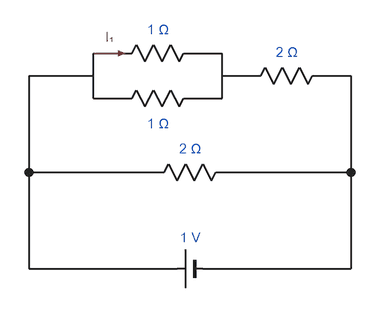
The current (in A) flowing through resistor in the circuit is
- 1221 mark
Question 122
The current I in the given network is
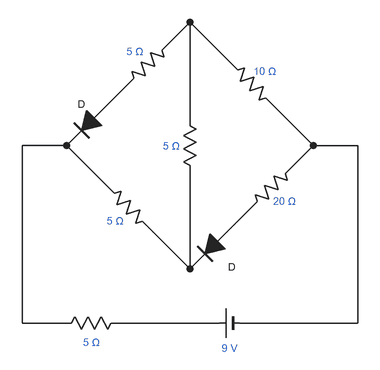
- 1231 mark
Question 123
The length of a potentiometer wire is and it carries a current of . For a cell of emf and internal resistance of , the null point on it is found to be at . The resistance of whole wire is
- 1241 mark
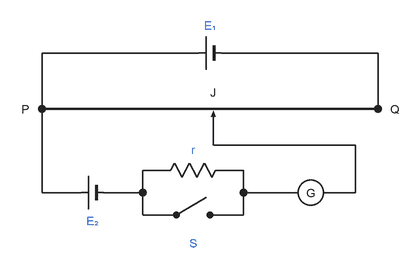
Question 124
A potentiometer wire PQ of length is connected to a standard cell . Another cell of emf is connected with a resistance r and switch S (as shown in the given figure). With switch S open, the null position is obtained at a distance of from Q. The potential gradient in the potentiometer wire is
- 1251 mark
Question 125
Two resistors and are connected in series across a battery. The potential difference measured by a voltmeter of across resistor is close to
- 1261 mark
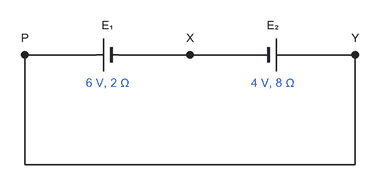
Question 126
A cell of emf and internal resistance is connected with another cell of emf and internal resistance . The potential difference across points X and Y is
- 1271 mark
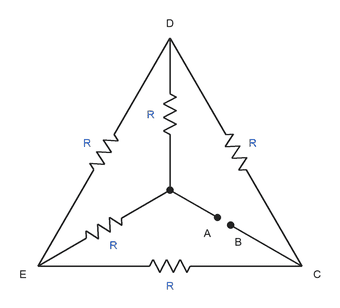
Question 127
Five equal resistances are connected in a network as shown in the given figure. The net resistance between the points A and B is
- 1281 mark
Question 128
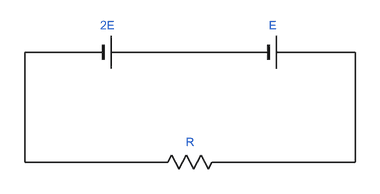
Two cells of emf and with internal resistance and respectively are connected in series to an external resistance R. The value of R, at which the potential difference across the terminals of the first cell becomes zero
- 1291 mark
Question 129
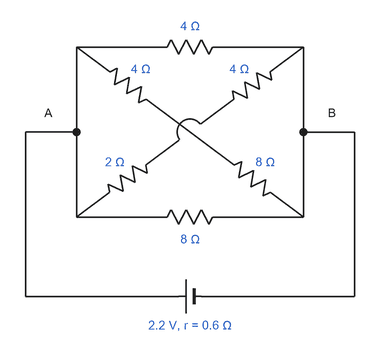
In the given figure, the emf of the cell is and internal resistance is . Calculate the power dissipated in the whole circuit.
- 1301 mark
Question 130
What equal length of an iron wire and a copper-nickel alloy wire, each of diameter connected parallel to give an equivalent resistance of ? (Given resistivities of iron and copper-nickel alloy wire are and , respectively.)
- 1311 mark
Question 131
If you are provided a set of resistances , and . Connect these resistances so as to obtain an equivalent resistance of .
- 1321 mark
Question 132
Five identical cells each of internal resistance and emf are connected in series and in parallel with an external resistance 'R'. For what value of 'R', current in series and parallel combination will remain the same
- 1331 mark
Question 133
The equivalent resistance of the given circuit between the terminals A and B is

- 1341 mark
Question 134
In a potentiometer circuit, a cell of emf gives balance point at length of wire. If another cell of emf replaces the first cell, then at what length of the wire, the balance point occurs?
- 1351 mark
Question 135
The effective resistance of a parallel connection that consists of four wires of equal length, equal area of cross-section and same material is . What will be the effective resistance if they are connected in series?
- 1361 mark
Question 136
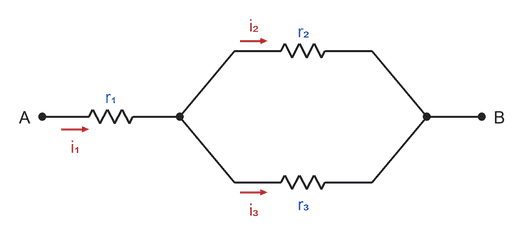
Three resistors having resistances , and are connected as shown in the given circuit. The ratio of current in terms of resistances used in the circuit is
- 1371 mark
Question 137
identical cells each of emf E and internal resistance 'r' are connected in parallel. A external resistance 'R' is connected in series to this combination. The current through R is