
Question 161 markMCQMedium
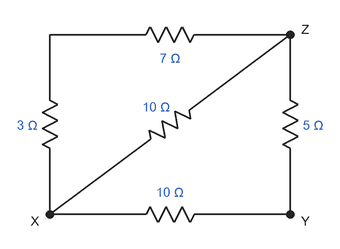
The equivalent resistance between the points X and Y in the following circuit diagram will be
Confirming your payment
Sign up now and get 250 free tokens.
Direct Current Circuits · Question 16 of 126
The equivalent resistance between the points X and Y in the following circuit diagram will be
(A)
(B)
(C)
(D)
Answer: (B)
Key idea: Reduce the network step by step from the side away from the terminals, combining resistors in series (one after another with no junction between) or in parallel (joining the same two points).
Step 1 — Combine the and .
The and meet at the top-left corner, where nothing else is connected, so they are in series between X and Z.
Step 2 — Add the diagonal in parallel.
This and the diagonal both join X to Z, so they are in parallel.
Step 3 — Add the arm ZY in series.
The path from X to Y through Z has followed by the arm.
Step 4 — Add the arm XY in parallel.
The path X–Z–Y and the arm both join X to Y, so they are in parallel.
Why the other options are wrong:
Note: In the book's figure both top corners are marked Z. The top-left corner is a separate junction, as the book's own working treats it, and it is drawn unlabelled here.
Therefore, the equivalent resistance between X and Y is 5 Ω: option (B).