Solution:
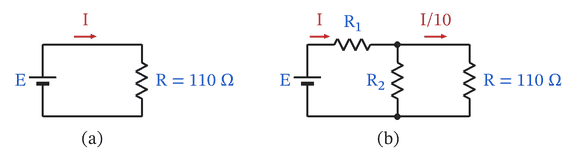
Key idea: The current drawn from the battery is the same in both circuits, so the total resistance must be the same, 110 Ω. In circuit (b), R carries 10I, so by the junction rule R2 carries the rest, 109I.
Step 1 — Find R2.
The resistors R2 and R are in parallel, so they have the same p.d. across them.
R2×109I=110×10I
9R2=110
R2=9110 Ω
So R2 is about 12.2 Ω.
Step 2 — Find the resistance of the parallel pair.
We combine R and R2 by product over sum.
Rp=110+9110110×9110
Rp=10110
Rp=11 Ω
Step 3 — Find R1.
The resistor R1 is in series with the pair, and the total must be 110 Ω.
R1+11=110
R1=99 Ω
Step 4 — Check the current share.
The fraction of the current through R is R2+RR2, and with R2=9110 Ω this works out to 101, as required.
Therefore, R1=99 Ω and R2=9110 Ω, about 12.2 Ω.