
Question 1154 marksHard
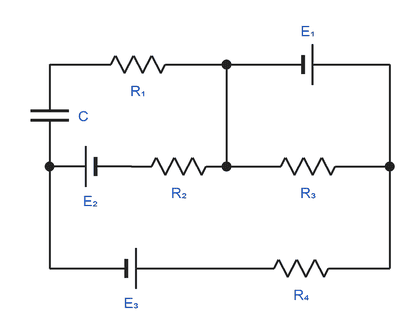
In the given circuit, V, , , . Find the current in and the energy stored in the capacitor.
Confirming your payment
Sign up now and get 250 free tokens.
Direct Current Circuits · Question 115 of 126
In the given circuit, V, , , . Find the current in and the energy stored in the capacitor.
Solution:
Key idea: In the steady state the capacitor is fully charged, so no current flows in the branch with and . Kirchhoff's rules then give the other currents. The cells have no internal resistance, and the long plate of each cell symbol is its positive terminal.
Step 1 — Write the values.
From the chains in the stem we read V, V and V.
In the same way the resistances are , , and .
Step 2 — Find the current in .
Call the junction where , and meet (the vertical wire makes the two middle dots one point). Both and are joined between and the right-hand side, so the p.d. across equals .
Step 3 — Write the potentials of the junctions.
We take the left-hand side (the lower plate of ) as V and let be at . The positive plate of faces the right-hand side, so the right-hand side is at . The positive plate of faces the left-hand side, and the positive plate of faces .
Step 4 — Apply the junction rule to and the right-hand side together.
No current flows through , so the current entering this pair of points from the left-hand side through and and through and must add to zero. (The and branches only carry current between and the right-hand side.)
Step 5 — Find the capacitor voltage.
No current flows in , so there is no p.d. across it. The capacitor therefore has the full p.d. between the left-hand side ( V) and ( V) across it, so the capacitor voltage is V.
Step 6 — Find the energy stored in the capacitor.
The energy stored is with .
Note: The book prints the data with stray commas, as ", V, , ". This is a printing slip for the chains used above, which give the book's own answer. Read literally ( V, V, V, ), the same method gives A and J.
Therefore, the current in is A, and the energy stored in the capacitor is J.