
Question 1123 marksMedium
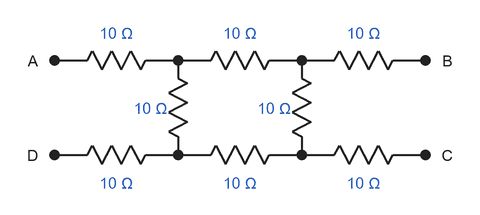
Find the resistance between (i) and , and (ii) and of the given network.
Confirming your payment
Sign up now and get 250 free tokens.
Direct Current Circuits · Question 112 of 126
Find the resistance between (i) and , and (ii) and of the given network.
Solution:
Key idea: A resistor with one end free (not on any closed path between the two chosen terminals) carries no current and can be left out. Call the top junctions and and the bottom junctions and , from left to right, so that and are the two vertical resistors.
Step 1 — Part (i): remove the dead ends between and .
The resistors leading to and to end at free terminals, so they carry no current. Current goes from through to , from to , and through from to .
Step 2 — Part (i): find the resistance between and .
There are two paths from to : the direct resistor, and the path of three resistors (). They are in parallel.
Step 3 — Part (i): add the series parts.
The resistors and are in series with .
Step 4 — Part (ii): remove the dead ends between and .
Now the resistors leading to and to end at free terminals and carry no current. Current goes from to , from to , and from through to .
Step 5 — Part (ii): find the resistance between and .
There are two paths from to : and , each of two resistors (). Two equal paths in parallel give half of one.
Step 6 — Part (ii): add the series parts.
The resistors and are in series with .
Therefore, the resistance is (i) between and , and (ii) between and .