
Opening your dashboard
Class 10 Maths Chapter 17: Circles Solutions
110 textbook questions with step-by-step answers, free to read, for ICSE 2026-27.
Get talked through Ch 17, not just shown the answer
Reading a finished solution is not the same as being able to do it. The AI tutor takes one question at a time and works it with you, in your own words, until you can.
- Ask it out loud, in your own words
- It gives you the next step, not the answer
- Stuck on part (ii)? Start there
110 questions with solutions
1–3 marks · Mixed difficulty
The first 18 solutions are on this page. This chapter is a long one, so the rest open on their own page to keep this one quick to load.
- 11 mark
Question 1
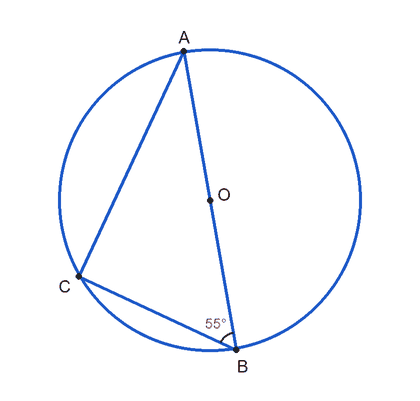
In the given figure, O is centre of the circle and ∠B = 55°. The angle A is equal to:
 Solve with AI
Answer
(A) 55°
- Correct
(B) 35°
(C) 45°
(D) 50°
Answer: (B) 35°
Concept: These facts are used here.
- Angle in a semicircle: the angle that a diameter subtends at any point on the circle is .
- Angle sum: the three angles of a triangle add up to .
Step 1 — Spot the diameter.
The chord AB passes through the centre O, so AB is a diameter. C is a point on the circle, so is an angle in a semicircle.
Step 2 — Use the angle sum of triangle ABC.
Two angles of are now known: and . The third angle is what is left of .
Watch out: The right angle is at C, the point on the circle, not at A or B. The diameter AB is the side opposite the right angle.
Why the other options are wrong:
- (A) 55°: is itself. would equal only if AC = BC, and then both would be .
- (C) 45°: for would force to be as well (the two acute angles add up to ), but is .
- (D) 50°: with , the angles of the triangle would add up to , not .
Therefore, , option (B).
- 21 mark
Question 2
In the given figure, O is centre of the circle and angle OBA = 50°. The angle P is :
 Solve with AI
Answer
(A) 50°
(B) 80°
- Correct
(C) 40°
(D) 60°
Answer: (C) 40°
Concept: These facts are used here.
- Radii are equal: two radii and a chord form an isosceles triangle, so the angles opposite the two radii are equal.
- Angle at the centre: the angle that an arc subtends at the centre is double the angle it subtends at any point on the remaining part of the circle.
Step 1 — Use the equal radii.
OA and OB are radii, so is isosceles and the angles opposite these sides are equal.
Step 2 — Find the angle at the centre.
The angle sum of gives .
Step 3 — Halve it to get the angle at P.
The arc AB subtends at the centre and at the point P on the remaining part of the circle. So is half of .
Watch out: The angle at the circumference is HALF the angle at the centre on the same arc, not equal to it.
Why the other options are wrong:
- (A) 50°: is , a base angle of , not the angle at P.
- (B) 80°: is , the angle at the centre. It must be halved to give the angle at P.
- (D) 60°: at P would need , that is, base angles of each, not .
Therefore, , option (C).
- 31 mark
Question 3
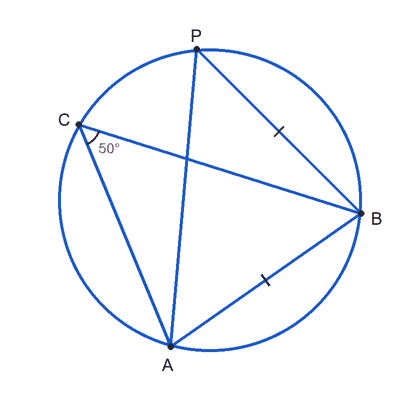
In the given figure, chord AB = chord PB and angle C = 50°. The angle PAB is equal to :
 Solve with AI
Answer
(A) 65°
- Correct
(B) 50°
(C) 75°
(D) 60°
Answer: (B) 50°
Concept: These facts are used here.
- Angles in the same segment: angles subtended by the same chord (or arc) at points on the circle on the same side of that chord are equal.
- In a triangle, the angles opposite equal sides are equal.
Step 1 — Move the 50° angle to P.
and are both subtended by the chord AB, and C and P lie on the same side of AB. So they are angles in the same segment and are equal.
Step 2 — Use AB = PB in triangle APB.
In , side AB is opposite and side PB is opposite . Equal sides have equal opposite angles.
Watch out: Pair each side with the angle OPPOSITE it. Side PB is opposite the angle at A, and side AB is opposite the angle at P.
Why the other options are wrong:
- (A) 65°: comes from , which treats as the angle at B between the equal sides. The angle is at P, and it is one of the two equal angles.
- (C) 75°: because AB = PB, must equal (), so it cannot be .
- (D) 60°: is the angle of an equilateral triangle, but is not equilateral: its angle at P is .
Therefore, , option (B).
- 41 mark
Question 4
O′ and O″ are centres of two circles which intersect each other at points A and B. Then :
 Solve with AI
Answer
(A) BC = BD.
(B) BC is larger than BD.
(C) BC is smaller than BD.
- Correct
(D) C, B and D are collinear.
Answer: (D) C, B and D are collinear.
Concept: These facts are used here.
- Angle in a semicircle: the angle that a diameter subtends at any point on the circle is .
- Two angles at a point that add up to form a straight line.
Step 1 — Find the angle at B in the first circle.
O′ lies on AC, so AC is a diameter of the circle with centre O′. B is on this circle, so is an angle in a semicircle.
Step 2 — Find the angle at B in the second circle.
O″ lies on AD, so AD is a diameter of the circle with centre O″. B is on this circle too.
Step 3 — Add the two angles at B.
BC and BD lie on opposite sides of AB, so the two angles at B sit side by side.
The angles CBA and ABD together make a straight angle, so CB and BD lie along one straight line.
Watch out: Do not judge from the drawing which of BC and BD is longer; nothing about the sizes of the circles is given.
Why the other options are wrong:
- (A) BC = BD: this holds only when the two circles are equal. For circles of different sizes, as in the figure, it fails.
- (B) BC is larger than BD: BC is larger than BD only when the circle with centre O′ is the larger one; the question does not say which is larger.
- (C) BC is smaller than BD: BC is smaller than BD only when the circle with centre O′ is the smaller one; again, this is not given.
Therefore, C, B and D are collinear, option (D).
- 51 mark
Question 5
In the given figure, O is centre of the circle, AB//DC and ∠ACD = 32°, ∠DAB is equal to :
 Solve with AI
Answer
- Correct
(A) 122°
(B) 148°
(C) 90°
(D) none of the above
Answer: (A) 122°
Concept: These facts are used here.
- Angle in a semicircle: the angle that a diameter subtends at any point on the circle is .
- Parallel lines: a transversal makes equal alternate angles and co-interior angles that add up to .
Step 1 — Use the diameter DC.
DC passes through the centre O, so DC is a diameter, and is an angle in a semicircle.
Step 2 — Use AB ∥ DC.
AC is a transversal of the parallel lines AB and DC. and are alternate angles, so they are equal.
Step 3 — Add the two parts of angle DAB.
The line AC lies inside , splitting it into and .
Watch out: is made of two parts. Finding only stops halfway.
Why the other options are wrong:
- (B) 148°: is . That treats and as co-interior angles, but they are not on the same transversal.
- (C) 90°: is only ; it leaves out .
- (D) none of the above: the value is among the options, so 'none of the above' is wrong.
Therefore, , option (A).
- 63 marks
Question 6
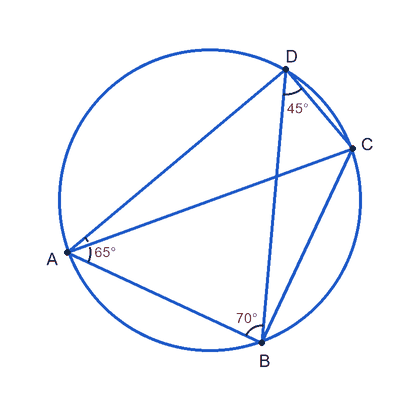
In the given figure, ∠BAD = 65°, ∠ABD = 70°, ∠BDC = 45°
(i) Prove that AC is a diameter of the circle.
(ii) Find ∠ACB.
 Solve with AI
Written solution
Solution:
Concept: These facts are used here.
- Angle sum: the three angles of a triangle add up to .
- Converse: if a chord subtends a right angle at a point on the circle, the chord is a diameter; and if a pair of opposite angles of a quadrilateral add up to , its vertices lie on a circle (it is cyclic).
- Angles in the same segment: angles subtended by the same chord (or arc) at points on the circle on the same side of that chord are equal.
Step 1 — Part (i): find angle ADB.
In two angles are given, so the third is what is left of .
Step 2 — Part (i): find angle ADC.
DB lies inside , so is the sum of its two parts.
Step 3 — Part (i): conclude.
The chord AC subtends a right angle at D, a point on the circle. By the converse of the angle in a semicircle, AC is a diameter. Hence proved.
Step 4 — Part (ii): find angle ACB.
and are both subtended by the chord AB, with C and D on the same side of AB. They are angles in the same segment.
Watch out: is given, but must be worked out; only their sum is .
Therefore, (i) , so AC is a diameter; (ii) .
- 73 marks
Question 7
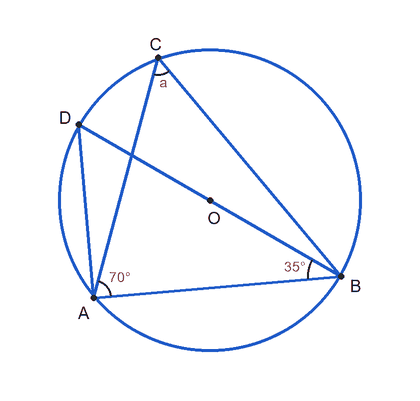
In the following figure, O is the centre of the circle. Find the value of a.
 Solve with AI
Written solution
Solution:
Concept: These facts are used here.
- Angle in a semicircle: the angle that a diameter subtends at any point on the circle is .
- Angles in the same segment: angles subtended by the same chord (or arc) at points on the circle on the same side of that chord are equal.
Step 1 — Use the diameter DB.
DB passes through the centre O, so DB is a diameter and is an angle in a semicircle.
Step 2 — Find angle ADB.
In we now know and (marked at B).
Step 3 — Find a.
Here stands for . It is subtended by the chord AB at C, and is subtended by the same chord at D, on the same side of AB. So they are angles in the same segment.
Watch out: The marked at A is ; it is not needed for . Do not add it into .
Therefore, .
- 83 marks
Question 8
In the following figure, O is the centre of the circle. Find the value of b.
 Solve with AI
Written solution
Solution:
Concept: These facts are used here.
- Angles in the same segment: angles subtended by the same chord (or arc) at points on the circle on the same side of that chord are equal.
- Angle sum: the three angles of a triangle add up to .
- Angles on a straight line add up to .
Step 1 — Name the crossing point.
Let the chords AC and DB meet at E. The marked there is .
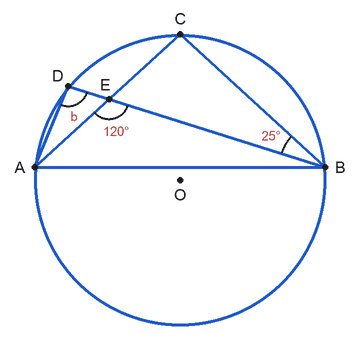
Step 2 — Find angle AED.
DEB is a straight line, so and form a linear pair.
Step 3 — Find angle DAE.
and are both subtended by the chord DC, with A and B on the same side of DC. They are angles in the same segment.
Step 4 — Find b in triangle ADE.
, which is the angle at D of .
Watch out: The angle is , opposite D. The angle inside is its supplement, .
Therefore, .
- 93 marks
Question 9
In the following figure, O is the centre of the circle. Find the value of c.
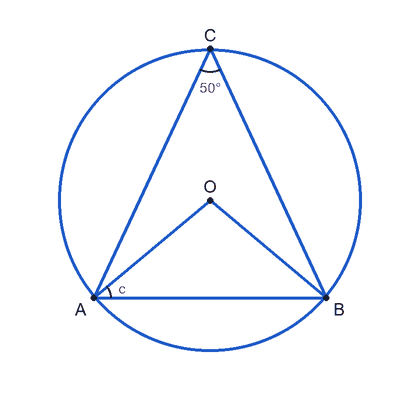 Solve with AI
Written solution
Solution:
Concept: These facts are used here.
- Angle at the centre: the angle that an arc subtends at the centre is double the angle it subtends at any point on the remaining part of the circle.
- Radii are equal: two radii and a chord form an isosceles triangle, so the angles opposite the two radii are equal.
Step 1 — Find the angle at the centre.
The arc AB subtends at the centre and at C, on the remaining part of the circle.
Step 2 — Use the isosceles triangle OAB.
OA = OB (radii), so and are equal, and each is . These two equal angles share what is left of in .
Watch out: Double to get the angle at the centre; do not halve it.
Therefore, .
- 103 marks
Question 10
In the following figure, O is the centre of the circle. Find the value of d.
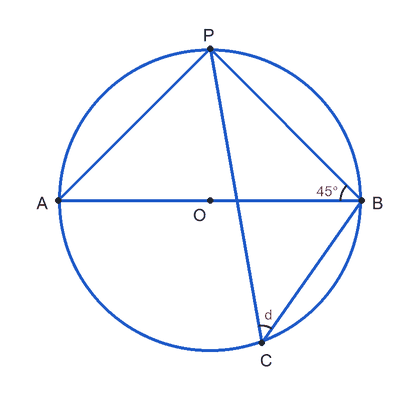 Solve with AI
Written solution
Solution:
Concept: These facts are used here.
- Angle in a semicircle: the angle that a diameter subtends at any point on the circle is .
- Angles in the same segment: angles subtended by the same chord (or arc) at points on the circle on the same side of that chord are equal.
Step 1 — Use the diameter AB.
AB passes through O, so AB is a diameter and is an angle in a semicircle.
Step 2 — Find angle PAB.
In we know and .
Step 3 — Find d.
Here stands for . It is subtended by the chord PB at C, and is subtended by the same chord at A, on the same side of PB. They are angles in the same segment.
Watch out: stands on the chord PB, so compare it with (also on PB), not with .
Therefore, .
- 113 marks
Question 11
Calculate :
(i) ∠CDB,
(ii) ∠ABC,
(iii) ∠ACB.
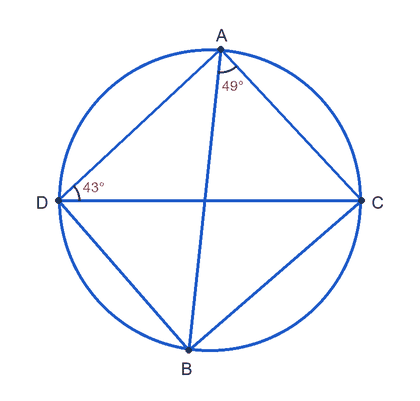 Solve with AI
Written solution
Solution:
Concept: These facts are used here.
- Angles in the same segment: angles subtended by the same chord (or arc) at points on the circle on the same side of that chord are equal.
- Angle sum: the three angles of a triangle add up to .
Step 1 — Read the figure.
The figure marks at A and at D.
Step 2 — Part (i): find angle CDB.
and are both subtended by the chord CB, with A and D on the same side of CB. They are angles in the same segment.
Step 3 — Part (ii): find angle ABC.
and are both subtended by the chord AC, with B and D on the same side of AC.
Step 4 — Part (iii): find angle ACB.
Two angles of are now known, so the third is what is left of .
Watch out: For each angle, first name the chord it stands on (the side opposite the vertex), then look for another angle on that chord.
Therefore, (i) ; (ii) ; (iii) .
- 123 marks
Question 12
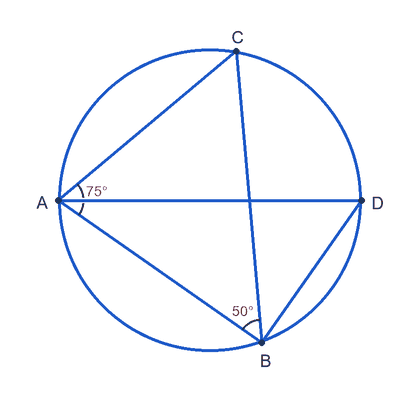
Given : ∠CAB = 75° and ∠CBA = 50°. Find the value of ∠DAB + ∠ABD.
 Solve with AI
Written solution
Solution:
Concept: These facts are used here.
- Angle sum: the three angles of a triangle add up to .
- Angles in the same segment: angles subtended by the same chord (or arc) at points on the circle on the same side of that chord are equal.
Step 1 — Find angle ACB.
In we know and .
Step 2 — Move it to D.
and are both subtended by the chord AB, with C and D on the same side of AB. They are angles in the same segment.
Step 3 — Use the angle sum of triangle ABD.
The other two angles of share what is left of .
Watch out: The question asks for the SUM of the two angles; each one on its own cannot be found from the data.
Therefore, .
- 133 marks
Question 13
In the figure, given alongside, AOB is a diameter of the circle and ∠AOC = 110°. Find ∠BDC.
 Solve with AI
Written solution
Solution:
Concept: These facts are used here.
- Angles on a straight line add up to .
- Angle at the centre: the angle that an arc subtends at the centre is double the angle it subtends at any point on the remaining part of the circle.
Step 1 — Find angle BOC.
AOB is a straight line (a diameter), so and form a linear pair.
Step 2 — Halve it.
The arc BC subtends at the centre and (marked ) at D, on the remaining part of the circle.
Watch out: stands on the arc BC, so use , not . Half of () is a common wrong answer.
Therefore, .
- 143 marks
Question 14
In the following figure, O is the centre of the circle, ∠AOB = 60° and ∠BDC = 100°. Find ∠OBC.
 Solve with AI
Written solution
Solution:
Concept: These facts are used here.
- Angle at the centre: the angle that an arc subtends at the centre is double the angle it subtends at any point on the remaining part of the circle.
- Angle sum: the three angles of a triangle add up to .
Step 1 — Find angle ACB.
The arc AB subtends at the centre and at C, on the remaining part of the circle.
Step 2 — Use triangle BDC.
D lies on AC, so is the same angle as (). In we also know .
Step 3 — Read off angle OBC.
D lies on OB, so the ray BD is the ray BO, and is the same angle as .
Watch out: is at D, where AC crosses OB. It is not an angle at the centre.
Therefore, .
- 153 marks
Question 15
In cyclic quadrilateral ABCD, ∠DAC = 27°; ∠DBA = 50° and ∠ADB = 33°. Calculate :
(i) ∠DBC,
(ii) ∠DCB,
(iii) ∠CAB.
 Solve with AI
Written solution
Solution:
Concept: These facts are used here.
- Angles in the same segment: angles subtended by the same chord (or arc) at points on the circle on the same side of that chord are equal.
- Cyclic quadrilateral: the opposite angles of a quadrilateral whose four vertices lie on a circle add up to .
- Angle sum: the three angles of a triangle add up to .
Step 1 — Part (i): find angle DBC.
and are both subtended by the chord DC, with A and B on the same side of DC. They are angles in the same segment.
Step 2 — Part (ii): find angle DAB.
In two angles are given: and .
Step 3 — Part (ii): find angle DCB.
and are opposite angles of the cyclic quadrilateral ABCD, so they add up to .
Step 4 — Part (iii): find angle CAB.
The diagonal AC lies inside and splits it into and .
Watch out: (the whole angle at A) is found first; the is only the part .
Therefore, (i) ; (ii) ; (iii) .
- 163 marks
Question 16
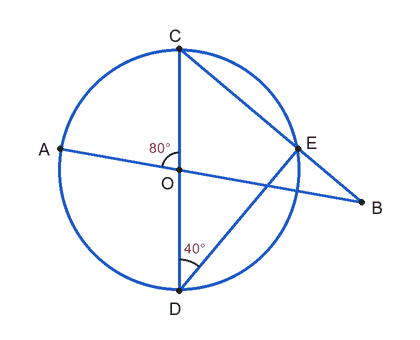
In the figure given below, AB and CD are straight lines through the centre O of a circle. If ∠AOC = 80° and ∠CDE = 40°, find the number of degrees in :
(i) ∠DCE,
(ii) ∠ABC.
 Solve with AI
Written solution
Solution:
Concept: These facts are used here.
- Angle in a semicircle: the angle that a diameter subtends at any point on the circle is .
- Angle sum: the three angles of a triangle add up to .
- Angles on a straight line add up to .
Step 1 — Part (i): use the diameter CD.
CD passes through the centre O, so CD is a diameter and is an angle in a semicircle.
Step 2 — Part (i): find angle DCE.
In we know and .
Step 3 — Part (ii): find angle BOC.
AOB is a straight line, so and form a linear pair.
Step 4 — Part (ii): find angle OCB.
E lies on CB and O lies on CD, so is the same angle as .
Step 5 — Part (ii): find angle ABC.
In two angles are now known, and is the same angle as because O lies on BA.
Watch out: is not inside ; the angle of that triangle at O is its supplement, .
Therefore, (i) ; (ii) .
- 173 marks
Question 17
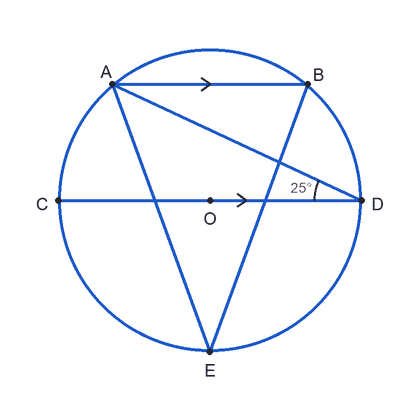
In the figure, given alongside, AB // CD and O is the centre of the circle. If ∠ADC = 25°; find the angle AEB. Give reasons in support of your answer.
 Solve with AI
Written solution
Solution:
Concept: These facts are used here.
- Angle in a semicircle: the angle that a diameter subtends at any point on the circle is .
- Parallel lines: a transversal makes equal alternate angles and co-interior angles that add up to .
- Angles in the same segment: angles subtended by the same chord (or arc) at points on the circle on the same side of that chord are equal.
Step 1 — Join AC and BC.
We join AC and BC. CD passes through the centre O, so CD is a diameter and is an angle in a semicircle.
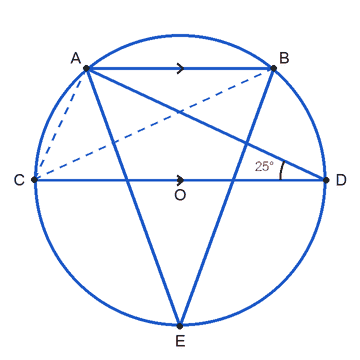
Step 2 — Find angle ACD.
In we know and .
Step 3 — Use AB ∥ CD.
AD is a transversal of the parallel lines AB and CD, so the alternate angles and are equal.
Step 4 — Find angle BCD.
and are both subtended by the chord BD, with A and C on the same side of BD. They are angles in the same segment.
Step 5 — Find angle ACB.
CB lies inside , so is what is left after taking away .
Step 6 — Find angle AEB.
and are both subtended by the chord AB, with C and E on the same side of AB. They are angles in the same segment.
Watch out: The question asks for reasons, so name the rule (semicircle, alternate angles, same segment) at every step.
Therefore, .
- 183 marks
Question 18
AB is a diameter of the circle APBR as shown in the figure. APQ and RBQ are straight lines. Find :
(i) ∠PRB,
(ii) ∠PBR,
(iii) ∠BPR.
 Solve with AI
Written solution
Solution:
Concept: These facts are used here.
- Angles in the same segment: angles subtended by the same chord (or arc) at points on the circle on the same side of that chord are equal.
- Angle in a semicircle: the angle that a diameter subtends at any point on the circle is .
- Angle sum: the three angles of a triangle add up to .
Step 1 — Part (i): find angle PRB.
and are both subtended by the chord PB, with A and R on the same side of PB. They are angles in the same segment.
Step 2 — Part (ii): find angle BPQ.
AB is a diameter, so (angle in a semicircle). APQ is a straight line, so the angle next to it at P is also a right angle.
Step 3 — Part (ii): find angle PBQ.
In we know and .
Step 4 — Part (ii): find angle PBR.
RBQ is a straight line, so and form a linear pair.
Step 5 — Part (iii): find angle BPR.
In two angles are now known.
Watch out: is obtuse: it is the supplement of , not itself.
Therefore, (i) ; (ii) ; (iii) .
- 193 marks
Question 19
In the given figure, A is the centre of the circle, ABCD is a parallelogram and CDE is a straight line.
Prove that : ∠BCD = 2∠ABE.
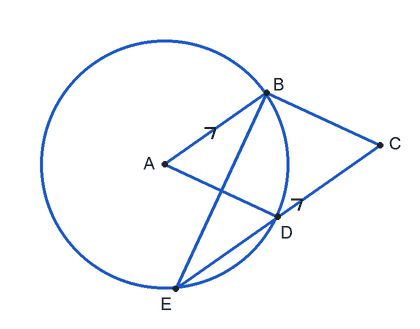
- 203 marks
Question 20
In the given figure, I is the incentre of ΔABC. BI when produced meets the circumcircle of Δ ABC at D. Given ∠BAC = 55° and ∠ACB = 65°; calculate :
(i) ∠DCA,
(ii) ∠DAC,
(iii) ∠DCI,
(iv) ∠AIC.
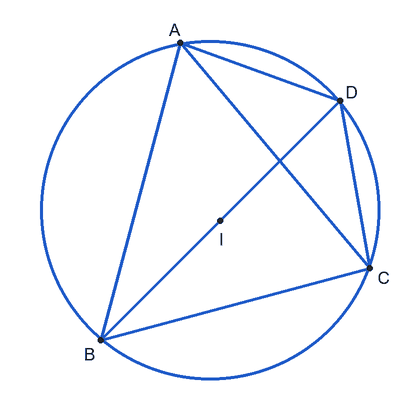
- 213 marks
Question 21
In the given figure, AB = AC = CD and ∠ADC = 38°. Calculate :
(i) Angle ABC
(ii) Angle BEC
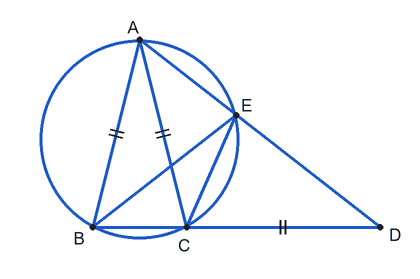
- 223 marks
Question 22
In the given figure, AC is the diameter of circle, centre O. Chord BD is perpendicular to AC. Write down the angles p, q and r in terms of x.
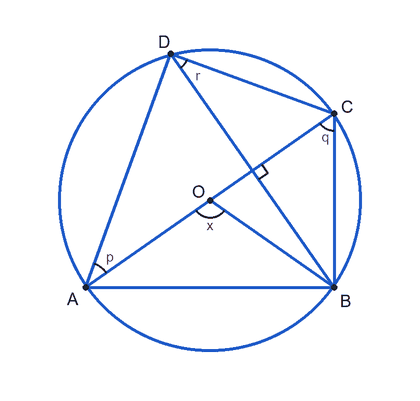
- 233 marks
Question 23
In the given figure, AOB is a diameter and DC is parallel to AB. If ∠CAB = x°; find (in terms of x) the values of :
(i) ∠COB,
(ii) ∠DOC,
(iii) ∠DAC,
(iv) ∠ADC.
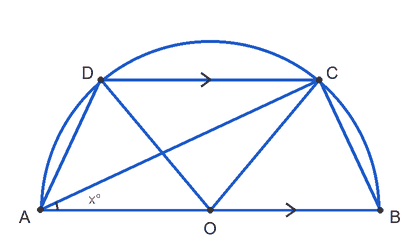
- 243 marks
Question 24
In the given figure, PQ is the diameter of the circle whose centre is O. Given ∠ROS = 42°, calculate ∠RTS.
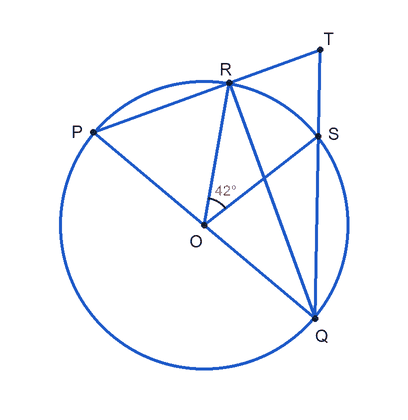
- 253 marks
Question 25
The given figure shows a circle with centre O and ∠ABP = 42°. Calculate the measure of:
(i) ∠PQB
(ii) ∠QPB + ∠PBQ
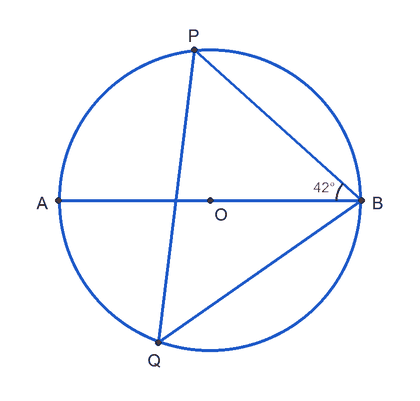
- 263 marks
Question 26
In the given figure, M is the centre of the circle. Chords AB and CD are perpendicular to each other.
If ∠MAD = x and ∠BAC = y :
(i) express ∠AMD in terms of x.
(ii) express ∠ABD in terms of y.
(iii) prove that : x = y.
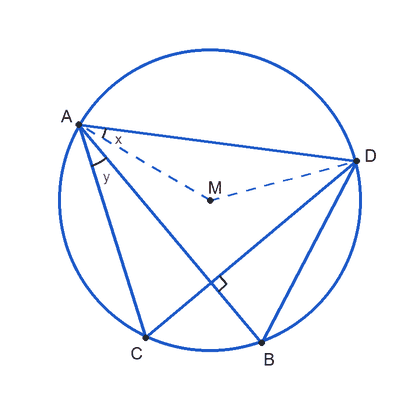
- 271 mark
Question 27
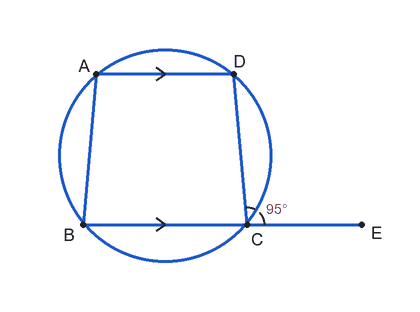
ABCD is a trapezium with AD parallel to BC. Side BC is produced to point E and angle DCE = 95°. Angle B is equal to :
- 281 mark
Question 28
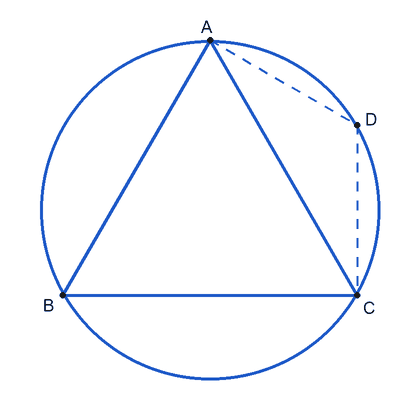
In the given figure, ABC is an equilateral triangle. Angle ADC is :
- 291 mark
Question 29
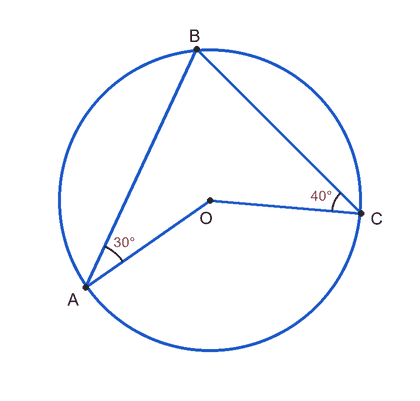
In the given figure, O is the centre of the circle. ∠OAB and ∠OCB are 30° and 40° respectively. ∠AOC is equal to :
- 301 mark
Question 30
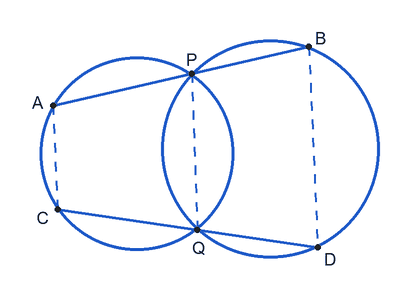
In the given figure APB and CQD are two straight lines, then :
- 311 mark
Question 31
In the figure, given below, ∠ABC is equal to :

- 323 marks
Question 32
In the given figure, O is the centre of the circle. If ∠AOB = 140° and ∠OAC = 50°; find :
(i) ∠ACB,
(ii) ∠OBC,
(iii) ∠OAB,
(iv) ∠CBA.
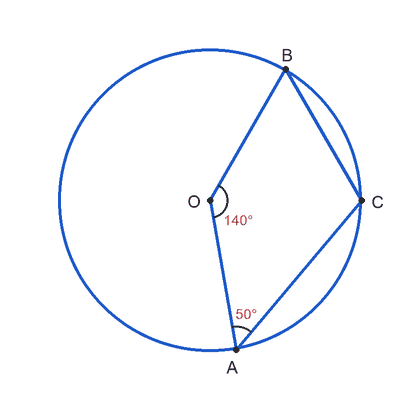
- 333 marks
Question 33
In the figure, given below, ABCD is a cyclic quadrilateral in which ∠BAD = 75°; ∠ABD = 58° and ∠ADC = 77°. Find :
(i) ∠BDC,
(ii) ∠BCD,
(iii) ∠BCA.
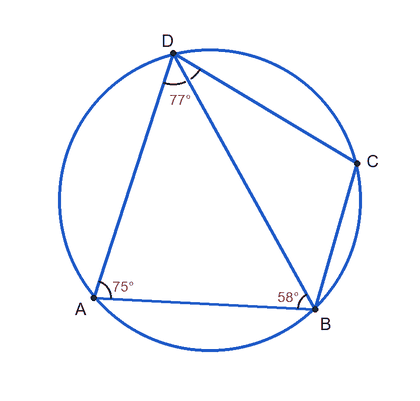
- 343 marks
Question 34
In the following figure, O is centre of the circle and Δ ABC is equilateral. Find :
(i) ∠ADB
(ii) ∠AEB.
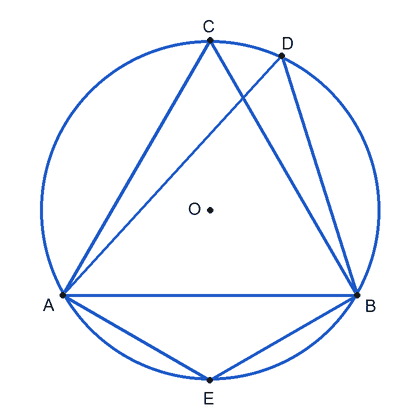
- 353 marks
Question 35
ABCD is a cyclic quadrilateral with O as centre of the circle. If ∠ADC = 130°; find ∠BAC.

- 363 marks
Question 36
In the following figure,
(i) if ∠BAD = 96°, find ∠BCD and ∠BFE.
(ii) Prove that AD is parallel to FE.
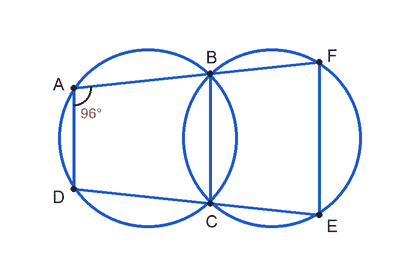
- 373 marks
Question 37
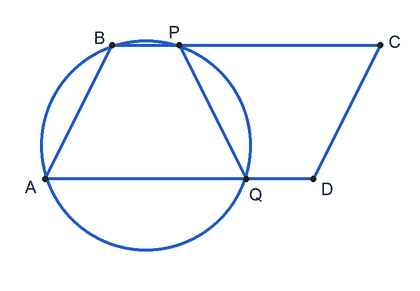
ABCD is a parallelogram. A circle through vertices A and B meets side BC at point P and side AD at point Q. Show that quadrilateral PCDQ is cyclic.
- 383 marks
Question 38
Prove that :
(i) the parallelogram, inscribed in a circle, is a rectangle.
(ii) the rhombus, inscribed in a circle, is a square.
- 393 marks
Question 39
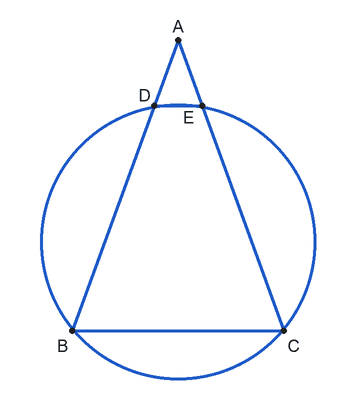
In the given figure, AB = AC. Prove that DECB is an isosceles trapezium.
- 403 marks
Question 40
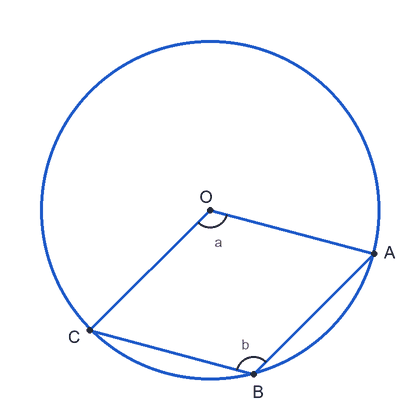
The figure given below, shows a circle with centre O.
Given : ∠AOC = a and ∠ABC = b.
(i) Find the relationship between a and b.
(ii) Find the measure of angle OAB, if OABC is a parallelogram.
- 413 marks
Question 41
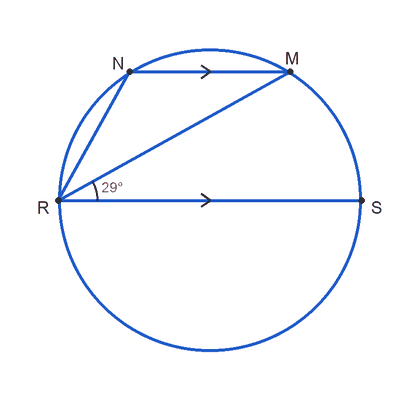
In the given figure, RS is a diameter of the circle. NM is parallel to RS and ∠MRS = 29°. Calculate :
(i) ∠RNM,
(ii) ∠NRM.
- 423 marks
Question 42
In the given figure, SP is bisector of ∠RPT and PQRS is a cyclic quadrilateral. Prove that : SQ = SR.

- 433 marks
Question 43
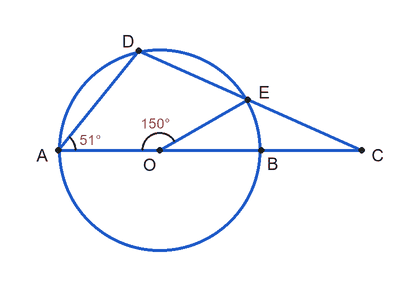
In the figure, O is the centre of the circle, ∠AOE = 150°, ∠DAO = 51°. Calculate the sizes of the angles CEB and OCE.
- 443 marks
Question 44
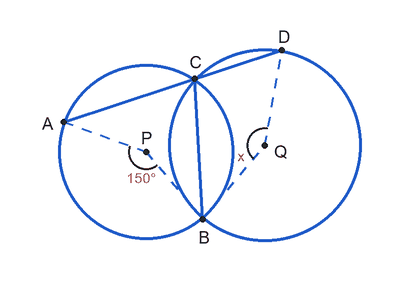
In the figure, given below, P and Q are the centres of two circles intersecting at B and C. ACD is a straight line. Calculate the numerical value of x.
- 453 marks
Question 45
The figure shows two circles which intersect at A and B. The centre of the smaller circle is O and lies on the circumference of the larger circle. Given ∠APB = a°.
Calculate, in terms of a°, the value of :
(i) obtuse ∠AOB,
(ii) ∠ACB,
(iii) ∠ADB.
Give reasons for your answers clearly.

- 463 marks
Question 46
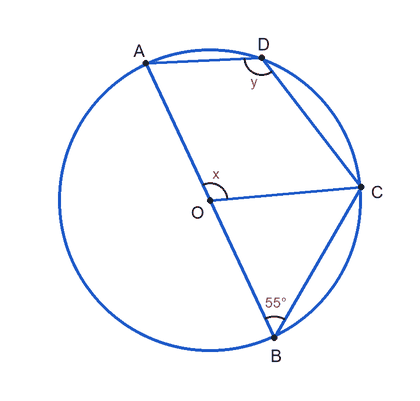
In the given figure, O is the centre of the circle and ∠ABC = 55°. Calculate the values of x and y.
- 473 marks
Question 47
ABCD is a cyclic quadrilateral in which AB is parallel to DC and AB is a diameter of the circle. Given ∠BED = 65°; calculate :
(i) ∠DAB,
(ii) ∠BDC.

- 483 marks
Question 48
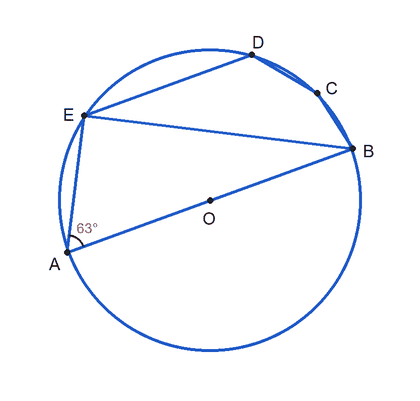
In the given figure, AB is a diameter of the circle. Chord ED is parallel to AB and ∠EAB = 63°. Calculate :
(i) ∠EBA,
(ii) ∠BCD.
- 493 marks
Question 49
In the given figure, AB is a diameter of the circle with centre O. DO is parallel to CB and ∠DCB = 120°. Calculate :
(i) ∠DAB,
(ii) ∠DBA,
(iii) ∠DBC,
(iv) ∠ADC.
Also, show that the Δ AOD is an equilateral triangle.

- 503 marks
Question 50
Calculate the angles x, y and z if :
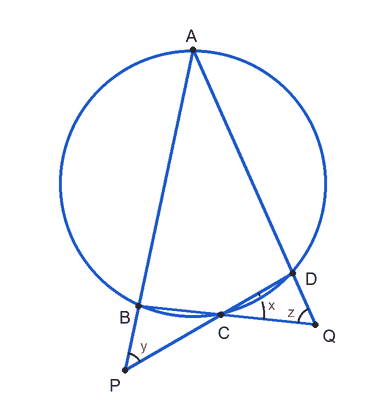
- 513 marks
Question 51
In the given figure, AC is the diameter of the circle with centre O. CD and BE are parallel. Angle ∠AOB = 80° and ∠ACE = 10°. Calculate :
(i) Angle BEC,
(ii) Angle BCD,
(iii) Angle CED.
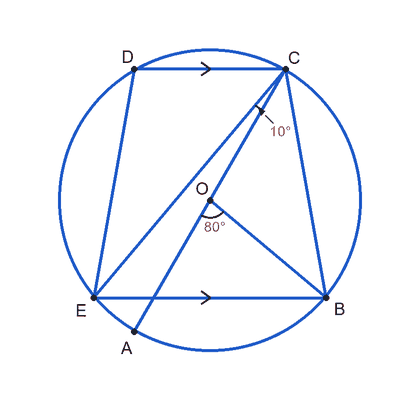
- 523 marks
Question 52
In the given figure, AE is the diameter of the circle. Write down the numerical value of ∠ABC + ∠CDE. Give reasons for your answer.

- 533 marks
Question 53
In the given figure, AOC is a diameter and AC is parallel to ED. If ∠CBE = 64°, calculate ∠DEC.
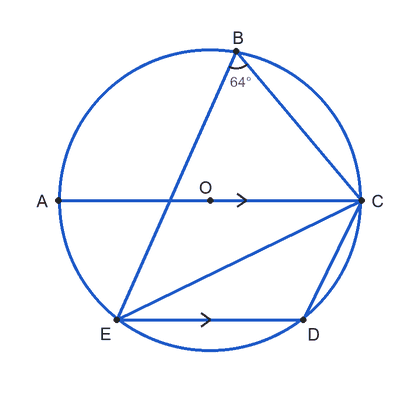
- 543 marks
Question 54
Use the given figure to find :
(i) ∠BAD,
(ii) ∠DQB.
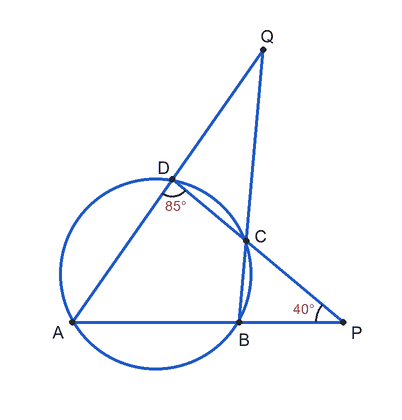
- 553 marks
Question 55
In the given figure, PQ is a diameter. Chord SR is parallel to PQ. Given that ∠PQR = 58°. Calculate :
(i) ∠RPQ,
(ii) ∠STP.
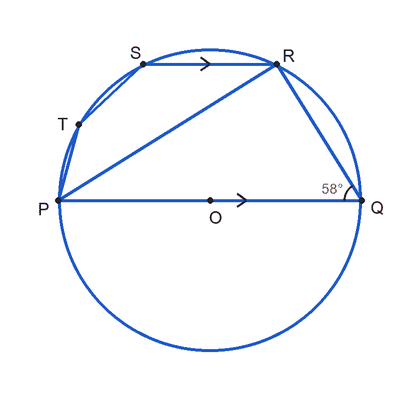
- 563 marks
Question 56
AB is the diameter of the circle with centre O. OD is parallel to BC and ∠AOD = 60°. Calculate the numerical values of :
(i) ∠ABD,
(ii) ∠DBC,
(iii) ∠ADC.
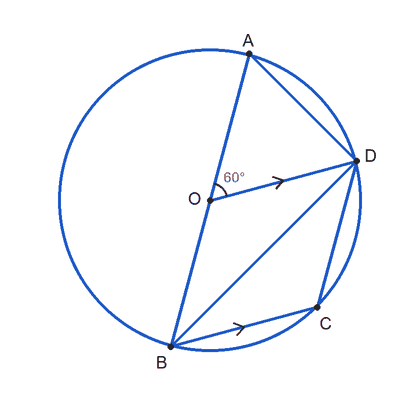
- 573 marks
Question 57
In the given figure, the centre O of the small circle lies on the circumference of the bigger circle. If ∠APB = 75° and ∠BCD = 40°, find :
(i) ∠AOB,
(ii) ∠ACB,
(iii) ∠ABD,
(iv) ∠ADB.
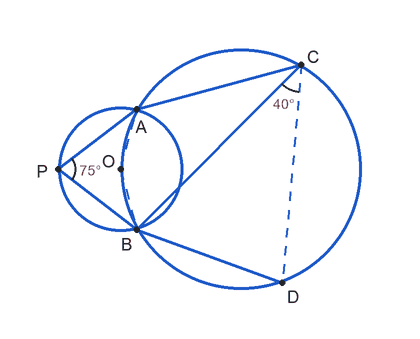
- 583 marks
Question 58
In the given figure, ∠BAD = 65°, ∠ABD = 70° and ∠BDC = 45°. Find :
(i) ∠BCD
(ii) ∠ACB
Hence, show that AC is a diameter.
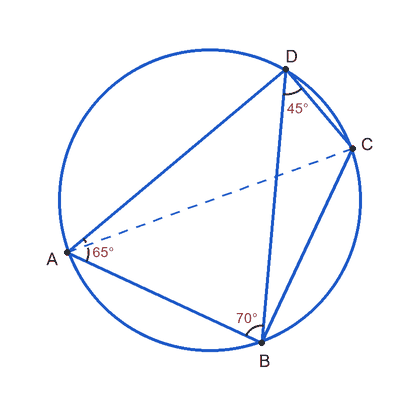
- 593 marks
Question 59
In a cyclic quadrilateral ABCD, ∠A : ∠C = 3 : 1 and ∠B : ∠D = 1 : 5; find each angle of the quadrilateral.
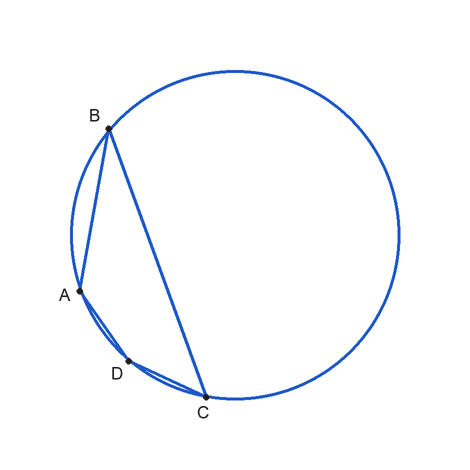
- 601 mark
Question 60
In the given figure, O is the centre of the circle and chord AB : chord CD = 3 : 5. If angle AOB = 60°, angle COD is equal to :
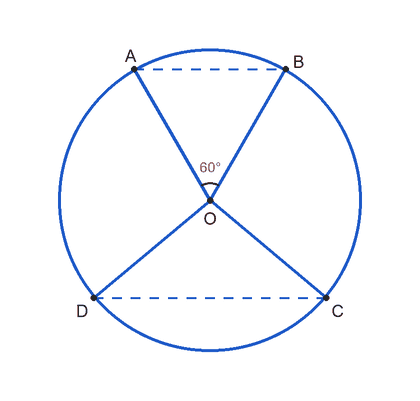
- 611 mark
Question 61
In the given figure, O is the centre of the circle and angle OAB = 55°, then angle ACB is equal to :
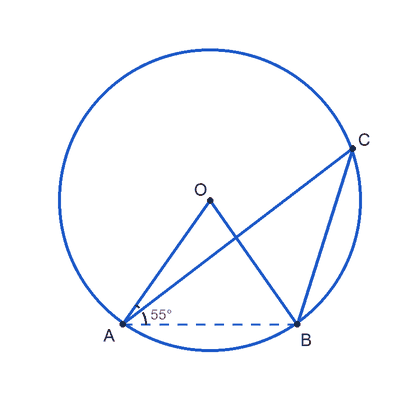
- 621 mark
Question 62
In the given figure, O is the centre of a circle. AB is the side of a square and BC is side of a regular hexagon. Also, arc AD = arc CD. Angle DOC is equal to :
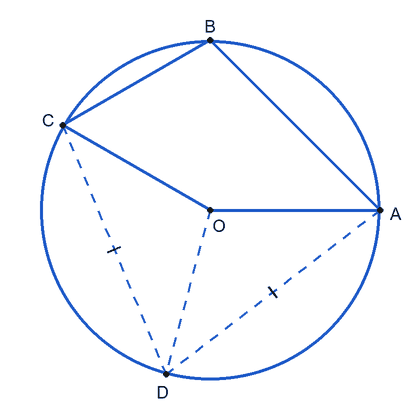
- 631 mark
Question 63
In the given figure, O is the centre of the circle, AB is side of a regular pentagon, then angle ACB is equal to :
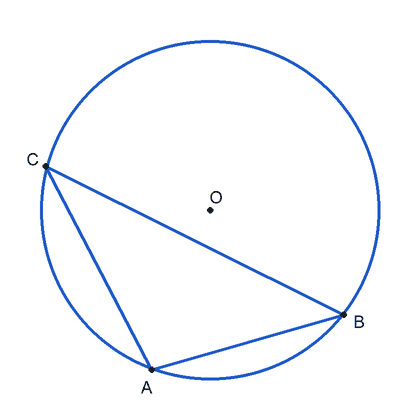
- 641 mark
Question 64
In the given figure, O is the centre of the circle, chords AB, CD and EF are equal whereas chords BC, DE and FA are separately equal. The angle AOC is equal to :

- 653 marks
Question 65
In a cyclic-trapezium, the non-parallel sides are equal and the diagonals are also equal. Prove it.
- 663 marks
Question 66
In the following figure, AD is the diameter of the circle with centre O. Chords AB, BC and CD are equal. If ∠DEF = 110°, calculate :
(i) ∠AEF,
(ii) ∠FAB.
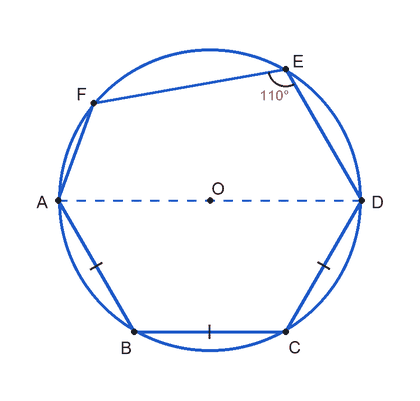
- 673 marks
Question 67
If two sides of a cyclic-quadrilateral are parallel; prove that :
(i) its other two sides are equal.
(ii) its diagonals are equal.
- 683 marks
Question 68
The given figure shows a circle with centre O. Also, PQ = QR = RS and ∠PTS = 75°. Calculate :
(i) ∠POS,
(ii) ∠QOR,
(iii) ∠PQR.
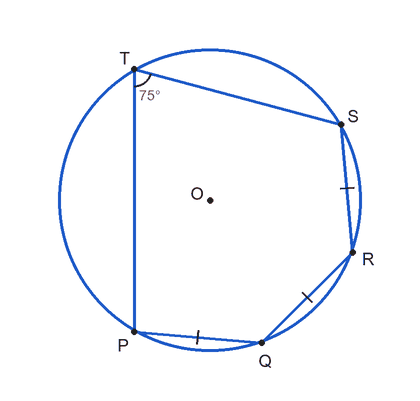
- 693 marks
Question 69
In the given figure, AB is a side of a regular six-sided polygon and AC is a side of a regular eight-sided polygon inscribed in the circle with centre O. Calculate the sizes of :
(i) ∠AOB,
(ii) ∠ACB,
(iii) ∠ABC.
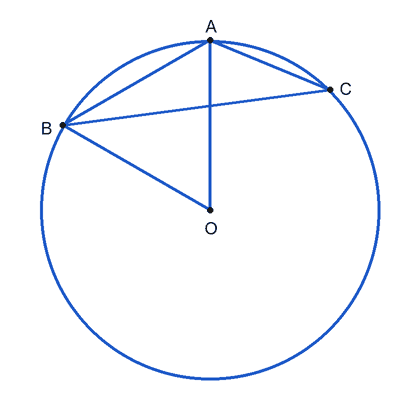
- 703 marks
Question 70
In a regular pentagon ABCDE, inscribed in a circle; find the ratio between angle EDA and angle ADC.

- 713 marks
Question 71
In the given figure, AB = BC = CD and ∠ABC = 132°. Calculate :
(i) ∠AEB,
(ii) ∠AED,
(iii) ∠COD.
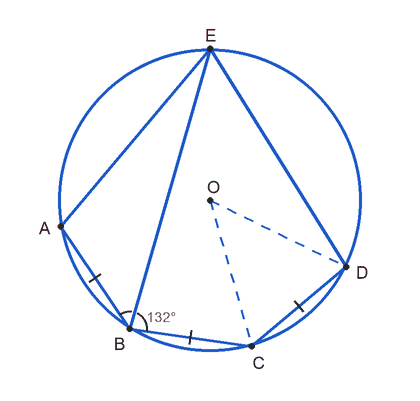
- 723 marks
Question 72
In the figure, O is the centre of the circle and the length of arc AB is twice the length of arc BC. If angle AOB = 108°, find :
(i) ∠CAB,
(ii) ∠ADB.
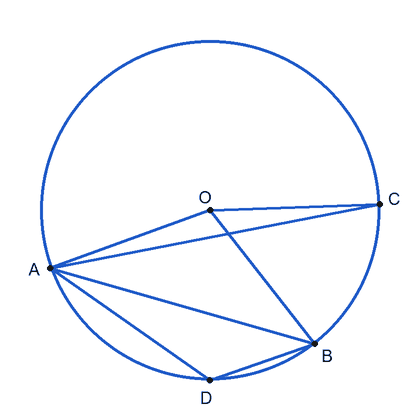
- 733 marks
Question 73
The figure shows a circle with centre O. AB is the side of regular pentagon and AC is the side of regular hexagon. Find the angles of triangle ABC.
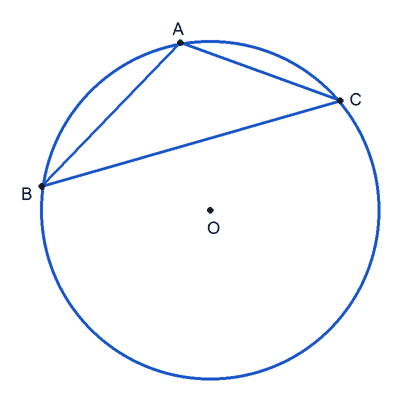
- 743 marks
Question 74
In the given figure, BD is a side of a regular hexagon, DC is a side of a regular pentagon and AD is a diameter. Calculate :
(i) ∠ADC,
(ii) ∠BDA,
(iii) ∠ABC,
(iv) ∠AEC.
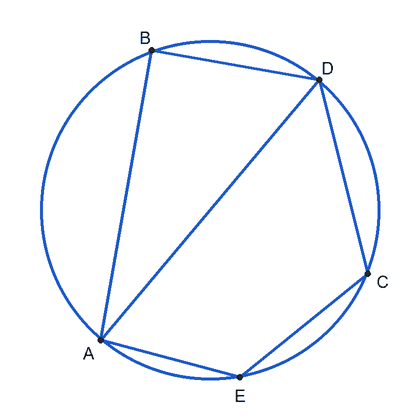
- 751 mark
Question 75
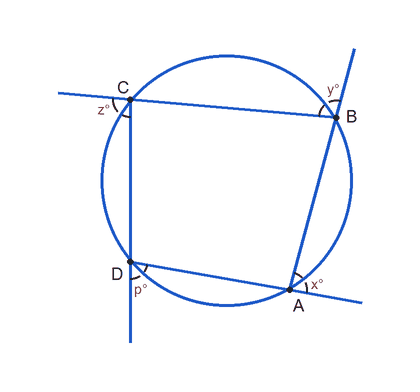
In the given figure x°, y°, z° and p° are exterior angles of cyclic quadrilateral ABCD, then x° + y° + z° + p° is :
- 761 mark
Question 76
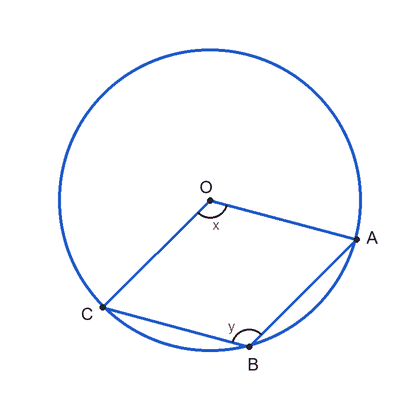
In the given figure, O is centre of the circle and OABC is a rhombus, then :
- 771 mark
Question 77
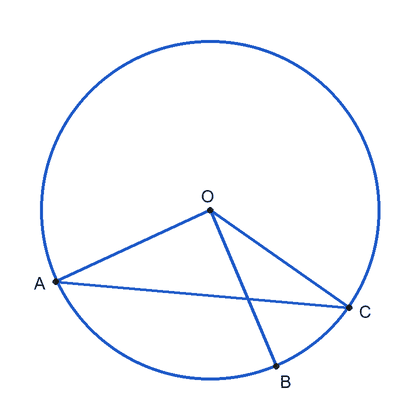
Arcs AB and BC are of lengths in the ratio 11 : 4 and O is centre of the circle. If angle BOC = 32°, angle AOC is :
- 781 mark
Question 78
In the given figure, AB is the side of regular pentagon and BC is the side of regular hexagon. Angle APC is :

- 791 mark
Question 79
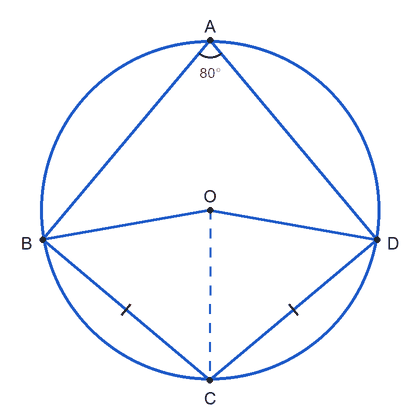
In the given figure, O is centre of the circle. Chord BC = chord CD and angle A = 80°. Angle BOC is :
- 801 mark
Question 80
In the given circle, ∠BAD = 95°, ∠ABD = 40° and ∠BDC = 45°.
Assertion (A) : To show that AC is a diameter, the angle ADC or angle ABC need to be proved equal to 90°.
Reason (R) : In ΔADB, ∠ADB = 180° – 95° – 40° = 45°
∴ Angle ADC = 45° + 45° = 90°
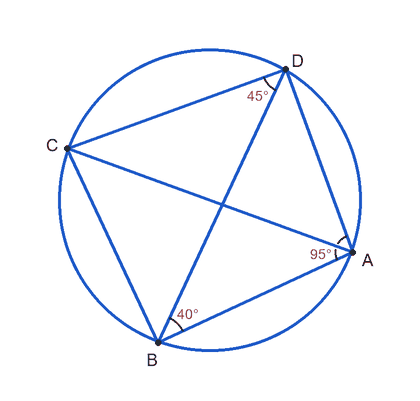
- 811 mark
Question 81
ABCD is a cyclic quadrilateral, BD and AC are its diameters. Also, ∠DBC = 50°.
Assertion (A) : ∠BAC = 40°.
Reason (R) : ∠BAC = ∠BDC = 180° – (50° + 90°) = 40°
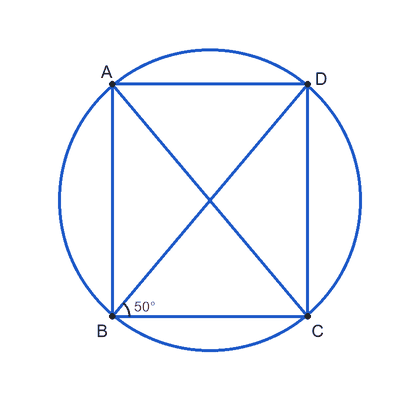
- 821 mark
Question 82
Points A, C, B and D are concyclic, AB is diameter and ∠ABC = 60°.
Assertion (A) : ∠BAC = 60°.
Reason (R) : AB is diameter so ∠ACB = 90° and ∠ABC + ∠BAC = 90°

- 831 mark
Question 83
AB is diameter of the circle and ∠ACD = 38°.
Assertion (A) : x = 38°.
Reason (R) : ∠ACB = 90°
x = ∠DCB = 90° – 38 = 52°
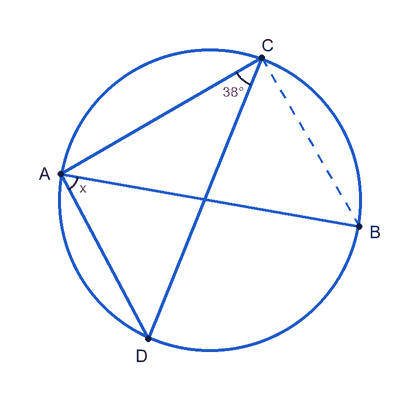
- 841 mark
Question 84
Chords AC and BD intersect each other at point P.
Assertion (A) : PA × PC = PB × PD
Reason (R) : ΔAPD ~ ΔBPC
⇒

- 851 mark
Question 85
A circle with centre at point O and ∠AOC = 160°.
Statement (1) : Angle x = 100° and angle y = 80°.
Statement (2) : The angle which, an arc of a circle subtends at the centre of the circle is double the angle which it subtends at any point on the remaining part of the circumference.
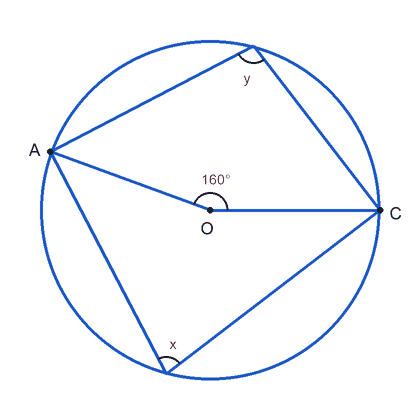
- 861 mark
Question 86
AC is diameter, AE is parallel to BC and ∠BAC = 50°.
Statement (1) : ∠EDC + 50° = 180°.
Statement (2) : ∠EDC + ∠EAC = 180°
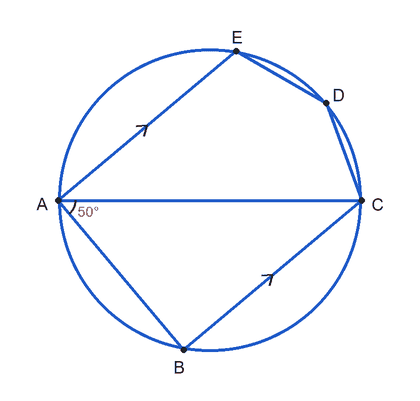
- 871 mark
Question 87
O is centre of the circle, OB = BC and ∠BOC = 20°
Statement (1) : x = 2 × 20° = 40°
Statement (2) : ∠BOC = 20°
x = ∠OAB + 20°
= ∠OBA + 20° = 40° + 20° = 60°
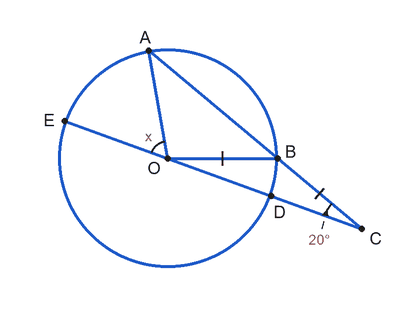
- 881 mark
Question 88
O is centre of the circle and ∠AOC = 120°.
Statement (1) : ∠ABC = 120°
Statement (2) : ∠ABC + ∠ADC = 180°
⇒ ∠ABC + 60° = 180°

- 893 marks
Question 89
In the given circle with diameter AB, find the value of x.
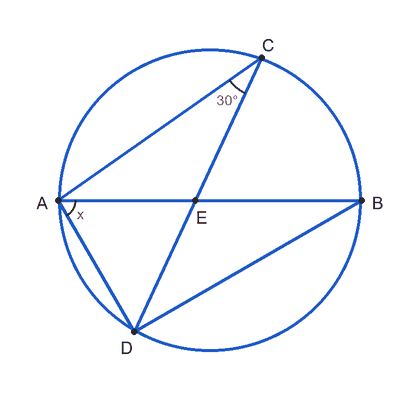
- 903 marks
Question 90
In the given figure, ABC is a triangle in which ∠BAC = 30°. Show that BC is equal to the radius of the circumcircle of the triangle ABC, whose centre is O.

- 913 marks
Question 91
Prove that the circle drawn on any one of the equal sides of an isosceles triangle as diameter bisects the base.
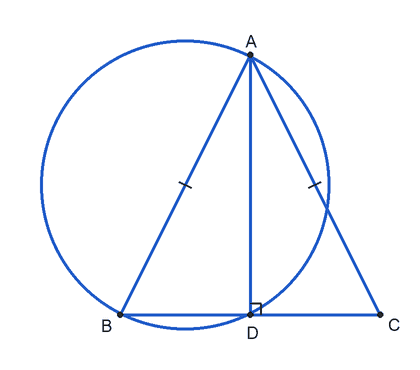
- 923 marks
Question 92
In the given figure, chord ED is parallel to diameter AC of the circle. Given ∠CBE = 65°, calculate ∠DEC.

- 933 marks
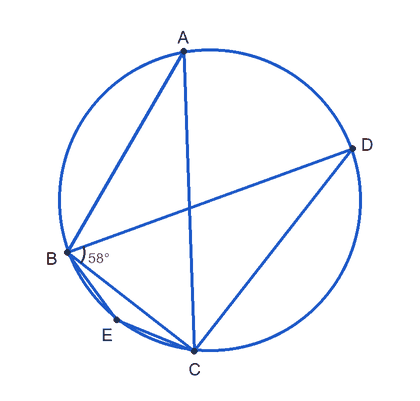
Question 93
In the figure, ∠DBC = 58°. BD is a diameter of the circle. Calculate :
(i) ∠BDC
(ii) ∠BEC
(iii) ∠BAC
- 943 marks
Question 94
D and E are points on equal sides AB and AC of an isosceles triangle ABC such that AD = AE. Prove that the points B, C, E and D are concyclic.

- 953 marks
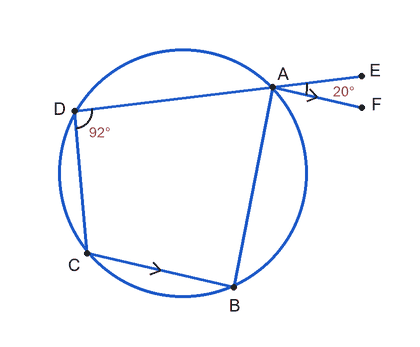
Question 95
In the given figure, ABCD is a cyclic quadrilateral. AF is drawn parallel to CB and DA is produced to point E. If ∠ADC = 92°, ∠FAE = 20°; determine ∠BCD. Give reason in support of your answer.
- 963 marks
Question 96
If I is the incentre of triangle ABC and AI when produced meets the circumcircle of triangle ABC in point D. If ∠BAC = 66° and ∠ABC = 80°. Calculate:
(i) ∠DBC,
(ii) ∠IBC,
(iii) ∠BIC.

- 973 marks
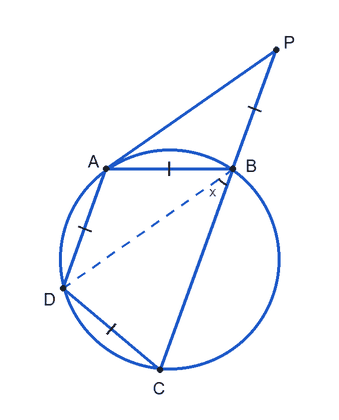
Question 97
In the given figure, AB = AD = DC = PB and ∠DBC = x°. Determine, in terms of x :
(i) ∠ABD, (ii) ∠APB.
Hence or otherwise, prove that AP is parallel to DB.
- 983 marks
Question 98
In the given figure; ABC, AEQ and CEP are straight lines. Show that ∠APE and ∠CQE are supplementary.

- 993 marks
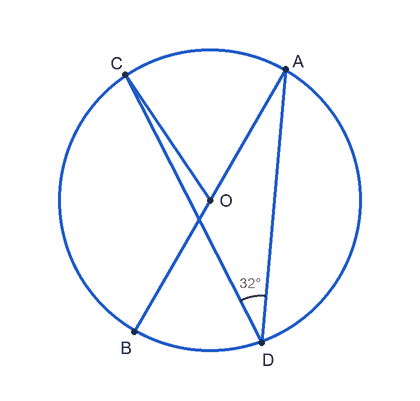
Question 99
In the given figure, AB is the diameter of the circle with centre O. If ∠ADC = 32°, find angle BOC.
- 1003 marks
Question 100
In a cyclic-quadrilateral PQRS, angle PQR = 135°. Sides SP and RQ produced meet at point A whereas sides PQ and SR produced meet at point B.
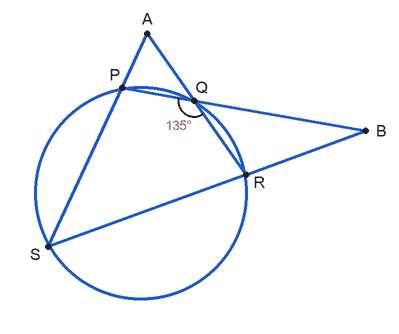
If ∠A : ∠B = 2 : 1; find angles A and B.
- 1013 marks
Question 101
In the following figure, ABCD is a cyclic quadrilateral in which AD is parallel to BC. If the bisector of angle A meets BC at point E and the given circle at point F, prove that :
(i) EF = FC (ii) BF = DF

- 1023 marks
Question 102
ABCD is a cyclic quadrilateral. Sides AB and DC produced meet at point E; whereas sides BC and AD produced meet at point F.
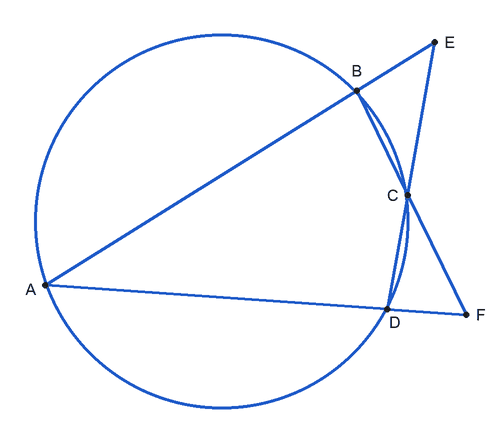
If ∠DCF : ∠F : ∠E = 3 : 5 : 4, find the angles of the cyclic quadrilateral ABCD.
- 1033 marks
Question 103
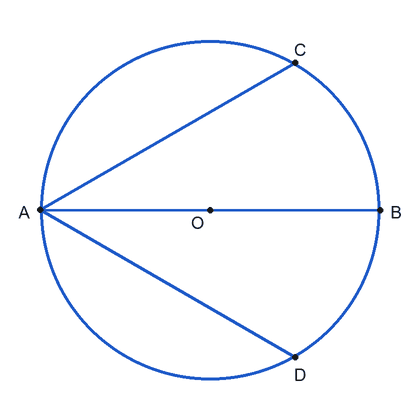
In the given figure, AB is the diameter of a circle with centre O.
If chord AC = chord AD, prove that :
(i) arc BC = arc DB
(ii) AB is bisector of ∠CAD.
Further, if the length of arc AC is twice the length of arc BC, find :
(a) ∠BAC (b) ∠ABC
- 1043 marks
Question 104
In cyclic quadrilateral ABCD; AD = BC, ∠BAC = 30° and ∠CBD = 70°; find :

(i) ∠BCD (ii) ∠BCA
(iii) ∠ABC (iv) ∠ADC
- 1053 marks
Question 105
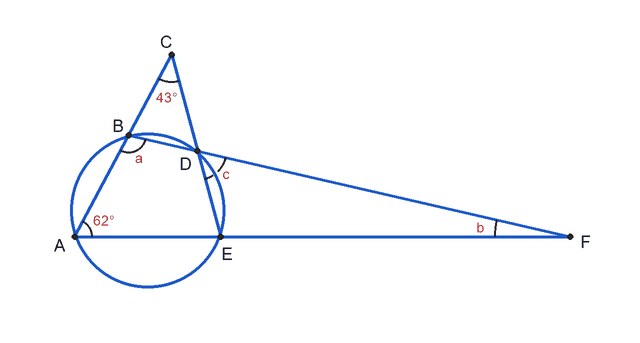
In the given figure, ∠ACE = 43° and ∠CAF = 62°; find the values of a, b and c.
- 1063 marks
Question 106
In the given figure, AB is parallel to DC, ∠BCE = 80° and ∠BAC = 25°. Find :
(i) ∠CAD (ii) ∠CBD (iii) ∠ADC
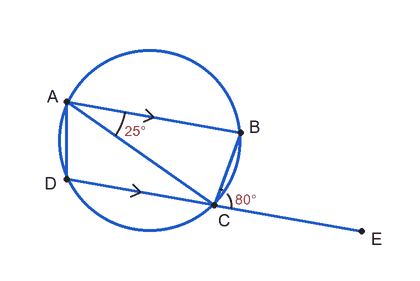
- 1073 marks
Question 107
In the figure, given below, CP bisects angle ACB. Show that DP bisects angle ADB.

- 1083 marks
Question 108
In the given figure, AD = BC, ∠BAC = 30° and ∠CBD = 70°. Find :
(i) ∠BCD
(ii) ∠BCA
(iii) ∠ABC
(iv) ∠ADB
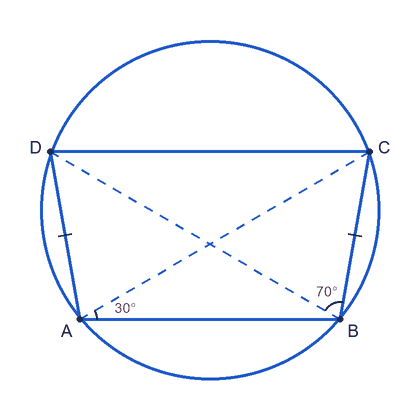
- 1093 marks
Question 109
In the given figure, AD is a diameter. O is the centre of the circle. AD is parallel to BC and ∠CBD = 32°. Find :
(i) ∠OBD
(ii) ∠AOB
(iii) ∠BED

- 1103 marks
Question 110
In the figure given, O is the centre of the circle. ∠DAE = 70°. Find giving suitable reasons, the measure of
(i) ∠BCD
(ii) ∠BOD
(iii) ∠OBD
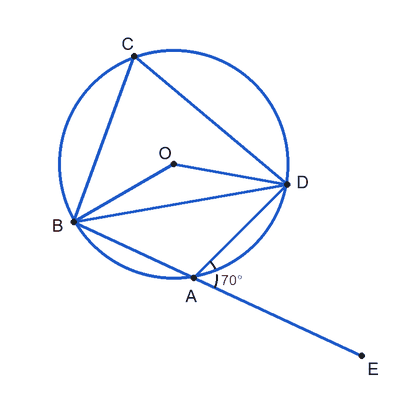
What Class 10 Maths Ch 17 covers
The sections of the chapter, in the order the book takes them. Every question above comes from one of these.
- 01Arc and Its Types
- 02Segment and Relation Between Arcs and Segments
- 03Cyclic Properties
- 04Some Important Results
More ways to study this chapter
The same chapter asked three other ways. Practise it, revise it, and see what the board has set on Ch 17 before.
- Competency-Based Questions (CBQ)Case study questions: a situation, and the part of the chapter that answers it.40questionsOpen
- Previous Year QuestionsQuestions that have actually appeared in board papers, each tagged with its year.14questionsOpen
- Practice QuestionsExtra questions per chapter, for when one attempt at a method is not enough.40questionsOpen
Ch 17 in past ICSE papers
The same chapter as the board has actually asked it. These are worded differently from the textbook exercise, which is the point of reading them.
- 14 marks
Board paper question 1
In the figure given below, AD is a diameter. O is the center of the circle. AD is parallel to BC and . Find:
(i)
(ii)
(iii) .
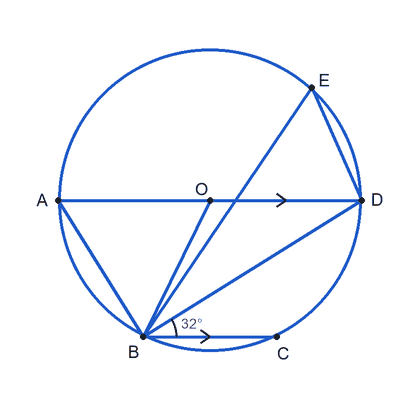 Solve with AI
Written solution
Solution:
Concept: These facts are used here.
- Parallel lines: a transversal cutting two parallel lines makes equal alternate angles.
- Angle at the centre: the angle that an arc subtends at the centre is double the angle it subtends at any point on the remaining part of the circle.
- Angle in a semicircle: the angle that a diameter subtends at any point on the circle is .
- Angles in the same segment: angles subtended by the same chord (or arc) at points on the circle on the same side of that chord are equal.
Step 1 — Find ∠OBD (part i).
AD is parallel to BC, and BD is a transversal that cuts them. So and are alternate angles and are equal.
O is the centre, so OB and OD are radii and is isosceles. The angles opposite the equal radii are equal, and is the same angle as because O lies on AD.
Step 2 — Find ∠AOB (part ii).
The arc AB subtends at the centre and at the point D on the rest of the circle. The angle at the centre is double the angle at the circle.
Step 3 — Find ∠ABD first (for part iii).
AD is a diameter and B is a point on the circle, so is an angle in a semicircle.
Now the angle sum of gives the angle at A.
Step 4 — Find ∠BED (part iii).
and are both subtended by the chord BD, and E and A lie on the same side of BD. So they are angles in the same segment and are equal.
Watch out: In part (ii) the angle at the centre is DOUBLE the angle at the circle; is not itself.
Therefore, , and .
- 23 marks
Board paper question 2
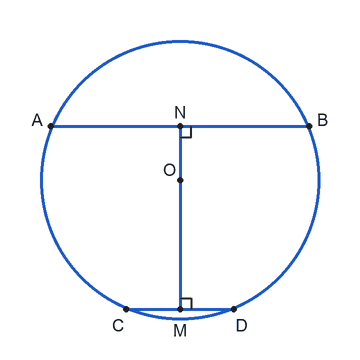
AB and CD are two parallel chords of a circle such that AB = 24 cm and CD = 10 cm. If the radius of the circle is 13 cm, find the distance between the two chords.
 Solve with AI
Written solution
Solution:
Concept: Perpendicular from the centre: the perpendicular from the centre of a circle to a chord bisects the chord, and the radius, the half-chord and the distance from the centre form a right-angled triangle. Pythagoras' theorem: in a right-angled triangle, .
Step 1 — Name the points.
Let O be the centre. Draw ON perpendicular to AB and OM perpendicular to CD. Because AB and CD are parallel, N, O and M lie on one straight line, and in the figure the chords are on opposite sides of O, so the distance between the chords is .
Step 2 — Distance of AB from O.
The perpendicular ON bisects AB, so AN is half of AB. In right the radius OA is the hypotenuse.
Step 3 — Distance of CD from O.
In the same way OM bisects CD, and in right the radius OC is the hypotenuse.
Step 4 — Add the two distances.
The chords lie on opposite sides of the centre, so the distances add.
Watch out: If the two chords were on the SAME side of the centre, the distance would be cm. The figure shows them on opposite sides, so the answer is cm.
Therefore, the distance between the two chords is cm.
- 34 marks
Board paper question 3
In the figure given, O is the centre of the circle. . Find giving suitable reasons, the measure of:
(i)
(ii)
(iii)
 Solve with AI
Written solution
Solution:
Concept: These facts are used here.
- Exterior angle of a cyclic quadrilateral: when one side of a cyclic quadrilateral is produced, the exterior angle formed equals the interior opposite angle.
- Angle at the centre: the angle that an arc subtends at the centre is double the angle it subtends at any point on the remaining part of the circle.
- Equal radii: two radii and a chord form an isosceles triangle, so the angles opposite the two radii are equal.
Step 1 — Find ∠BCD (part i).
ABCD is a cyclic quadrilateral, and its side BA is produced to E. So is the exterior angle at A, and it equals the interior opposite angle at C.
Step 2 — Find ∠BOD (part ii).
The arc BAD subtends at the centre and at C on the remaining part of the circle. The angle at the centre is double.
Step 3 — Find ∠OBD (part iii).
OB and OD are radii, so is isosceles with . These two equal angles share what is left of after .
Watch out: The exterior angle at A equals the interior angle at the OPPOSITE vertex C, not the angle at B or D.
Therefore, , and .
- 44 marks
Board paper question 4
PQRS is a cyclic quadrilateral. Given , and , calculate :
(i)
(ii)
(iii)
 Solve with AI
Written solution
Solution:
Concept: These facts are used here.
- Cyclic quadrilateral: the opposite angles of a quadrilateral whose four vertices lie on a circle add up to .
- Angle sum: the three angles of a triangle add up to .
- Angles in the same segment: angles subtended by the same chord (or arc) at points on the circle on the same side of that chord are equal.
Step 1 — Find ∠QRS (part i).
In the cyclic quadrilateral PQRS, the angles at P and R are opposite angles, so they add up to .
Step 2 — Find ∠PQR.
The angles at Q and S are also opposite angles of PQRS.
Step 3 — Find ∠RQS (part ii).
The diagonal QS splits into and , so subtract the known part.
Step 4 — Find ∠PSQ.
In two angles are known, so the angle sum gives the third.
Step 5 — Find ∠PRQ (part iii).
and are both subtended by the chord PQ, and R and S lie on the same side of PQ. So they are angles in the same segment and are equal.
Watch out: is the angle of the quadrilateral at S, not ; the diagonal QS splits it.
Therefore, , and .
- 53 marks
Board paper question 5
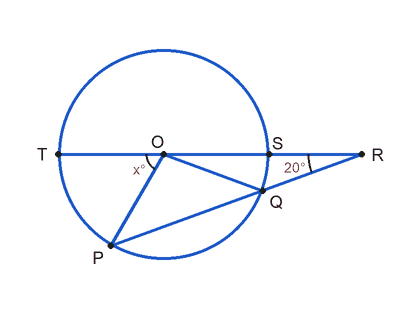
In the figure given below 'O' is the centre of the circle. If QR = OP and . Find the value of 'x' giving reasons.
 Solve with AI
Written solution
Solution:
Concept: These facts are used here.
- Equal radii: two radii and a chord form an isosceles triangle, so the angles opposite the two radii are equal.
- Exterior angle of a triangle: an exterior angle equals the sum of the two interior opposite angles.
Step 1 — Use QR = OP.
OP and OQ are radii, so they are equal. The question says QR equals OP, so QR equals OQ as well. In the angles opposite these equal sides are equal.
Step 2 — Find ∠OQP.
P, Q and R lie on one line, so is the exterior angle of at Q. It equals the sum of the two interior opposite angles.
Step 3 — Find ∠OPQ.
OP = OQ (radii), so is isosceles and its base angles are equal.
Step 4 — Find x.
T, O and R lie on one line, so is the exterior angle of at O. It equals the sum of the interior opposite angles at P and R.
Watch out: is the same angle as because Q lies on PR; do not add again.
Therefore, .
- 64 marks
Board paper question 6
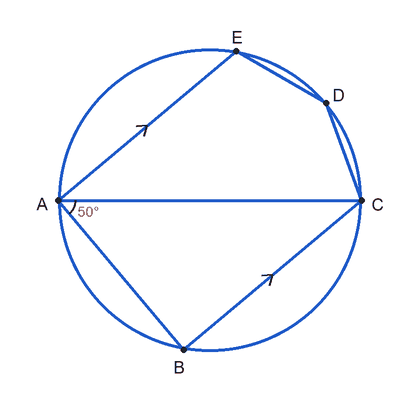
In the given figure, ABCDE is a pentagon inscribed in a circle such that AC is a diameter and side BC//AE. If , find giving reasons:
(i)
(ii)
(iii)
Hence, prove that BE is also a diameter.
Solve with AIWritten solution
Solution:
Concept: These facts are used here.
- Angle in a semicircle: the angle that a diameter subtends at any point on the circle is .
- Parallel lines: a transversal cutting two parallel lines makes equal alternate angles.
- Cyclic quadrilateral: the opposite angles of a quadrilateral whose four vertices lie on a circle add up to .
- Angles in the same segment: angles subtended by the same chord (or arc) at points on the circle on the same side of that chord are equal.
- Converse tests: a chord that subtends a right angle at a point on the circle is a diameter; a quadrilateral with a pair of opposite angles adding up to is cyclic.
Step 1 — Find ∠ACB (part i).
AC is a diameter and B is on the circle, so (angle in a semicircle). The angle sum of then gives .
Step 2 — Find ∠CAE.
BC is parallel to AE, and AC is a transversal. So and are alternate angles.
Step 3 — Find ∠EDC (part ii).
A, E, D and C lie on the circle, so AEDC is a cyclic quadrilateral. Its angles at A and D are opposite angles.
Step 4 — Find ∠BEC (part iii).
and are both subtended by the chord BC, and E and A lie on the same side of BC. So they are equal.
Step 5 — Prove that BE is a diameter.
AC is a diameter, so too. In :
Now add the two parts of the angle at C.
The chord BE subtends a right angle at the point C on the circle, so BE is a diameter.
Watch out: In part (ii) use the cyclic quadrilateral AEDC; the angle at D is opposite the angle at A, not the angle at E.
Therefore, , , , and BE is a diameter.
All 14 board paper questions for this chapter, solved the same way.
Class 10 Maths Ch 17 questions students ask
How many questions are there in Class 10 Maths Ch 17?
110 questions. Every one is solved step by step on this page.
Are these Class 10 Maths solutions free?
Yes. Every question and its full working is free to read, with no account needed.
Can I download the Class 10 Maths Ch 17 solutions as a PDF?
There is no PDF to download. Every solution is on this page instead, which means it is searchable, always the current syllabus, and readable on a phone. Use your browser's print option if you want it on paper.