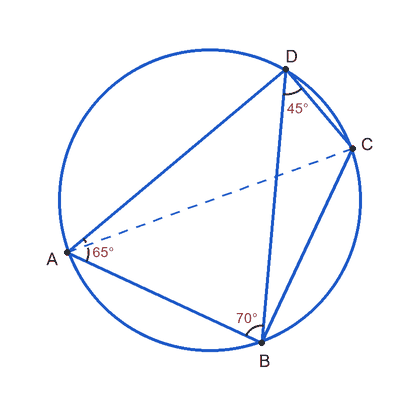
Solution:
Concept: These facts are used here.
- Cyclic quadrilateral: the opposite angles of a quadrilateral whose four vertices lie on a circle add up to 180∘.
- Angles in the same segment: angles subtended by the same chord (or arc) at points on the circle on the same side of that chord are equal.
- Converse: if a chord subtends a right angle at a point on the circle, the chord is a diameter; and if a pair of opposite angles of a quadrilateral add up to 180∘, its vertices lie on a circle (it is cyclic).
Step 1 — Part (i): find angle BCD.
∠BCD and ∠BAD are opposite angles of the cyclic quadrilateral ABCD.
∠BCD=180∘−∠BAD=180∘−65∘=115∘
Step 2 — Part (ii): find angle ADB.
In △ABD we know ∠BAD=65∘ and ∠ABD=70∘.
∠ADB=180∘−65∘−70∘=45∘
Step 3 — Part (ii): find angle ACB.
∠ACB and ∠ADB are both subtended by the chord AB, with C and D on the same side of AB. They are angles in the same segment.
∠ACB=∠ADB=45∘
Step 4 — Show that AC is a diameter.
DB lies inside ∠ADC, so ∠ADC is the sum of its two parts.
∠ADC=∠ADB+∠BDC=45∘+45∘=90∘
The chord AC subtends a right angle at D, a point on the circle, so AC is a diameter.
Watch out: ∠BDC=45∘ is given, but ∠ADB must be worked out before adding.
Therefore, (i) ∠BCD=115∘; (ii) ∠ACB=45∘; and ∠ADC=90∘ shows that AC is a diameter.