
Question 203 marksMedium
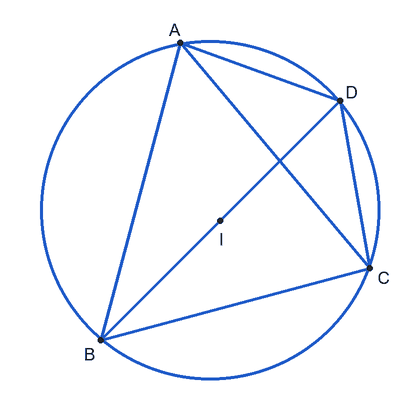
In the given figure, I is the incentre of ΔABC. BI when produced meets the circumcircle of Δ ABC at D. Given ∠BAC = 55° and ∠ACB = 65°; calculate :
(i) ∠DCA,
(ii) ∠DAC,
(iii) ∠DCI,
(iv) ∠AIC.
Confirming your payment
Sign up now and get 250 free tokens.
Circles · Question 20 of 110
In the given figure, I is the incentre of ΔABC. BI when produced meets the circumcircle of Δ ABC at D. Given ∠BAC = 55° and ∠ACB = 65°; calculate :
(i) ∠DCA,
(ii) ∠DAC,
(iii) ∠DCI,
(iv) ∠AIC.
Solution:
Concept: These facts are used here.
Step 1 — Find angle ABC.
By the angle sum of :
Step 2 — Halve the angles at the incentre.
I is the incentre, so BI (and BD) bisects , AI bisects and CI bisects .
Step 3 — Part (i): find angle DCA.
and are both subtended by the chord DA, with B and C on the same side of DA. They are angles in the same segment.
Step 4 — Part (ii): find angle DAC.
and are both subtended by the chord DC, with A and B on the same side of DC.
Step 5 — Part (iii): find angle DCI.
CA lies inside , so the angle is the sum of and .
Step 6 — Part (iv): find angle AIC.
In the angles at A and C are the half-angles from Step 2.
Watch out: Only the angle at B is split by BD; the halves at A and C come from AI and CI, which are not drawn in the figure.
Therefore, (i) ; (ii) ; (iii) ; (iv) .