
Question 653 marksMedium
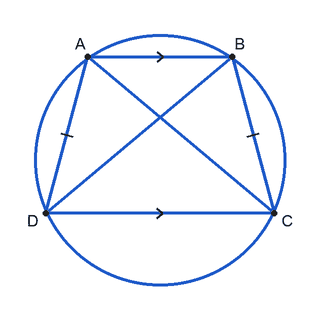
In a cyclic-trapezium, the non-parallel sides are equal and the diagonals are also equal. Prove it.
Confirming your payment
Sign up now and get 250 free tokens.
Circles · Question 65 of 110
In a cyclic-trapezium, the non-parallel sides are equal and the diagonals are also equal. Prove it.
Solution:
Concept: These facts are used here.
Given: ABCD is a cyclic trapezium with AB ∥ DC.
Step 1 — Set up.
Let ABCD be a cyclic trapezium with AB ∥ DC. We must prove AD = BC (non-parallel sides) and AC = BD (diagonals).
Step 2 — Find two equal angles.
AC is a transversal of the parallel lines AB and DC, so the alternate angles are equal.
Step 3 — Prove AD = BC.
is the angle that the chord AD subtends at C, and is the angle that the chord BC subtends at A. Equal angles at the circumference stand on equal chords, so AD = BC.
Step 4 — Prove the base angles at D and C are equal.
In the cyclic quadrilateral, . With BC as a transversal of AB ∥ DC, the co-interior angles give . Both equal , so .
Step 5 — Prove AC = BD.
Compare and : AD = BC (Step 3), (Step 4) and DC is common. So (SAS), and their corresponding sides AC and BD are equal.
Watch out: Match the angle with the chord it stands on: an angle at C between CA and CD stands on the chord AD.
Therefore, in a cyclic trapezium the non-parallel sides are equal (AD = BC) and the diagonals are equal (AC = BD). Hence proved.