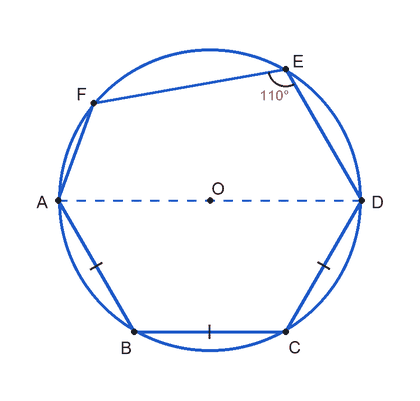
Solution:
Concept: These facts are used here.
- Angle in a semicircle: the angle that a diameter subtends at any point on the circle is 90∘.
- Cyclic quadrilateral: the opposite angles of a quadrilateral whose four vertices lie on a circle add up to 180∘.
- Equal chords: equal chords of a circle subtend equal angles at the centre (and equal angles at the circle), and cut off equal arcs.
- Angle at the centre: the angle that an arc subtends at the centre is double the angle it subtends at any point on the remaining part of the circle.
Step 1 — Part (i): join AE.
We join AE. AD is a diameter, so ∠AED is an angle in a semicircle and equals 90∘.
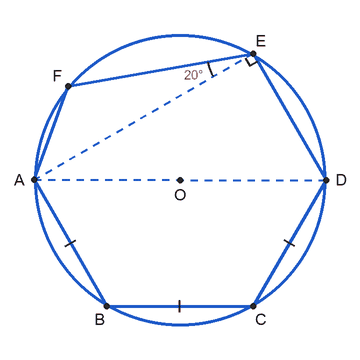
Step 2 — Part (i): find angle AEF.
EA lies inside ∠DEF, so ∠AEF is what is left after taking away ∠AED.
∠AEF=∠DEF−∠AED=110∘−90∘=20∘
Step 3 — Part (ii): find angle FAD.
∠FAD and ∠FED are opposite angles of the cyclic quadrilateral AFED.
∠FAD=180∘−∠FED=180∘−110∘=70∘
Step 4 — Part (ii): find angle BAD.
The equal chords AB, BC and CD cut the semicircle into three equal arcs, so each subtends 60∘ (one-third of 180∘) at O. The arc BD (two of these arcs) subtends ∠BOD=120∘ at the centre and ∠BAD at A.
∠BAD=21×∠BOD=21×120∘=60∘
Step 5 — Part (ii): add.
AD lies inside ∠FAB (F and B are on opposite sides of the diameter), so ∠FAB is the sum of the two parts.
∠FAB=∠FAD+∠DAB=70∘+60∘=130∘
Watch out: ∠DEF=110∘ is opposite ∠FAD in AFED; it is not opposite ∠FAB.
Therefore, (i) ∠AEF=20∘; (ii) ∠FAB=130∘.