
Question 673 marksMedium
If two sides of a cyclic-quadrilateral are parallel; prove that :
(i) its other two sides are equal.
(ii) its diagonals are equal.
Confirming your payment
Sign up now and get 250 free tokens.
Circles · Question 67 of 110
If two sides of a cyclic-quadrilateral are parallel; prove that :
(i) its other two sides are equal.
(ii) its diagonals are equal.
Solution:
Concept: These facts are used here.
Given: ABCD is a cyclic quadrilateral with AB ∥ DC.
Step 1 — Set up.
Let ABCD be a cyclic quadrilateral with AB ∥ DC. The other two sides are AD and BC, and the diagonals are AC and BD.
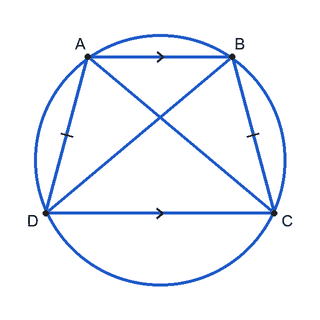
Step 2 — Part (i): find two equal angles.
AC is a transversal of the parallel lines AB and DC, so the alternate angles are equal.
Step 3 — Part (i): conclude.
is the angle that the chord BC subtends at A, and is the angle that the chord AD subtends at C. Equal angles at the circumference stand on equal chords, so BC = AD.
Step 4 — Part (ii): show the base angles at A and B are equal.
With AD as a transversal, the co-interior angles give ; in the cyclic quadrilateral, . Both equal , so .
Step 5 — Part (ii): use congruent triangles.
Compare and : AD = BC (part (i)), (Step 4) and AB is common. So (SAS), and the corresponding sides BD and AC are equal.
Watch out: List the vertices of the congruent triangles in matching order (A ↔ B, B ↔ A, D ↔ C) so that BD matches AC.
Therefore, (i) the other two sides are equal (AD = BC); (ii) the diagonals are equal (AC = BD). Hence proved.