Solution:
Concept: These facts are used here.
- An exterior angle of a triangle equals the sum of the two interior opposite angles.
- Vertically opposite angles are equal.
- Cyclic quadrilateral: the opposite angles of a quadrilateral whose four vertices lie on a circle add up to 180∘.
Step 1 — Write the angles with one letter.
Let each of the equal ratios be k, so x=3k, y=4k and z=5k.
Step 2 — Move x to triangle BCP.
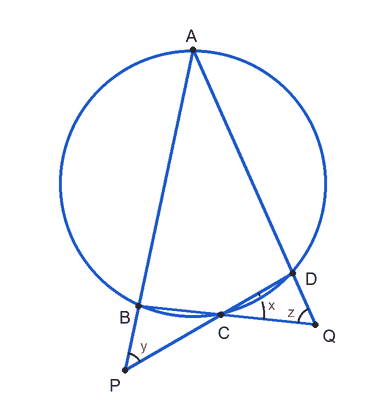
The lines PCD and QCB cross at C, so the vertically opposite angles ∠BCP and ∠DCQ are equal.
∠BCP=∠DCQ=x
Step 3 — Find angle ABC.
PBA is a straight line, so ∠ABC is the exterior angle of △BCP at B. It equals the sum of the interior opposite angles at P and C.
∠ABC=y+x
Step 4 — Find angle ADC.
QDA is a straight line, so ∠ADC is the exterior angle of △DCQ at D.
∠ADC=z+x
Step 5 — Use the cyclic quadrilateral ABCD.
∠ABC and ∠ADC are opposite angles of ABCD, so they add up to 180∘.
(y+x)+(z+x)2x+y+z6k+4k+5k15kk=180∘=180∘=180∘=180∘=12∘
Step 6 — Find x, y and z.
Multiply k=12∘ by 3, 4 and 5.
x=3×12∘=36∘
y=4×12∘=48∘
z=5×12∘=60∘
Check: The angles of the cyclic quadrilateral at B and D are 48∘+36∘=84∘ and 60∘+36∘=96∘, and
84∘+96∘=180∘
Watch out: x appears in BOTH exterior angles (once as ∠BCP, once as ∠DCQ), so the equation has 2x.
Therefore, x=36∘, y=48∘ and z=60∘.