
Question 383 marksEasy
Prove that :
(i) the parallelogram, inscribed in a circle, is a rectangle.
(ii) the rhombus, inscribed in a circle, is a square.
Confirming your payment
Sign up now and get 250 free tokens.
Circles · Question 38 of 110
Prove that :
(i) the parallelogram, inscribed in a circle, is a rectangle.
(ii) the rhombus, inscribed in a circle, is a square.
Solution:
Concept: These facts are used here.
Step 1 — Part (i): set up.
Let ABCD be a parallelogram inscribed in a circle.

Step 2 — Part (i): combine the two facts.
As a parallelogram, ABCD has equal opposite angles, so . As a cyclic quadrilateral, its opposite angles add up to . So two equal angles add up to .
Step 3 — Part (i): conclude.
Adjacent angles of a parallelogram add up to , so once one angle is every angle is . A parallelogram with all angles is a rectangle.
Step 4 — Part (ii): use part (i).
A rhombus is a parallelogram, so by part (i) a rhombus inscribed in a circle has all its angles equal to . A rhombus (all sides equal) with all angles is a square.
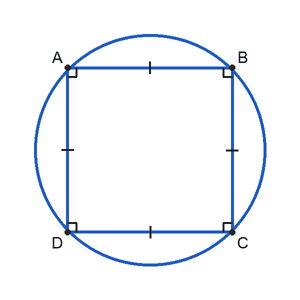
Watch out: The proof uses BOTH properties: 'opposite angles equal' (parallelogram) and 'opposite angles add up to ' (cyclic).
Therefore, (i) an inscribed parallelogram is a rectangle; (ii) an inscribed rhombus is a square. Hence proved.