
Opening your dashboard
Class 10 Maths Chapter 17 Circles: Previous Year Questions
14 questions on Chapter 17, each solved step by step. Class 10 Maths, ICSE 2026-27.
14 questions with solutions
1–4 marks · Mixed difficulty
- 14 marks
Question 1
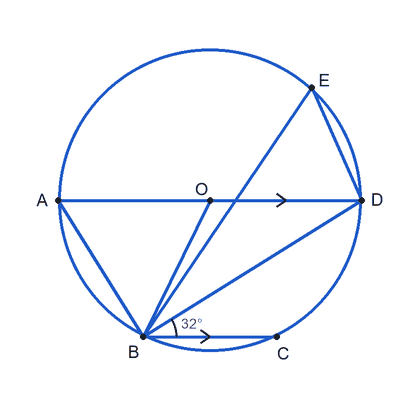
In the figure given below, AD is a diameter. O is the center of the circle. AD is parallel to BC and . Find:
(i)
(ii)
(iii) .
 Solve with AI
Written solution
Solution:
Concept: These facts are used here.
- Parallel lines: a transversal cutting two parallel lines makes equal alternate angles.
- Angle at the centre: the angle that an arc subtends at the centre is double the angle it subtends at any point on the remaining part of the circle.
- Angle in a semicircle: the angle that a diameter subtends at any point on the circle is .
- Angles in the same segment: angles subtended by the same chord (or arc) at points on the circle on the same side of that chord are equal.
Step 1 — Find ∠OBD (part i).
AD is parallel to BC, and BD is a transversal that cuts them. So and are alternate angles and are equal.
O is the centre, so OB and OD are radii and is isosceles. The angles opposite the equal radii are equal, and is the same angle as because O lies on AD.
Step 2 — Find ∠AOB (part ii).
The arc AB subtends at the centre and at the point D on the rest of the circle. The angle at the centre is double the angle at the circle.
Step 3 — Find ∠ABD first (for part iii).
AD is a diameter and B is a point on the circle, so is an angle in a semicircle.
Now the angle sum of gives the angle at A.
Step 4 — Find ∠BED (part iii).
and are both subtended by the chord BD, and E and A lie on the same side of BD. So they are angles in the same segment and are equal.
Watch out: In part (ii) the angle at the centre is DOUBLE the angle at the circle; is not itself.
Therefore, , and .
- 23 marks
Question 2
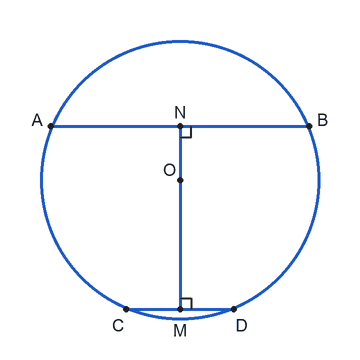
AB and CD are two parallel chords of a circle such that AB = 24 cm and CD = 10 cm. If the radius of the circle is 13 cm, find the distance between the two chords.
 Solve with AI
Written solution
Solution:
Concept: Perpendicular from the centre: the perpendicular from the centre of a circle to a chord bisects the chord, and the radius, the half-chord and the distance from the centre form a right-angled triangle. Pythagoras' theorem: in a right-angled triangle, .
Step 1 — Name the points.
Let O be the centre. Draw ON perpendicular to AB and OM perpendicular to CD. Because AB and CD are parallel, N, O and M lie on one straight line, and in the figure the chords are on opposite sides of O, so the distance between the chords is .
Step 2 — Distance of AB from O.
The perpendicular ON bisects AB, so AN is half of AB. In right the radius OA is the hypotenuse.
Step 3 — Distance of CD from O.
In the same way OM bisects CD, and in right the radius OC is the hypotenuse.
Step 4 — Add the two distances.
The chords lie on opposite sides of the centre, so the distances add.
Watch out: If the two chords were on the SAME side of the centre, the distance would be cm. The figure shows them on opposite sides, so the answer is cm.
Therefore, the distance between the two chords is cm.
- 34 marks
Question 3
In the figure given, O is the centre of the circle. . Find giving suitable reasons, the measure of:
(i)
(ii)
(iii)
 Solve with AI
Written solution
Solution:
Concept: These facts are used here.
- Exterior angle of a cyclic quadrilateral: when one side of a cyclic quadrilateral is produced, the exterior angle formed equals the interior opposite angle.
- Angle at the centre: the angle that an arc subtends at the centre is double the angle it subtends at any point on the remaining part of the circle.
- Equal radii: two radii and a chord form an isosceles triangle, so the angles opposite the two radii are equal.
Step 1 — Find ∠BCD (part i).
ABCD is a cyclic quadrilateral, and its side BA is produced to E. So is the exterior angle at A, and it equals the interior opposite angle at C.
Step 2 — Find ∠BOD (part ii).
The arc BAD subtends at the centre and at C on the remaining part of the circle. The angle at the centre is double.
Step 3 — Find ∠OBD (part iii).
OB and OD are radii, so is isosceles with . These two equal angles share what is left of after .
Watch out: The exterior angle at A equals the interior angle at the OPPOSITE vertex C, not the angle at B or D.
Therefore, , and .
- 44 marks
Question 4
PQRS is a cyclic quadrilateral. Given , and , calculate :
(i)
(ii)
(iii)
 Solve with AI
Written solution
Solution:
Concept: These facts are used here.
- Cyclic quadrilateral: the opposite angles of a quadrilateral whose four vertices lie on a circle add up to .
- Angle sum: the three angles of a triangle add up to .
- Angles in the same segment: angles subtended by the same chord (or arc) at points on the circle on the same side of that chord are equal.
Step 1 — Find ∠QRS (part i).
In the cyclic quadrilateral PQRS, the angles at P and R are opposite angles, so they add up to .
Step 2 — Find ∠PQR.
The angles at Q and S are also opposite angles of PQRS.
Step 3 — Find ∠RQS (part ii).
The diagonal QS splits into and , so subtract the known part.
Step 4 — Find ∠PSQ.
In two angles are known, so the angle sum gives the third.
Step 5 — Find ∠PRQ (part iii).
and are both subtended by the chord PQ, and R and S lie on the same side of PQ. So they are angles in the same segment and are equal.
Watch out: is the angle of the quadrilateral at S, not ; the diagonal QS splits it.
Therefore, , and .
- 53 marks
Question 5
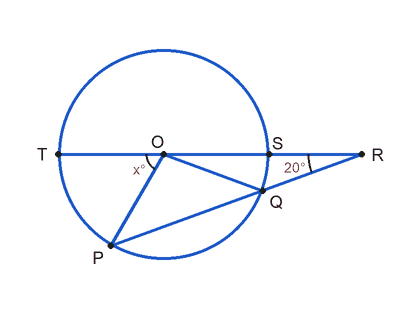
In the figure given below 'O' is the centre of the circle. If QR = OP and . Find the value of 'x' giving reasons.
 Solve with AI
Written solution
Solution:
Concept: These facts are used here.
- Equal radii: two radii and a chord form an isosceles triangle, so the angles opposite the two radii are equal.
- Exterior angle of a triangle: an exterior angle equals the sum of the two interior opposite angles.
Step 1 — Use QR = OP.
OP and OQ are radii, so they are equal. The question says QR equals OP, so QR equals OQ as well. In the angles opposite these equal sides are equal.
Step 2 — Find ∠OQP.
P, Q and R lie on one line, so is the exterior angle of at Q. It equals the sum of the two interior opposite angles.
Step 3 — Find ∠OPQ.
OP = OQ (radii), so is isosceles and its base angles are equal.
Step 4 — Find x.
T, O and R lie on one line, so is the exterior angle of at O. It equals the sum of the interior opposite angles at P and R.
Watch out: is the same angle as because Q lies on PR; do not add again.
Therefore, .
- 64 marks
Question 6
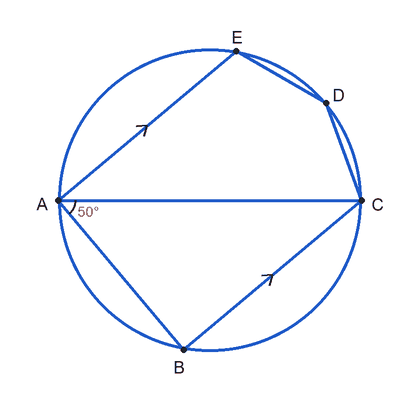
In the given figure, ABCDE is a pentagon inscribed in a circle such that AC is a diameter and side BC//AE. If , find giving reasons:
(i)
(ii)
(iii)
Hence, prove that BE is also a diameter.
Solve with AIWritten solution
Solution:
Concept: These facts are used here.
- Angle in a semicircle: the angle that a diameter subtends at any point on the circle is .
- Parallel lines: a transversal cutting two parallel lines makes equal alternate angles.
- Cyclic quadrilateral: the opposite angles of a quadrilateral whose four vertices lie on a circle add up to .
- Angles in the same segment: angles subtended by the same chord (or arc) at points on the circle on the same side of that chord are equal.
- Converse tests: a chord that subtends a right angle at a point on the circle is a diameter; a quadrilateral with a pair of opposite angles adding up to is cyclic.
Step 1 — Find ∠ACB (part i).
AC is a diameter and B is on the circle, so (angle in a semicircle). The angle sum of then gives .
Step 2 — Find ∠CAE.
BC is parallel to AE, and AC is a transversal. So and are alternate angles.
Step 3 — Find ∠EDC (part ii).
A, E, D and C lie on the circle, so AEDC is a cyclic quadrilateral. Its angles at A and D are opposite angles.
Step 4 — Find ∠BEC (part iii).
and are both subtended by the chord BC, and E and A lie on the same side of BC. So they are equal.
Step 5 — Prove that BE is a diameter.
AC is a diameter, so too. In :
Now add the two parts of the angle at C.
The chord BE subtends a right angle at the point C on the circle, so BE is a diameter.
Watch out: In part (ii) use the cyclic quadrilateral AEDC; the angle at D is opposite the angle at A, not the angle at E.
Therefore, , , , and BE is a diameter.
- 73 marks
Question 7
In the figure given below, O is the centre of the circle and is a diameter. If and . Find:
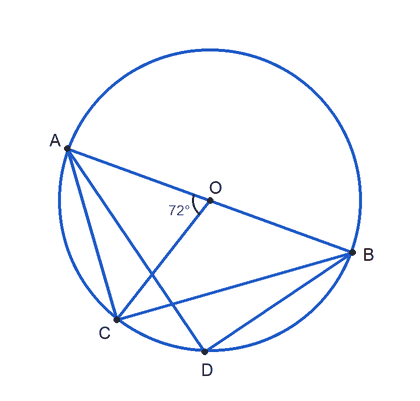
(i)
(ii)
(iii)
Solve with AIWritten solution
Solution:
Concept: These facts are used here.
- Angle at the centre: the angle that an arc subtends at the centre is double the angle it subtends at any point on the remaining part of the circle.
- Equal chords: equal chords of a circle subtend equal angles at points on the circle.
- Angle in a semicircle: the angle that a diameter subtends at any point on the circle is .
Step 1 — Find ∠ABC (part i).
The arc AC subtends at the centre and at B on the remaining part of the circle, so is half of .
Step 2 — Find ∠BAD (part ii).
The chords AC and BD are equal, so they subtend equal angles at points on the circle: stands on AC and stands on BD.
Step 3 — Find ∠ABD (part iii).
AB is a diameter and D is on the circle, so . The angle sum of gives .
Watch out: is half of , not ; only the angle at the centre is .
Therefore, , and .
- 81 mark
Question 8
ABCD is a cyclic quadrilateral. If and then is equal to:
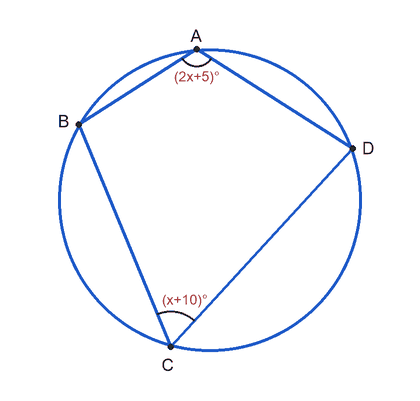 Solve with AI
Answer
(A)
(B)
- Correct
(C)
(D)
Answer: (C)
Concept: Cyclic quadrilateral: the opposite angles of a quadrilateral whose four vertices lie on a circle add up to .
Step 1 — Write the cyclic-quadrilateral equation.
and are opposite angles of the cyclic quadrilateral ABCD, so they add up to .
Step 2 — Solve for x.
Collect the terms, then divide by 3.
Step 3 — Check.
Put back: the two angles are and .
Watch out: The opposite angles add up to ; they are not equal. Setting the two expressions equal gives the wrong value 5.
Why the other options are wrong:
- (A) : with the two angles are and , which add up to , not .
- (B) : with the two angles are and , which add up to , not .
- (D) : comes from making the two angles equal ( each); they add up to only .
Therefore, , option (C).
- 92 marks
Question 9
In the given figure A, B, C and D are points on the circle with centre O. Given .
Find:
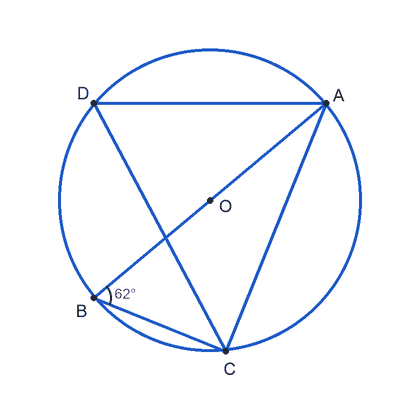
(a)
(b)
Solve with AIWritten solution
Solution:
Concept: These facts are used here.
- Angles in the same segment: angles subtended by the same chord (or arc) at points on the circle on the same side of that chord are equal.
- Angle in a semicircle: the angle that a diameter subtends at any point on the circle is .
- Angle sum: the three angles of a triangle add up to .
Step 1 — Spot the diameter.
The chord AB passes through the centre O, so AB is a diameter. The given angle is the angle at B between the diameter BA and the chord BC.
Step 2 — Find ∠ADC (part a).
and are both subtended by the chord AC, and D and B lie on the same side of AC. So they are angles in the same segment and are equal.
Step 3 — Find ∠CAB (part b).
AB is a diameter and C is on the circle, so . The angle sum of gives .
Watch out: The right angle in is at C, the point on the circle, not at A or B.
Therefore, and .
- 101 mark
Question 10
In the given diagram, chords AC and BC are equal. If , then is:
 Solve with AI
Answer
(A)
(B)
(C)
- Correct
(D)
Answer: (D)
Concept: These facts are used here.
- Linear pair: angles on a straight line add up to .
- Isosceles triangle: the angles opposite equal sides are equal.
- Cyclic quadrilateral: the opposite angles of a quadrilateral whose four vertices lie on a circle add up to .
Step 1 — Find ∠ACB.
B, C and D lie on one straight line, so and form a linear pair.
Step 2 — Find ∠ABC.
AC = BC, so in the angles opposite these sides are equal: . They share what is left of .
So is in fact equilateral.
Step 3 — Use the cyclic quadrilateral ABCE.
A, B, C and E lie on the circle, and E is on the arc AC away from B. So ABCE is a cyclic quadrilateral, and its angles at B and E are opposite angles.
Watch out: E lies on the other side of AC from B, so is the SUPPLEMENT of , not equal to it.
Why the other options are wrong:
- (A) : is half of ; no rule of the circle gives half here.
- (B) : is . It would be only if E were on the same side of AC as B.
- (C) : would need AC to be a diameter, but , not .
Therefore, , option (D).
- 111 mark
Question 11
In the adjoining diagram, PQ is a tangent at A to the circle with centre O. If , then is:
 Solve with AI
Answer
(A)
- Correct
(B)
(C)
(D)
Answer: (B)
Concept: These facts are used here.
- Equal radii: two radii and a chord form an isosceles triangle, so the angles opposite the two radii are equal.
- Angle sum: the three angles of a triangle add up to .
- Angle at the centre: the angle that an arc subtends at the centre is double the angle it subtends at any point on the remaining part of the circle.
Step 1 — Use the equal radii.
OA and OC are radii, so is isosceles and its base angles are equal.
Step 2 — Find ∠AOC.
The angle sum of gives the angle at the centre.
Step 3 — Halve it.
The arc AC subtends at the centre and at B on the remaining part of the circle.
Watch out: The tangent PQ is not needed here; it only tells us that OA is perpendicular to PQ.
Why the other options are wrong:
- (A) : does not follow from any rule; it is not linked to the given .
- (C) : would need to be , which makes equal to .
- (D) : is , the angle at the centre; the angle at B is half of it.
Therefore, , option (B).
- 124 marks
Question 12
In the adjoining diagram and .
(a) Find and .
(b) Prove that CBGH is a cyclic quadrilateral.
 Solve with AI
Written solution
Solution:
Concept: These facts are used here.
- Angle at the centre: the angle that an arc subtends at the centre is double the angle it subtends at any point on the remaining part of the circle.
- Angle in a semicircle: the angle that a diameter subtends at any point on the circle is .
- Angle sum: the three angles of a triangle add up to .
- Converse tests: a chord that subtends a right angle at a point on the circle is a diameter; a quadrilateral with a pair of opposite angles adding up to is cyclic.
Step 1 — Find ∠DBC (part a).
The arc DE subtends at the centre and at B. E lies on BC, so is the same angle as , and it is half the angle at the centre.
Step 2 — Find ∠BDC.
AB is a diameter (it passes through O), so . A, D and C lie on one line, so is the other angle of this linear pair.
Step 3 — Find ∠DCE (part a).
E lies on CB, so is the angle of . Its angle sum gives it.
Step 4 — Prove CBGH is cyclic (part b).
H lies on CA produced, so is the same angle as . Add the opposite angles of the quadrilateral CBGH at C and at G.
A pair of opposite angles of CBGH adds up to , so its four vertices lie on a circle.
Watch out: is HALF of , because the arc DE subtends at the centre.
Therefore, and , and CBGH is a cyclic quadrilateral.
- 134 marks
Question 13
In the adjoining figure of a circle with centre O and diameter AD, and BC is parallel to AD. Find:
(a)
(b)
(c)
(d)
 Solve with AI
Written solution
Solution:
Concept: These facts are used here.
- Angles in the same segment: angles subtended by the same chord (or arc) at points on the circle on the same side of that chord are equal.
- Angle at the centre: the angle that an arc subtends at the centre is double the angle it subtends at any point on the remaining part of the circle.
- Angle in a semicircle: the angle that a diameter subtends at any point on the circle is .
- Parallel lines: a transversal cutting two parallel lines makes equal alternate angles.
- Exterior angle of a cyclic quadrilateral: when one side of a cyclic quadrilateral is produced, the exterior angle formed equals the interior opposite angle.
Step 1 — Find ∠BAD (part a).
and are both subtended by the chord BD, and A and E lie on the same side of BD. So they are equal.
Step 2 — Find ∠BOD (part b).
The arc BD subtends at the centre and at A, so it is double.
Step 3 — Find ∠DBC (part c).
AD is a diameter, so . The angle sum of gives .
BC is parallel to AD and BD is a transversal, so and are alternate angles.
Step 4 — Find ∠DCF (part d).
A, B, C and D lie on the circle, so ABCD is a cyclic quadrilateral. BC is produced to F, so is the exterior angle at C, and it equals the interior opposite angle at A.
Watch out: For part (d), the interior angle OPPOSITE C in ABCD is the angle at A, not the angle at B.
Therefore, , , and .
- 141 mark
Question 14
In the given diagram, O is the centre of the circle and ABCD is a cyclic quadrilateral. If , then the value of is :
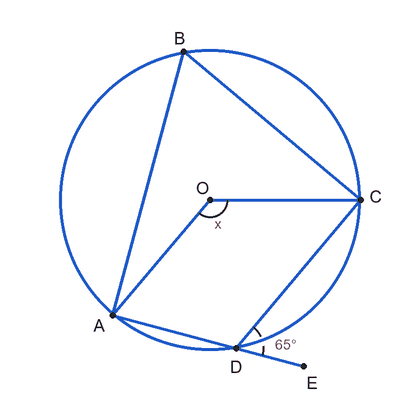 Solve with AI
Answer
(A)
(B)
(C)
- Correct
(D)
Answer: (D)
Concept: These facts are used here.
- Exterior angle of a cyclic quadrilateral: when one side of a cyclic quadrilateral is produced, the exterior angle formed equals the interior opposite angle.
- Angle at the centre: the angle that an arc subtends at the centre is double the angle it subtends at any point on the remaining part of the circle.
Step 1 — Find ∠ABC.
AD is produced to E, so is the exterior angle of the cyclic quadrilateral ABCD at D. It equals the interior opposite angle at B.
Step 2 — Double it to get x.
The arc ADC subtends at the centre and at B on the remaining part of the circle. The angle at the centre is double.
Watch out: The angle x is at the CENTRE, so it is double , not equal to it.
Why the other options are wrong:
- (A) : halves instead of doubling it.
- (B) : is , the angle at the circle, not the angle at the centre.
- (C) : is (), the interior angle at D.
Therefore, , option (D).