
Question 14 marksAsked 2016Medium
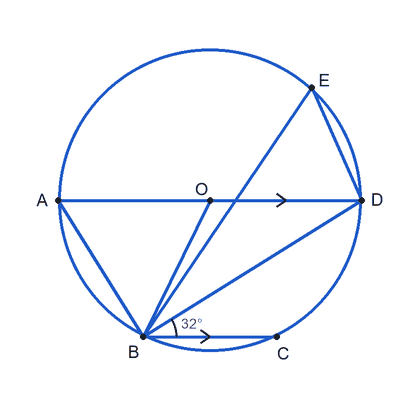
In the figure given below, AD is a diameter. O is the center of the circle. AD is parallel to BC and . Find:
(i)
(ii)
(iii) .
Confirming your payment
Sign up now and get 250 free tokens.
Previous Year Questions · Question 1 of 14
In the figure given below, AD is a diameter. O is the center of the circle. AD is parallel to BC and . Find:
(i)
(ii)
(iii) .
Solution:
Concept: These facts are used here.
Step 1 — Find ∠OBD (part i).
AD is parallel to BC, and BD is a transversal that cuts them. So and are alternate angles and are equal.
O is the centre, so OB and OD are radii and is isosceles. The angles opposite the equal radii are equal, and is the same angle as because O lies on AD.
Step 2 — Find ∠AOB (part ii).
The arc AB subtends at the centre and at the point D on the rest of the circle. The angle at the centre is double the angle at the circle.
Step 3 — Find ∠ABD first (for part iii).
AD is a diameter and B is a point on the circle, so is an angle in a semicircle.
Now the angle sum of gives the angle at A.
Step 4 — Find ∠BED (part iii).
and are both subtended by the chord BD, and E and A lie on the same side of BD. So they are angles in the same segment and are equal.
Watch out: In part (ii) the angle at the centre is DOUBLE the angle at the circle; is not itself.
Therefore, , and .