Solution:
Concept: These facts are used here.
- Angle sum: the three angles of a triangle add up to 180∘.
- Cyclic quadrilateral: the opposite angles of a quadrilateral whose four vertices lie on a circle add up to 180∘.
- Exterior angle of a cyclic quadrilateral: when one side of a cyclic quadrilateral is produced, the exterior angle formed equals the interior opposite angle.
Step 1 — Find angle AEC.
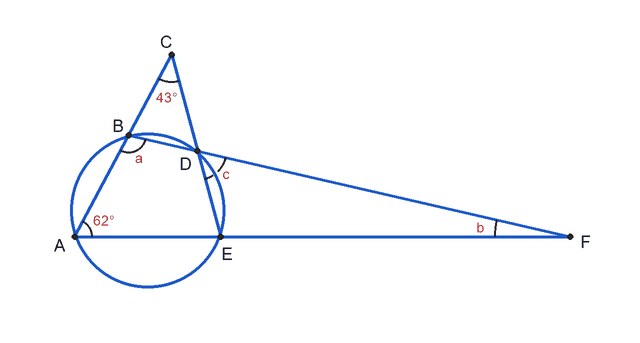
In △ACE, the angle at A is the given ∠CAF (62∘), because E lies on AF, and ∠ACE=43∘.
∠AEC=180∘−62∘−43∘=75∘
Step 2 — Find a.
Here a stands for ∠ABD. ABDE is a cyclic quadrilateral in which ∠ABD and ∠AED are opposite angles, and ∠AED is the same angle as ∠AEC (75∘) because D lies on EC.
a=180∘−∠AED=180∘−75∘=105∘
Step 3 — Find c.
BDF is a straight line, so BD is produced to F, and c=∠EDF is the exterior angle of ABDE at D. It equals the interior opposite angle at A.
c=∠BAE=62∘
Step 4 — Find b.
In △ABF, the angle at A is 62∘, and the angle at B is ∠ABF, the same as a (105∘), since D lies on BF.
b=180∘−∠BAF−∠ABF=180∘−62∘−105∘=13∘
Watch out: The angle at A is the same 62∘ in △ACE, in ABDE and in △ABF, because C, B lie on one arm and E, F on the other.
Therefore, a=105∘, b=13∘ and c=62∘.