
Question 1063 marksEasy
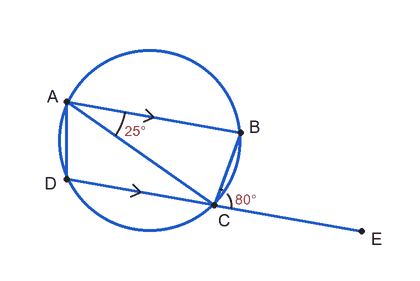
In the given figure, AB is parallel to DC, ∠BCE = 80° and ∠BAC = 25°. Find :
(i) ∠CAD (ii) ∠CBD (iii) ∠ADC
Confirming your payment
Sign up now and get 250 free tokens.
Circles · Question 106 of 110
In the given figure, AB is parallel to DC, ∠BCE = 80° and ∠BAC = 25°. Find :
(i) ∠CAD (ii) ∠CBD (iii) ∠ADC
Solution:
Concept: These facts are used here.
Step 1 — Find angle BAD.
DC is produced to E, so is the exterior angle of ABCD at C. It equals the interior opposite angle at A.
Step 2 — Part (i): find angle CAD.
AC lies inside , so is what is left after taking away .
Step 3 — Part (ii): find angle CBD.
and are both subtended by the chord CD, with A and B on the same side of CD.
Step 4 — Part (iii): find angle ADC.
AD is a transversal of the parallel lines AB and DC, so and are co-interior angles.
Watch out: is an exterior angle at C, so it equals the angle at A (opposite C), not .
Therefore, (i) ; (ii) ; (iii) .