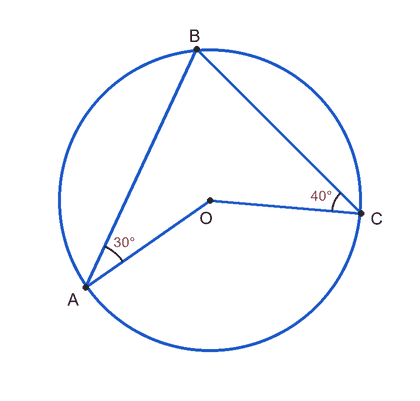
Answer: (D) 140°
Concept: These facts are used here.
- Radii are equal: two radii and a chord form an isosceles triangle, so the angles opposite the two radii are equal.
- Angle at the centre: the angle that an arc subtends at the centre is double the angle it subtends at any point on the remaining part of the circle.
Step 1 — Use the equal radii.
OA = OB and OB = OC (radii), so each of △OAB and △OBC is isosceles.
∠OBA=∠OAB=30∘
∠OBC=∠OCB=40∘
Step 2 — Find angle ABC.
OB lies inside ∠ABC, so ∠ABC is the sum of the two parts.
∠ABC=∠OBA+∠OBC=30∘+40∘=70∘
Step 3 — Double it.
The arc AC subtends ∠AOC at the centre and ∠ABC at B, on the remaining part of the circle.
∠AOC=2×∠ABC=2×70∘=140∘
Watch out: Both given angles are at the ends of radii; move each one to B first, then double the total.
Why the other options are wrong:
- (A) 70°: 70∘ is ∠ABC, the angle at the circumference. The angle at the centre is double it.
- (B) 80°: 80∘ is 2×40∘; it doubles only one part of ∠ABC.
- (C) 150°: 150∘ would need ∠ABC=75∘, but Step 2 gives 70∘.
Therefore, ∠AOC=140∘, option (D).