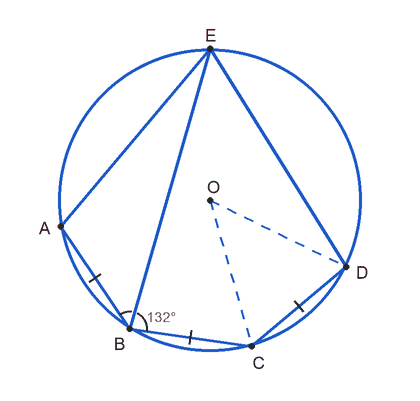
Solution:
Concept: These facts are used here.
- Cyclic quadrilateral: the opposite angles of a quadrilateral whose four vertices lie on a circle add up to 180∘.
- Equal chords: equal chords of a circle subtend equal angles at the centre (and equal angles at the circle), and cut off equal arcs.
- Angle at the centre: the angle that an arc subtends at the centre is double the angle it subtends at any point on the remaining part of the circle.
Step 1 — Part (i): join EC.
We join EC. Then ABCE is a cyclic quadrilateral in which ∠AEC and ∠ABC are opposite angles.
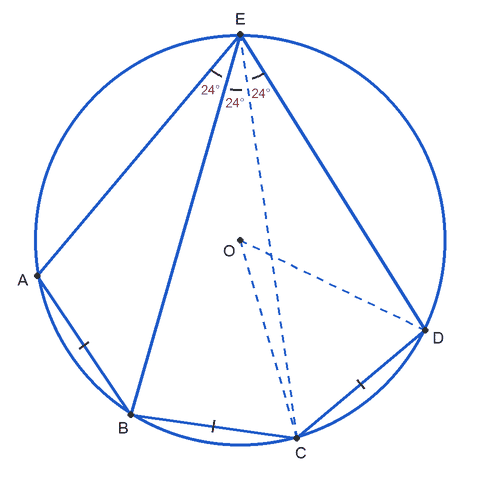
∠AEC=180∘−∠ABC=180∘−132∘=48∘
Step 2 — Part (i): split it.
AB = BC, so these equal chords subtend equal angles at E, and EB splits ∠AEC into two equal parts.
∠AEB=248∘=24∘
Step 3 — Part (ii): find angle AED.
CD equals AB too, so ∠CED=24∘ as well, and ∠AED is made of the three equal parts.
∠AED=∠AEB+∠BEC+∠CED=24∘+24∘+24∘=72∘
Step 4 — Part (iii): find angle COD.
The arc CD subtends ∠COD at the centre and ∠CED at E, on the remaining part of the circle.
∠COD=2×∠CED=2×24∘=48∘
Watch out: The three equal chords give three EQUAL angles at E; first find the angle on two of them (∠AEC) from the cyclic quadrilateral.
Therefore, (i) ∠AEB=24∘; (ii) ∠AED=72∘; (iii) ∠COD=48∘.