Solution:
Concept: These facts are used here.
- Angle at the centre: the angle that an arc subtends at the centre is double the angle it subtends at any point on the remaining part of the circle.
- The angles of a quadrilateral add up to 360∘.
- Radii are equal: two radii and a chord form an isosceles triangle, so the angles opposite the two radii are equal.
Step 1 — Part (i): find the reflex angle AOB.
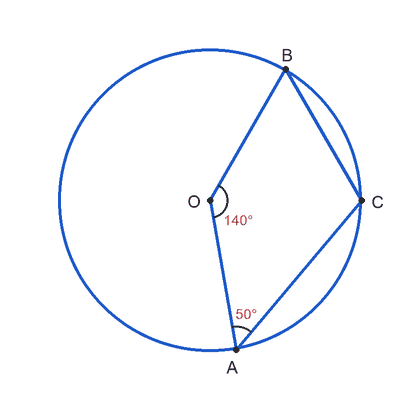
C lies on the minor arc AB, so the angle ACB stands on the major arc AB. The angle that the major arc subtends at O is the reflex angle AOB.
reflex ∠AOB=360∘−140∘=220∘
Step 2 — Part (i): halve it.
The angle at C is half the angle at the centre on the same (major) arc.
∠ACB=21×220∘=110∘
Step 3 — Part (ii): use quadrilateral OACB.
The four angles of OACB are ∠AOB=140∘ at O, ∠OAC=50∘ at A, ∠ACB=110∘ at C and ∠OBC at B. They add up to 360∘.
∠OBC=360∘−∠AOB−∠OAC−∠ACB=360∘−140∘−50∘−110∘=60∘
Step 4 — Part (iii): use the isosceles triangle OAB.
OA = OB (radii), so the base angles of △OAB are equal and share what is left after 140∘.
∠OAB=2180∘−140∘=240∘=20∘
Step 5 — Part (iv): find angle CBA.
BA lies inside ∠OBC, so ∠CBA is what is left after taking away ∠OBA=20∘.
∠CBA=∠OBC−∠OBA=60∘−20∘=40∘
Check: In △ABC the angle at A is ∠OAC−∠OAB=30∘, and the three angles add up to 180∘.
∠CAB+∠ACB+∠CBA=30∘+110∘+40∘=180∘
Watch out: C is on the minor arc, so ∠ACB is half the REFLEX angle, not half of 140∘.
Therefore, (i) ∠ACB=110∘; (ii) ∠OBC=60∘; (iii) ∠OAB=20∘; (iv) ∠CBA=40∘.